
A clinical dietitian does far more than hand you a meal chart — they decode your metabolism, hormones, and health history to build a plan that actually works for your body.
By the Profrea Editorial Team · Published July 2026
Gurgaon's fast-paced corporate lifestyle has made lifestyle diseases — obesity, PCOS, type 2 diabetes, thyroid disorders, and gut issues — increasingly common across age groups. Yet most people still treat nutrition as an afterthought, turning to generic internet diets or unqualified advice when symptoms appear. A qualified clinical dietitian in Gurgaon bridges the gap between what you eat and how your body actually responds — and that difference can be life-changing.
At Profrea, Nutrition & Dietetics is not a standalone service. It sits within a multi-specialty network that includes Dr. Ladli Chatterjee, General Physician & Diabetologist, and Dr. Soma Kumari, Gynecologist & Infertility Specialist — meaning your diet plan can be co-designed with the clinician managing your hormones, blood sugar, or reproductive health. That integrated approach is rare in Gurugram's fragmented healthcare landscape.
This is one of the most searched questions in the nutrition space — and the answer matters when you're dealing with a medical condition. A registered dietitian holds a formal clinical degree (B.Sc. or M.Sc. in Dietetics or Food & Nutrition) and is trained to manage therapeutic diets for diagnosed conditions such as diabetes, kidney disease, PCOS, and eating disorders. A nutritionist is a broader term that may or may not imply clinical training, depending on the country and certification body.
In India, the Food Safety and Standards Authority of India (FSSAI) and the Indian Dietetic Association (IDA) recognise registered dietitians as healthcare professionals. If you have a medical condition driving your weight or energy issues, a clinical dietitian — not a general wellness coach — is the right starting point. As the FSSAI notes, therapeutic dietary advice for disease management should come from qualified nutrition professionals.
Gurugram's working population faces a unique nutritional burden: long commutes, erratic meal timings, high-stress corporate roles, frequent travel, and easy access to ultra-processed food. According to the World Health Organization, obesity has nearly tripled globally since 1975, and urban India is one of the fastest-growing contributors to this trend. In Haryana specifically, NFHS-5 data shows rising rates of overweight adults and anaemia — both conditions where dietary intervention is first-line treatment.
Add to this the high prevalence of PCOS among women aged 18–35 in metro cities, and the picture becomes clear: Gurgaon needs accessible, medically-grounded nutrition consultation — not one-size-fits-all diet plans.
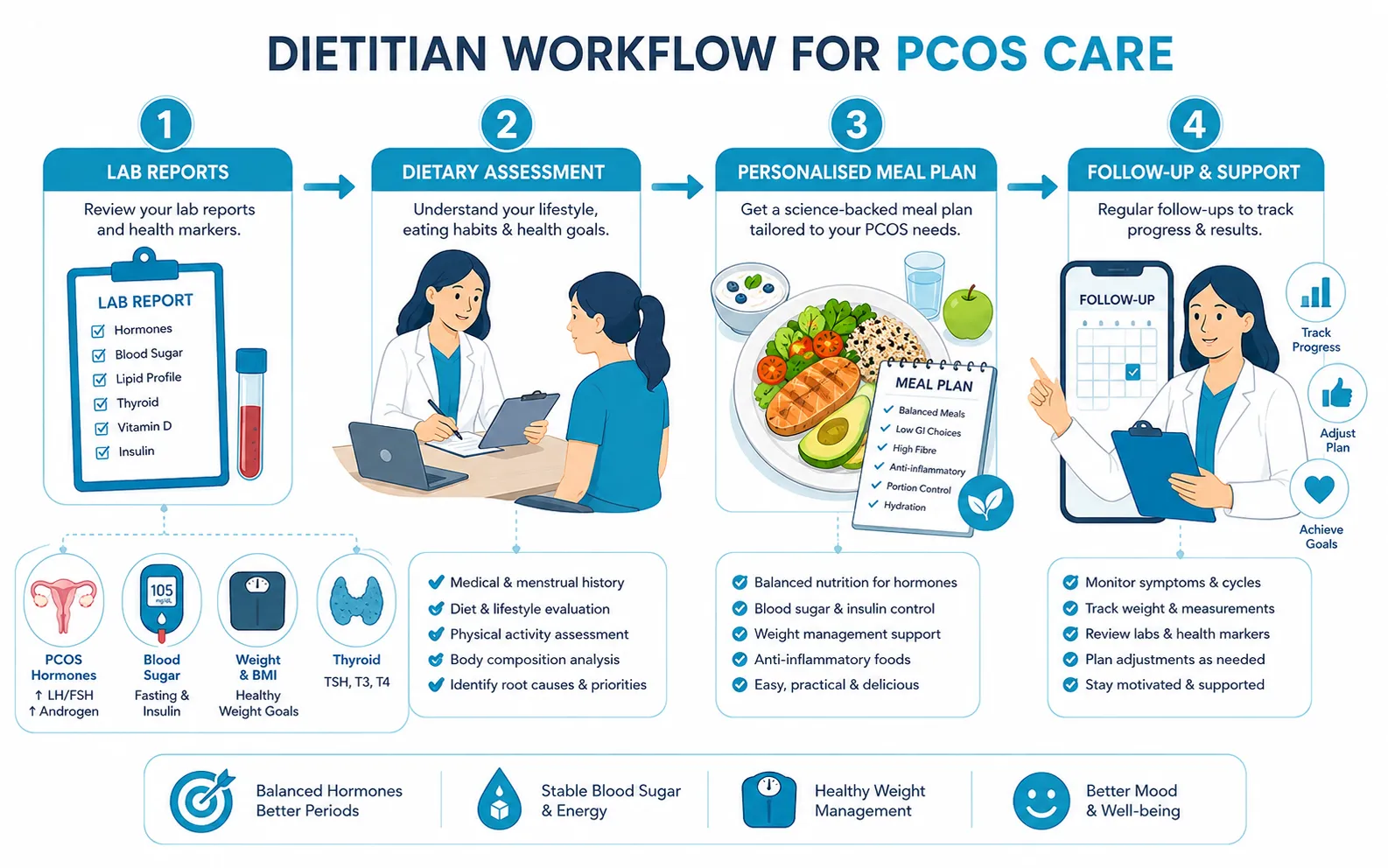
A first appointment with a clinical dietitian at Profrea typically covers:
Detailed dietary recall: A 24-hour or 3-day food diary review to understand your actual eating patterns, not the idealised version.
Anthropometric assessment: Body weight, BMI, waist-to-hip ratio, and where relevant, body composition analysis.
Medical history integration: Review of blood reports (HbA1c, thyroid panel, lipid profile, vitamin D, iron studies) in coordination with your treating physician.
Goal-setting: Whether that's weight loss, managing blood sugar, improving fertility outcomes, or reducing inflammation — the plan is anchored to a specific, measurable goal.
Personalised meal plan: Culturally appropriate, practical, and adjusted for your work schedule, food preferences, and budget.
Follow-up protocol: Progress reviews at 2–4 week intervals with plan adjustments based on labs and symptoms.
Profrea's dietitians work within the same clinical ecosystem as its diabetology team and gynaecology specialists, enabling seamless referrals and co-managed care — something that standalone nutrition clinics in Gurgaon cannot offer.
PCOS (Polycystic Ovary Syndrome) is one of the most common reasons women in Gurgaon seek a dietitian. Hormonal imbalances in PCOS drive insulin resistance, which makes standard calorie-restriction diets ineffective — and sometimes counterproductive. A clinical dietitian trained in hormonal nutrition will focus on:
Low glycaemic index (GI) carbohydrate choices to reduce insulin spikes
Anti-inflammatory foods (omega-3 rich sources, colourful vegetables, turmeric) to address the chronic low-grade inflammation in PCOS
Adequate protein distribution across meals to support satiety and muscle preservation
Inositol-rich foods and targeted micronutrient support (Vitamin D, magnesium, zinc) where deficiencies are confirmed on labs
Meal timing strategies aligned with circadian biology to support cortisol regulation
At Profrea, women with PCOS benefit from a coordinated approach: Dr. Soma Kumari (DNB Obs & Gynae, Fellowship in ART) manages the hormonal and reproductive aspects while the dietitian optimises the metabolic environment. This is the standard of care recommended by international PCOS guidelines — and it's available across Profrea's 7 clinic locations in Gurugram.
Medical nutrition therapy (MNT) is a cornerstone of diabetes management. For patients with type 2 diabetes or pre-diabetes, a dietitian's role is not simply to reduce sugar intake — it's to restructure the entire dietary pattern to improve insulin sensitivity, reduce HbA1c, and protect long-term organ health.
Profrea's Dr. Ladli Chatterjee — MBBS, MD (General Medicine), FIDD, and Fellow in Diabetes from the Royal Liverpool Academy, UK — leads the diabetology programme at VKaRe Diabetic Clinic and Profrea's South City-I and Sector 52 locations. Patients under her care receive integrated dietary counselling as part of their diabetes management plan, not as a separate, disconnected service.
For thyroid conditions (hypothyroidism, Hashimoto's thyroiditis), dietary adjustments — including iodine balance, selenium-rich foods, and goitrogen management — can meaningfully support medication efficacy. A dietitian familiar with thyroid physiology can help patients understand which foods to prioritise and which to moderate, without the anxiety-inducing misinformation that floods social media.
The global weight loss industry thrives on the promise of rapid results — but clinical evidence consistently shows that sustainable weight loss requires individualised, behaviour-based interventions. A 2021 review in The Lancet Diabetes & Endocrinology found that structured dietary counselling delivered by a registered dietitian produces significantly better long-term outcomes than self-directed dieting.
At Profrea, weight management plans are built around your metabolic rate, food preferences, lifestyle constraints, and any underlying medical conditions. The goal is not a crash diet — it's a recalibration of your relationship with food that you can sustain for years. Profrea's nutrition team uses structured follow-up protocols to track progress and adjust plans as your body responds.
For patients who need psychological support alongside dietary change — particularly those with emotional eating patterns — Profrea's Dr. Sarika Thakral, Consultant Clinical Psychologist with 15+ years of experience and certifications in NLP and EFT, is available for integrated behavioural support.
This depends on your goal and starting point, but here's a realistic framework based on clinical practice:
Weight loss (5–10% body weight): Typically 3–6 months of structured sessions (every 2–4 weeks), with measurable changes in energy and body composition visible within 4–6 weeks of adherence.
PCOS metabolic management: 3–4 months minimum to see meaningful hormonal and metabolic shifts; ongoing quarterly reviews thereafter.
Diabetes (HbA1c reduction): HbA1c reflects 3-month average blood glucose — so a minimum 3-month dietary intervention is needed to see lab-confirmed improvement.
Gut health / IBS: An elimination and reintroduction protocol typically runs 8–12 weeks under dietitian supervision.
Profrea offers both in-clinic and video consultation options, making it practical for Gurgaon's busy professionals to stay consistent with their nutrition plan without disrupting their work schedule.
With dozens of nutrition coaches and dietitians operating across Gurugram — many without verifiable clinical credentials — it's worth knowing what to look for:
Formal qualification: Look for B.Sc./M.Sc. in Dietetics, Food & Nutrition, or a related clinical field. Avoid practitioners whose only credential is a short online certification.
Medical integration: If you have a diagnosed condition (diabetes, PCOS, thyroid, kidney disease), your dietitian should be able to read and interpret your lab reports — or work directly with your treating doctor.
Personalised approach: Be cautious of any practitioner who offers a plan without a detailed initial assessment. Generic plans are rarely effective for medical conditions.
Transparent follow-up: A good dietitian schedules regular reviews and adjusts the plan based on your progress — not just your compliance.
Clinic accountability: Dietitians practising within a regulated multi-specialty clinic are subject to clinical governance standards that independent practitioners may not be.
Profrea's nutrition team operates across 7 clinic locations in Gurugram, with the added option of video consultations via the Profrea app — making expert dietary guidance accessible whether you're in Sector 45, South City, or anywhere else in the city. You can also explore Profrea's health screening packages to get a full baseline before starting your nutrition plan.
A registered dietitian holds a clinical degree and is trained to manage therapeutic diets for diagnosed medical conditions. A nutritionist is a broader term that may not imply clinical training. For conditions like diabetes, PCOS, or kidney disease, a clinical dietitian is the appropriate choice.
Look for formal clinical qualifications (B.Sc./M.Sc. in Dietetics), the ability to interpret lab reports, a personalised assessment process, and integration with medical specialists if you have a diagnosed condition. Profrea's multi-specialty clinics across Gurugram offer all of these within a single care network.
Yes — and this is one of the most impactful areas of clinical nutrition. PCOS-related weight gain is driven by insulin resistance and inflammation, not simply excess calories. A dietitian trained in hormonal nutrition will design a low-GI, anti-inflammatory plan and coordinate with your gynaecologist for a comprehensive approach.
Consultation fees in Gurgaon typically range from ₹500 to ₹2,000 per session depending on the clinician's qualifications and the clinic's infrastructure. Profrea offers competitive pricing with the added value of multi-specialty integration — contact the clinic directly or book via the Profrea app for current fee details.
Most patients see meaningful changes within 4–6 weeks of consistent adherence, but sustainable outcomes typically require 3–6 months of structured sessions. The exact number depends on your goal — weight loss, diabetes management, PCOS, or gut health — and your starting metabolic baseline.
Profrea's clinical dietitians in Gurgaon work alongside diabetologists, gynaecologists, and psychologists to create a plan tailored to your body, your labs, and your life.