

Not all weight struggles are solved by diet and exercise alone. Learn when your body is signalling that it needs a doctor's help — and what a medically guided plan actually looks like.
By Dr. Ladli Chatterjee, General Physician & Diabetologist, Profrea · Published July 2026
Millions of people in India try to manage their weight on their own — cutting carbs, joining gyms, trying intermittent fasting — and many do make progress. But for a significant number, the scale simply refuses to move, or it moves and then reverses, no matter how disciplined they are. If this sounds familiar, the issue may not be willpower. It may be biology.
Weight is regulated by a complex interplay of hormones, metabolism, gut health, sleep quality, and mental wellbeing. When one or more of these systems is out of balance, no amount of calorie counting will produce lasting results without addressing the root cause. That is precisely where a doctor — specifically one trained in metabolic and general medicine — becomes essential.
According to the World Health Organization, obesity has nearly tripled worldwide since 1975, and it is now recognised as a chronic, relapsing disease — not a lifestyle choice. This framing matters, because it means medical evaluation and ongoing clinical support are not luxuries; they are often medically appropriate and necessary.
A sustained, consistent effort — reduced calorie intake, regular physical activity — that produces no measurable change over 12 or more weeks is a clinical red flag. It suggests an underlying metabolic issue such as hypothyroidism, insulin resistance, or polycystic ovarian syndrome (PCOS) may be interfering with your body's ability to burn fat. A doctor can order targeted blood tests to rule these out before you spend another month frustrated.
If your diet and activity levels have not changed but you are gaining weight — particularly around the abdomen — this warrants medical attention. Sudden or unexplained weight gain can be linked to thyroid dysfunction, Cushing's syndrome, medication side effects (such as steroids or certain antidepressants), or fluid retention from cardiac or kidney issues. None of these should be managed with a crash diet.
If you are living with Type 2 diabetes, hypertension, high cholesterol, sleep apnoea, fatty liver disease, or PCOS, weight management is not optional — it is part of your treatment. Attempting to lose weight without medical supervision when you have these conditions can be risky. For example, weight loss in a diabetic patient can significantly alter medication requirements, and this needs to be monitored carefully. Dr. Ladli Chatterjee, General Physician and Diabetologist at Profrea, specialises in exactly this intersection — managing weight as part of comprehensive metabolic care.
Clinical guidelines from the National Heart, Lung, and Blood Institute (NHLBI) recommend that individuals with a BMI of 30 or above, or a BMI of 27.5 or above with at least one weight-related health condition, should receive formal medical evaluation and treatment for obesity. For South Asian populations, these thresholds are often adjusted lower, as metabolic risk tends to appear at lower BMI values. If you fall into either category, a doctor-led plan is the appropriate starting point.
These symptoms, when they appear together with weight changes, often point to hormonal imbalances — particularly thyroid disorders or adrenal dysfunction. Treating the symptom (weight) without addressing the hormonal cause will not produce lasting results. A physician can assess your thyroid function, cortisol levels, and other hormonal markers to build a complete picture.
Repeated cycles of weight loss and regain — commonly called yo-yo dieting — can alter metabolism, reduce muscle mass, and increase cardiovascular risk over time. If your relationship with food has been complicated by restrictive eating, binge cycles, or emotional eating, a medically supervised programme that includes psychological support is far safer and more effective than another solo attempt. Profrea's multi-specialty network includes Dr. Sarika Thakral, a Clinical Psychologist with 15+ years of experience, who can address the behavioural dimensions of weight management alongside medical treatment.
Pharmacological options for weight management — such as GLP-1 receptor agonists — and bariatric surgical procedures are increasingly available in India. However, these are not over-the-counter solutions. They require a thorough medical assessment, pre-treatment investigations, and ongoing monitoring. If you are exploring these options, a consultation with a qualified physician is the mandatory first step, not an optional one.
This is one of the most common questions patients ask, and the honest answer is: it depends on your starting point, your health status, and the method used. As a general clinical benchmark, a safe and sustainable rate of weight loss is 0.5 to 1 kg per week, or roughly 2 to 4 kg per month. Faster loss is sometimes appropriate in medically supervised settings — for instance, in patients with severe obesity or pre-surgical preparation — but it requires close monitoring of nutritional status, electrolytes, and organ function.
Crash diets that promise 10 kg in a month are not just ineffective in the long run — they can be actively harmful, causing muscle loss, gallstone formation, nutritional deficiencies, and metabolic slowdown that makes future weight loss even harder. A doctor-designed plan prioritises fat loss while preserving lean muscle mass, which is what determines your long-term metabolic health.
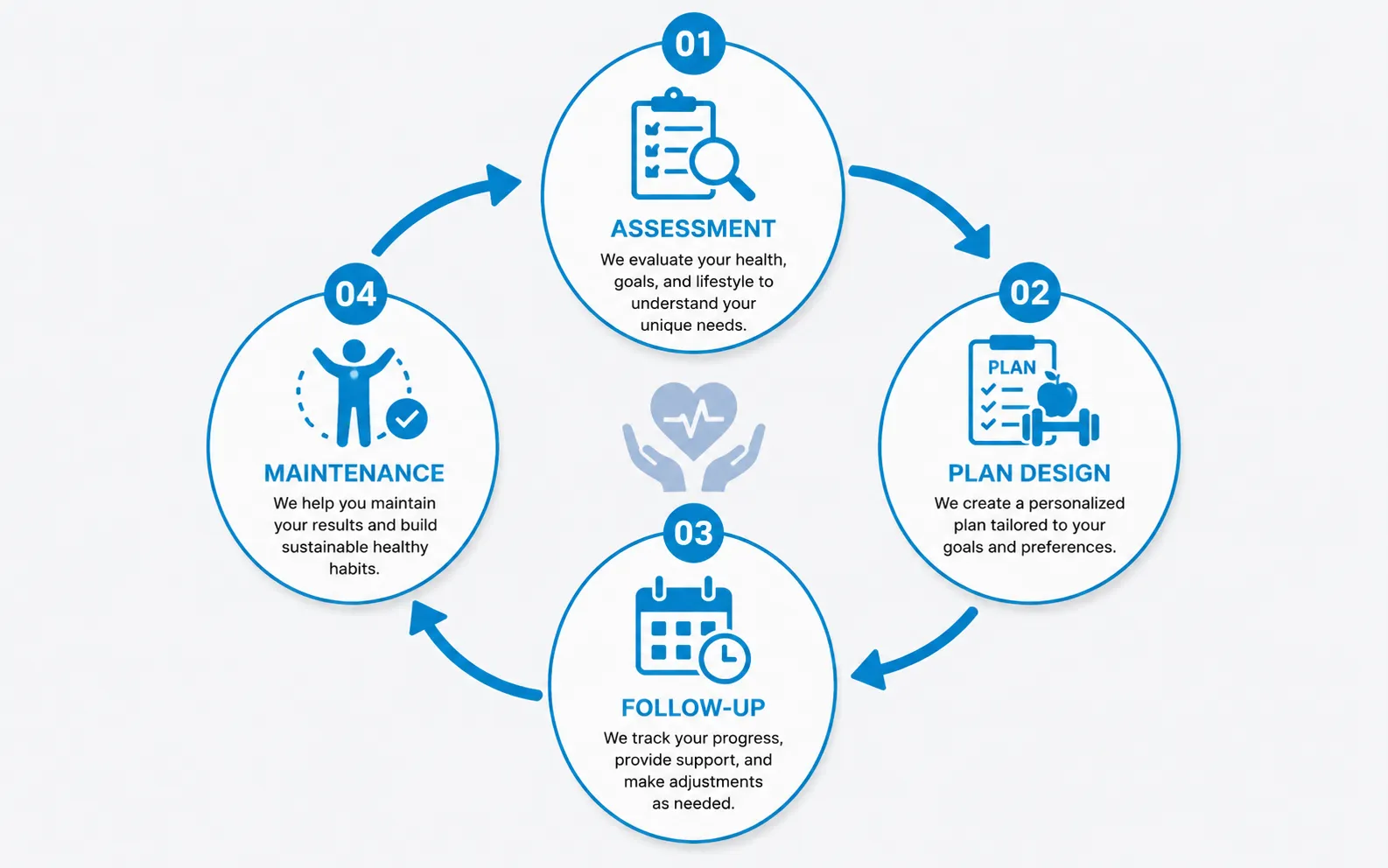
Many patients are unsure what to expect from a medical weight loss consultation, and this uncertainty often delays them from seeking help. Here is what a structured consultation typically involves:
Detailed history: Your doctor will ask about your weight history, diet patterns, physical activity, sleep, stress levels, medications, and family history of metabolic conditions.
Physical examination: This includes BMI calculation, waist circumference measurement, blood pressure, and assessment for signs of hormonal or metabolic disorders.
Targeted investigations: Blood tests typically include fasting glucose, HbA1c, thyroid function (TSH, T3, T4), lipid profile, liver function tests, kidney function, vitamin D, B12, and iron studies. Hormonal panels may be added based on clinical suspicion.
Personalised plan: Based on findings, your doctor will design a plan that may include dietary modifications (often in collaboration with a dietitian), a physical activity prescription, behavioural strategies, and — where clinically indicated — medication.
Follow-up schedule: Medical weight management is not a one-time event. Regular follow-ups allow your doctor to track progress, adjust the plan, and catch any emerging issues early.
At Profrea, this process is streamlined across 7 clinic locations in Gurugram, with the option of video consultations for follow-up appointments — making it practical to stay consistent with your care plan even on busy days.
The short answer: ideally, both — working together. A dietitian provides expert guidance on food choices, meal planning, and nutritional adequacy. A doctor identifies and manages the medical factors that influence weight, prescribes investigations, and — where necessary — medication. These roles complement rather than replace each other.
If you have any of the seven signs listed above, starting with a doctor is the right call. The doctor can then refer you to a dietitian as part of a coordinated care plan. Profrea's multi-specialty structure makes this kind of integrated care straightforward — your physician, dietitian, and psychologist (if needed) are all accessible within the same network. You can explore Profrea's nutrition specialists, including Dt. Swagata Pahari and Dt. Deepak, as part of a comprehensive weight management plan.
The evidence consistently shows that medically supervised weight loss programmes produce greater and more durable results than self-directed efforts, particularly for individuals with underlying health conditions. The reasons are straightforward:
Investigations identify and treat hidden barriers (e.g., hypothyroidism, insulin resistance) that make weight loss physiologically difficult.
Personalised calorie and macronutrient targets are based on your actual metabolic rate — not generic online calculators.
Medication, when appropriate, can meaningfully accelerate fat loss and reduce hunger in ways that willpower alone cannot.
Regular monitoring catches nutritional deficiencies, muscle loss, or worsening of co-existing conditions before they become serious problems.
Accountability to a clinician significantly improves adherence — one of the strongest predictors of long-term success.
Dr. Ladli Chatterjee holds an MD in General Medicine and a Fellowship in Diabetes from the Royal Liverpool Academy, UK — credentials that reflect deep expertise in the metabolic underpinnings of weight gain. Patients at Profrea's clinics in Sector 45, South City-I, and Sector 52, Gurgaon, benefit from this specialist-level insight applied to their individual weight management journey. You can view her full profile and book a consultation via the Dr. Ladli Chatterjee profile page.
For many patients, a weight loss consultation is also an opportunity to catch other health risks early. Excess weight is strongly associated with cardiovascular disease, Type 2 diabetes, certain cancers, and joint disease. Profrea offers structured health screening packages — including the Profrea Health Screen and Health Screen Premium — that can be combined with a weight management consultation to give you a complete picture of your metabolic health. Early detection of pre-diabetes or dyslipidaemia, for instance, can dramatically change the urgency and approach of a weight loss plan.
Weight gain becomes a medical concern when it is unexplained, rapid, or accompanied by other symptoms such as fatigue, hair loss, swelling, or mood changes. It also warrants medical attention when it is associated with a diagnosed condition like diabetes, PCOS, or hypertension, or when self-directed efforts over 3 or more months have produced no results.
A clinically safe and sustainable rate is 2 to 4 kg per month (approximately 0.5 to 1 kg per week). Faster rates may be appropriate in medically supervised settings but require careful monitoring. Programmes promising 8–10 kg per month through extreme restriction carry real health risks and rarely produce lasting results.
A thorough consultation includes a detailed medical history, physical examination, targeted blood tests (thyroid, glucose, lipids, hormones as needed), and the development of a personalised, evidence-based weight management plan. Follow-up appointments are scheduled to monitor progress and adjust the plan as needed.
Both have distinct and complementary roles. If you have underlying health conditions, unexplained weight gain, or have tried and failed with diet changes alone, start with a doctor. The doctor can then coordinate care with a dietitian and other specialists as part of an integrated plan.
Standard investigations typically include fasting blood glucose, HbA1c, thyroid function tests (TSH, T3, T4), complete lipid profile, liver function tests, kidney function tests, and micronutrient levels (Vitamin D, B12, iron). Additional hormonal tests — such as cortisol, testosterone, or insulin levels — may be ordered based on your symptoms and history.
Yes. Profrea offers video consultations alongside in-clinic appointments across 7 locations in Gurugram. This makes it easy to begin your weight loss journey with a qualified physician — including Dr. Ladli Chatterjee — without needing to take time off work for every follow-up visit.
Book a consultation with Dr. Ladli Chatterjee at Profrea — Gurugram's multi-specialty clinic network — and get a medically grounded plan built around your body, not a generic template.