

Both conditions can look identical in the first 48 hours — but the warning signs that separate dengue from a routine viral fever could save your life. Here is what every Gurgaon resident should know before the next monsoon spike.
By Dr. Ladli Chatterjee, General Physician & Diabetologist, Profrea · Published June 2026
Every year between July and November, clinics across Gurugram see a sharp rise in patients presenting with fever, body ache, and fatigue. Most assume it is a common viral infection and wait it out. Some are right. Others are not — and the delay in recognising dengue can lead to dangerous drops in platelet count, internal bleeding, and hospitalisation.
According to the World Health Organization, dengue infects an estimated 100–400 million people globally each year, with India accounting for a significant share of reported cases. Gurugram's dense urban population, waterlogging during rains, and high Aedes mosquito density make it one of the higher-risk districts in Haryana.
The good news: knowing what to look for — and when to test — makes all the difference. This guide walks you through the clinical distinctions, red-flag symptoms, and the right time to see a doctor.
"Viral fever" is an umbrella term for any fever caused by a viral infection — influenza, adenovirus, rhinovirus, and dozens of others. These viruses spread through respiratory droplets, contaminated surfaces, or close contact. The immune system responds by raising body temperature to slow viral replication, producing the familiar symptoms of fever, fatigue, and muscle ache.
Most viral fevers are self-limiting: they peak within two to three days and resolve within five to seven days with rest, fluids, and paracetamol. There is no specific antiviral treatment for the majority of them. The key clinical feature is that symptoms are gradual in onset and moderate in severity.
Dengue is caused by the dengue virus (DENV, serotypes 1–4) and is transmitted exclusively through the bite of an infected Aedes aegypti or Aedes albopictus mosquito. It is not contagious between people. The mosquito breeds in clean, stagnant water — flower pots, cooler trays, tyres, and overhead tanks — making urban homes a prime habitat.
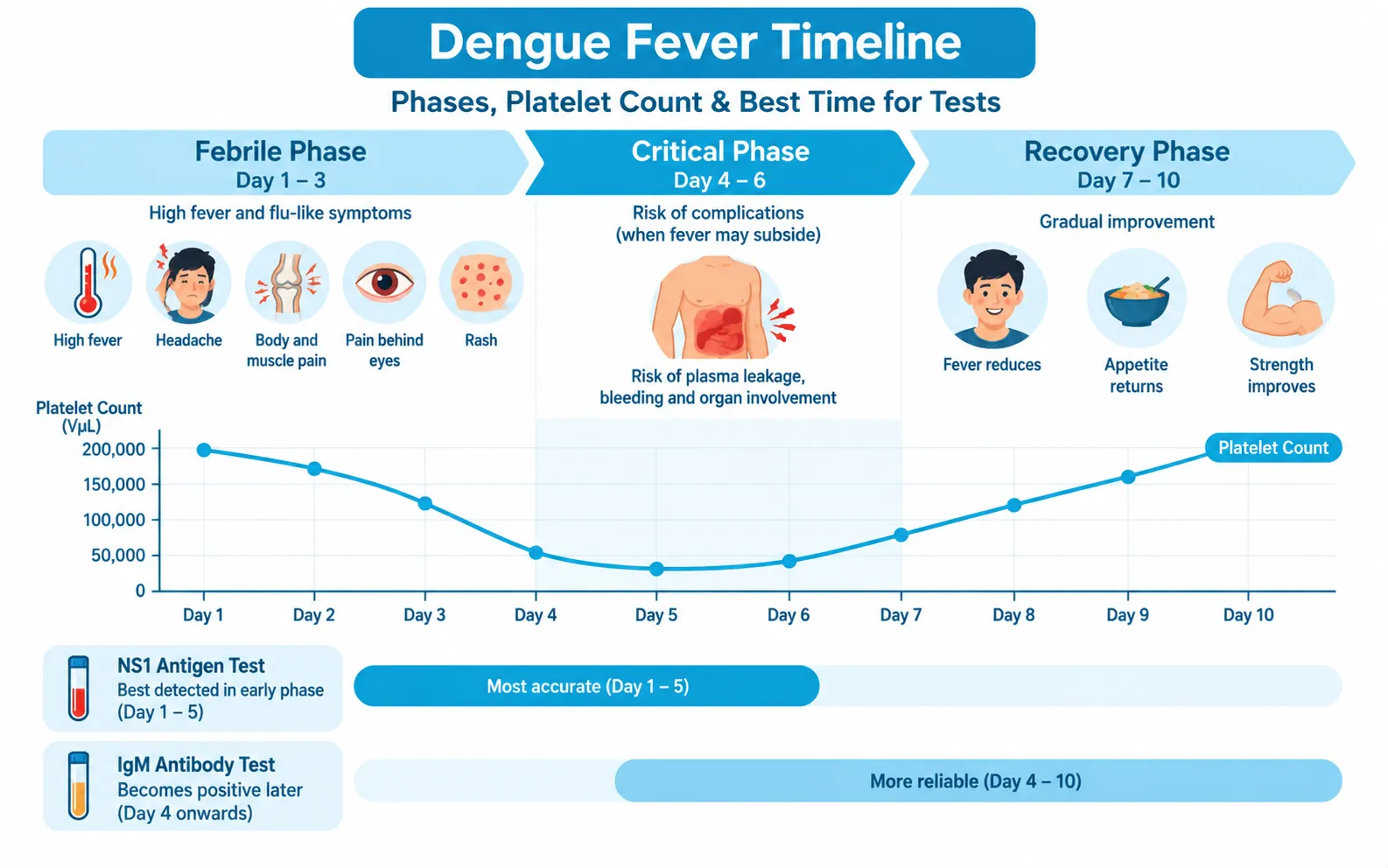
Dengue has an incubation period of 4–10 days after a mosquito bite. The illness then progresses through three phases: febrile, critical, and recovery. The critical phase — typically days 4–6 of illness — is when platelet counts drop most sharply and the risk of plasma leakage and haemorrhage is highest. This is the window where clinical monitoring is non-negotiable.
A 2020 review published on PubMed Central confirmed that early clinical recognition and timely supportive care remain the most effective interventions for preventing dengue mortality, as no specific antiviral drug is currently approved for dengue.
The table below summarises the most clinically useful distinguishing features. Keep in mind that early dengue (days 1–2) can mimic a routine viral fever almost perfectly — which is why timing of testing matters as much as symptom recognition.
| Feature | Viral Fever | Dengue Fever |
|---|---|---|
| Onset | Gradual (over 1–2 days) | Sudden, high-grade (often 39–40°C) |
| Fever pattern | Low to moderate, responds to paracetamol | High, may dip then spike (biphasic in some) |
| Body & joint pain | Mild to moderate muscle ache | Severe — nicknamed "breakbone fever" |
| Headache | Mild, diffuse | Severe, often retro-orbital (behind the eyes) |
| Skin rash | Rare or absent | Present in ~50–80% of cases (days 3–5); maculopapular, sparing palms/soles |
| Nausea / vomiting | Occasional | Common, can be persistent |
| Bleeding signs | None | Possible — gum bleed, nosebleed, petechiae |
| Platelet count | Normal | Often drops below 1,00,000/µL by day 4–6 |
| Duration | 3–7 days | 7–10 days; critical phase days 4–6 |
| Transmission | Person-to-person (droplets/contact) | Mosquito bite only (not person-to-person) |
Important caveat: No symptom alone is diagnostic. A patient with dengue may not develop a rash. A patient with a severe viral fever may have significant body ache. Clinical assessment combined with timely laboratory testing is the only reliable way to confirm dengue.
No — and this is one of the most common misconceptions that leads to delayed diagnosis. Studies suggest that a characteristic dengue rash appears in roughly 50–80% of confirmed dengue cases, typically emerging between days 3 and 5 of illness. It usually looks like a red, blotchy (maculopapular) rash on the trunk that spreads outward, often with islands of normal skin within the rash — sometimes described as "white islands in a sea of red."
Absence of a rash does not rule out dengue. If you have high-grade fever with severe retro-orbital headache and bone pain — especially during monsoon season in Gurugram — dengue testing is warranted regardless of whether a rash is present.
A normal platelet count is 1,50,000–4,50,000 per microlitre (µL) of blood. In dengue, the virus attacks platelets and the bone marrow's ability to produce them, causing thrombocytopenia (low platelet count). Here is a practical guide to interpreting platelet levels in the context of dengue:
1,00,000–1,50,000/µL: Mild drop — monitor closely with daily counts; no transfusion needed.
50,000–1,00,000/µL: Moderate thrombocytopenia — medical supervision essential; watch for bleeding signs.
20,000–50,000/µL: Significant risk — hospitalisation usually recommended; risk of spontaneous bleeding rises.
Below 20,000/µL: Severe — platelet transfusion may be required; emergency care needed.
It is equally important to watch for plasma leakage signs — abdominal pain, persistent vomiting, rapid breathing, or sudden improvement in fever followed by deterioration. These indicate severe dengue (previously called dengue haemorrhagic fever) and require immediate hospitalisation.
Patients managed by the general medicine team at Dr. Ladli Chatterjee (MBBS, MD General Medicine, Fellowship in Diabetes — Royal Liverpool Academy, UK) at Profrea's Gurugram clinics receive structured platelet monitoring protocols during the critical phase, with clear escalation criteria communicated to patients and families.
Timing your dengue test correctly is critical — the wrong test at the wrong time can give a false-negative result and create dangerous false reassurance.
Days 1–5 of fever: The NS1 antigen test is the test of choice. The NS1 protein is shed by the dengue virus into the bloodstream during the early febrile phase and is detectable from day 1 through approximately day 5. Sensitivity is highest in days 1–3.
From day 5 onwards: NS1 sensitivity drops. The dengue IgM/IgG antibody test becomes more reliable from day 5, as the immune system has had time to mount an antibody response.
Complete Blood Count (CBC) with platelet count should be done alongside either test and repeated every 24–48 hours once dengue is suspected or confirmed. A falling platelet count trend is often more clinically significant than any single reading.
If you are unsure which test to order, a consultation with a general physician in Gurugram will help you choose the right investigation at the right time — avoiding unnecessary cost and missed diagnoses.
Mild dengue — confirmed by testing, with platelet count above 1,00,000/µL and no warning signs — can often be managed at home under medical guidance. The pillars of home management are:
Hydration: Oral rehydration salts (ORS), coconut water, and clear fluids. Aim for at least 2–3 litres per day.
Fever control: Paracetamol only. Avoid ibuprofen, aspirin, and diclofenac — NSAIDs increase bleeding risk in dengue.
Rest: Physical activity raises the risk of bleeding complications.
Daily monitoring: Platelet count and haematocrit should be checked every 24–48 hours during the critical phase.
Mosquito protection: Use repellent and sleep under a net to prevent infecting other household mosquitoes.
You should see a doctor immediately if any of the following occur: severe abdominal pain, persistent vomiting (3 or more episodes in 24 hours), bleeding from gums or nose, blood in urine or stool, sudden drop in fever with cold/clammy skin, difficulty breathing, or extreme fatigue and restlessness. These are WHO-defined dengue warning signs requiring urgent evaluation.
Profrea offers both in-clinic consultations across 7 locations in Gurugram and video consultations for follow-up monitoring — so patients can check in with their doctor daily during the critical phase without leaving home when they are too unwell to travel. You can also explore Profrea's health screening packages that include CBC and relevant panels for comprehensive fever workup.
Gurugram's rapid urbanisation has created ideal conditions for Aedes mosquito breeding. Construction sites with water-filled containers, residential societies with poorly maintained water storage, and the city's low-lying areas that flood during heavy rains all contribute to a high mosquito burden from July through October.
The Haryana health department typically records its highest dengue case counts between August and October. Corporate professionals who spend long hours in air-conditioned offices may underestimate their exposure — but the Aedes mosquito bites predominantly during daylight hours, including early morning and late afternoon, making workplace and commute exposure significant.
Profrea's clinic network — with locations in Sector 45, South City-I, Sector 52, and other areas across Gurugram — is positioned to provide rapid access to fever evaluation and dengue testing for residents across the city. Patients managed by Dr. Ladli Chatterjee and the general medicine team benefit from structured fever protocols developed for the local epidemiological context.
There is currently no widely available dengue vaccine in routine use across India. Prevention relies entirely on mosquito control and personal protection:
Empty and scrub all water-holding containers (cooler trays, flower pot saucers, buckets) at least once a week.
Cover overhead water tanks with tight-fitting lids.
Use DEET-based or picaridin mosquito repellent on exposed skin during daytime hours.
Wear full-sleeved clothing during peak mosquito activity (dawn and dusk).
Use mosquito nets or window screens, especially for young children and elderly family members.
Report stagnant water accumulation in your society or neighbourhood to local municipal authorities.
If you have a child with fever during monsoon season, a consultation with a paediatrician at Profrea is advisable early — children can deteriorate faster than adults in dengue and may not articulate warning symptoms clearly.
The most useful early clues for dengue are: sudden high-grade fever (above 39°C), severe pain behind the eyes, intense joint and muscle pain, and a history of possible mosquito exposure. A viral fever tends to be more gradual and milder. However, the only reliable way to confirm dengue is through an NS1 antigen test (days 1–5) or IgM antibody test (from day 5). Do not rely on symptoms alone.
The key differences are severity of symptoms, platelet count, and cause. Dengue is caused by a specific virus transmitted by mosquitoes and causes a characteristic drop in platelet count, severe bone pain, and potential bleeding complications. Viral fever is a broad category of infections spread person-to-person, with milder symptoms and no platelet involvement. Dengue requires specific testing and closer medical monitoring.
No. A dengue rash appears in approximately 50–80% of confirmed cases, usually between days 3 and 5 of illness. It is a maculopapular (red, blotchy) rash on the trunk. Absence of a rash does not rule out dengue — testing is still required if other symptoms are present.
The NS1 antigen test is most accurate during days 1–5 of fever. After day 5, the IgM/IgG antibody test is more reliable. A CBC with platelet count should accompany either test and be repeated every 24–48 hours if dengue is suspected. Getting tested too early (day 1) or too late (after day 5 with NS1 only) can produce false-negative results.
Mild dengue with platelet count above 1,00,000/µL and no warning signs can be managed at home with rest, hydration, and paracetamol — but only under active medical supervision with regular platelet monitoring. You must see a doctor immediately if you develop severe abdominal pain, persistent vomiting, bleeding signs, breathing difficulty, or sudden deterioration after fever subsides. Never self-medicate with NSAIDs like ibuprofen or aspirin in dengue.
A general physician or general medicine specialist is your first point of contact for fever evaluation and dengue management. At Profrea, Dr. Ladli Chatterjee (MD General Medicine, Fellowship in Diabetes — Royal Liverpool Academy, UK) consults at multiple Gurugram locations including Sector 45 and South City-I. You can also book a video consultation if you are too unwell to travel. Additionally, Dr. Sanjay Misra is available for general medicine consultations in Gurugram.
Profrea's general medicine team in Gurugram can evaluate your symptoms, order the right tests at the right time, and guide you through safe management — in clinic or via video consultation.