

A clinically grounded guide for anyone in Gurgaon who has tried everything — and still can't shift the scale.
By Dr. Ladli Chatterjee, General Physician & Diabetologist (MBBS, MD, FIDD, FAM, Fellowship in Diabetes — Royal Liverpool Academy, UK) · Published July 2026
You eat carefully. You exercise. You track calories. And yet the number on the scale barely moves — or worse, it creeps upward. If this sounds familiar, you are not imagining things, and you are certainly not alone. For millions of people, the real obstacle to weight loss is not willpower or discipline. It is biology — specifically, the way an underactive thyroid or insulin resistance quietly rewires the body's metabolic engine.
This article explains the science behind these two conditions, why they so often appear together, and what evidence-based medical treatment actually looks like. If you are based in Gurgaon and have been going in circles with generic diet advice, the information below is written for you.
The thyroid gland — a small, butterfly-shaped structure at the base of your neck — produces hormones (T3 and T4) that regulate virtually every cell's energy use. When it underperforms, a condition called hypothyroidism, the metabolic rate slows. The body burns fewer calories at rest, retains more fluid, and becomes less efficient at converting food into usable energy.
According to the National Institute of Diabetes and Digestive and Kidney Diseases (NIDDK), hypothyroidism affects an estimated 4.6% of the U.S. population aged 12 and older, and prevalence is similarly significant in India — with women and people over 40 at highest risk. Common symptoms beyond weight gain include fatigue, cold intolerance, constipation, dry skin, and brain fog.
The weight gained from hypothyroidism is not purely fat. A significant portion is fluid retention caused by the accumulation of certain proteins under the skin. This is why people with untreated or under-treated hypothyroidism often feel puffy rather than simply heavier — and why standard calorie-cutting rarely produces the expected results.
Yes — but the sequence matters. Weight loss becomes significantly more achievable once thyroid hormone levels are optimised with appropriate treatment. However, normalising TSH alone does not automatically restore a pre-illness metabolic rate for everyone. A personalised plan that accounts for residual metabolic slowdown, dietary patterns, and activity levels is still necessary.
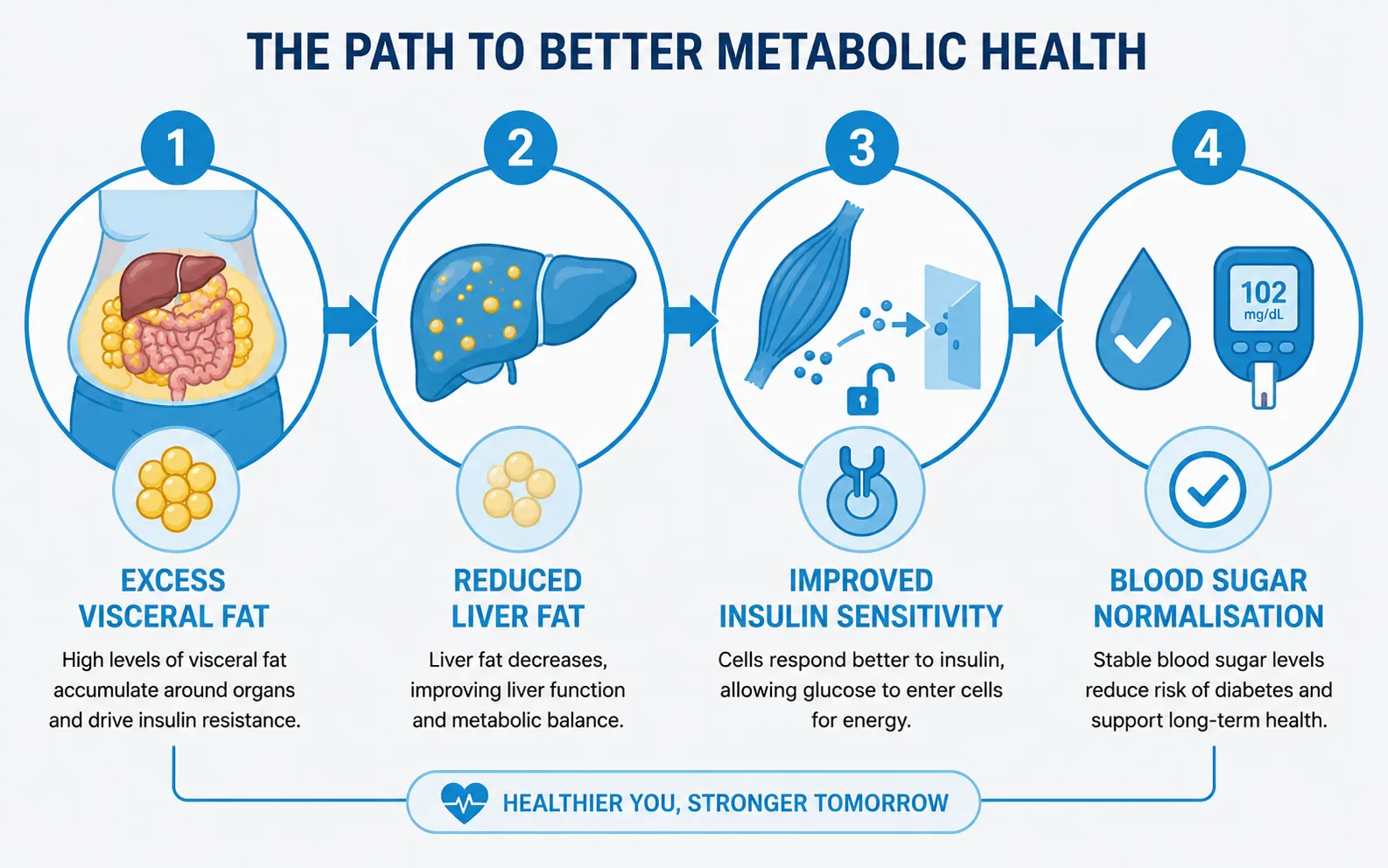
Insulin is the hormone that unlocks your cells so glucose can enter and be used as fuel. When cells become resistant to insulin's signal — a state called insulin resistance — the pancreas compensates by producing more and more insulin. Chronically elevated insulin levels have a direct fat-storing effect: they suppress the breakdown of fat (lipolysis) and actively promote fat storage, particularly around the abdomen.
A review published in the Journal of Clinical Endocrinology & Metabolism (NIH/PubMed) highlights that hyperinsulinaemia — the high-insulin state that accompanies insulin resistance — is independently associated with weight gain and difficulty losing weight, even before blood sugar levels become abnormal enough to diagnose pre-diabetes or type 2 diabetes.
This is a critical point: you can have insulin resistance with a completely normal fasting glucose. Standard blood sugar tests often miss it. A fasting insulin level, HOMA-IR calculation, or oral glucose tolerance test with insulin measurements is needed to identify the problem early.
The mechanism is a reinforcing cycle. High insulin → fat storage → more visceral fat → more inflammation → worsening insulin resistance → even higher insulin. Hunger signals are also disrupted: insulin resistance is frequently accompanied by leptin resistance, meaning the brain does not receive the satiety signal properly. The result is persistent hunger even after adequate caloric intake — making willpower-based approaches almost impossible to sustain.
These two conditions are not coincidentally linked. Thyroid hormones directly influence insulin sensitivity. When thyroid function is low, glucose uptake by muscle cells slows, insulin clearance from the bloodstream decreases, and the liver becomes less responsive to insulin's signals. The result is that hypothyroidism can independently worsen insulin resistance — and vice versa, as excess visceral fat (driven by insulin resistance) can impair thyroid hormone conversion from T4 to the more active T3.
For patients dealing with both conditions simultaneously, the metabolic burden is compounded. A treatment plan that addresses only one condition while ignoring the other will produce limited results. This is precisely why integrated metabolic care — managed by a physician who understands both endocrine axes — is so important.
Effective weight loss treatment for thyroid and insulin resistance is not a single pill or a crash diet. It is a structured, phased programme that typically includes the following components:
Before any intervention, a thorough baseline is essential: TSH, Free T3, Free T4, thyroid antibodies (TPO and TG Ab for autoimmune thyroid disease), fasting insulin, fasting glucose, HbA1c, lipid panel, liver function, and vitamin D and B12 levels. These results guide the entire treatment strategy.
For confirmed hypothyroidism, levothyroxine (synthetic T4) is the standard first-line treatment. Dosing is individualised and titrated over several weeks based on repeat TSH measurements. Some patients with persistent symptoms despite normal TSH may benefit from combination T4/T3 therapy — a decision made by the treating physician based on clinical response.
Lifestyle modification remains the most powerful intervention for insulin resistance. A low-glycaemic, higher-protein dietary pattern reduces postprandial insulin spikes. Resistance training is particularly effective at improving muscle insulin sensitivity. Where lifestyle changes are insufficient, medications such as metformin or newer agents (GLP-1 receptor agonists) may be considered under medical supervision.
Generic diet plans are rarely effective for metabolic weight loss. A plan tailored to thyroid status, insulin levels, activity capacity, and food preferences — ideally developed with a qualified dietitian working alongside the treating physician — produces far better adherence and outcomes. Profrea's network includes registered dietitians who work in coordination with the medical team.
Metabolic conditions are dynamic. Thyroid requirements change with weight loss itself. Insulin sensitivity improves as fat mass decreases, sometimes requiring medication adjustments. A structured follow-up schedule — typically every 6–8 weeks initially — ensures the plan evolves with the patient's progress.
This is one of the most common questions patients ask — and the honest answer is: it depends, and patience is genuinely required. Once thyroid hormone levels are optimised (which itself takes 6–12 weeks of dose titration), patients typically begin to notice reduced fluid retention within the first month. Actual fat loss, however, follows the same principles as metabolic weight loss in general — roughly 0.5–1 kg per week is a realistic and sustainable target when the treatment plan is followed consistently.
For insulin resistance, meaningful improvements in insulin sensitivity can be measured within 8–12 weeks of sustained dietary change and exercise. Weight loss tends to accelerate as insulin levels normalise, because the body's fat-burning machinery is no longer being suppressed.
The key message: do not judge progress by the scale alone in the first 4–6 weeks. Waist circumference, energy levels, hunger patterns, and blood markers are equally important indicators of whether the treatment is working.
Absolutely — and sooner rather than later. Untreated hypothyroidism carries risks well beyond weight gain: elevated LDL cholesterol, increased cardiovascular risk, depression, and in severe cases, myxoedema. Unaddressed insulin resistance is a direct precursor to type 2 diabetes, fatty liver disease, and polycystic ovary syndrome (PCOS) in women.
If you have been experiencing unexplained weight gain, persistent fatigue, difficulty losing weight despite genuine effort, or a family history of thyroid disease or diabetes, a medical evaluation is the right first step — not another diet plan.
At Profrea's clinics across Gurgaon, Dr. Ladli Chatterjee — an MD in General Medicine with a Fellowship in Diabetes from the Royal Liverpool Academy, UK, and additional qualifications in FIDD and FAM — leads the metabolic and diabetic care programme. Her approach integrates thyroid assessment, insulin profiling, and personalised weight management into a single coordinated care plan, available across multiple Gurgaon locations including Sector 45, South City-I, and Sector 52.
While a medical consultation is the most important action, there are evidence-informed steps that support metabolic health in the interim:
Prioritise protein at every meal. Protein has a lower insulin response than refined carbohydrates and helps preserve muscle mass during weight loss — critical for maintaining metabolic rate.
Reduce ultra-processed foods and refined sugars. These produce rapid insulin spikes and worsen insulin resistance over time.
Include resistance exercise 2–3 times per week. Muscle is the body's largest insulin-sensitive tissue. Building and maintaining it is one of the most effective non-pharmacological treatments for insulin resistance.
Prioritise sleep. Even one night of poor sleep measurably worsens insulin sensitivity the following day. Chronic sleep deprivation also elevates cortisol, which further impairs thyroid function.
Manage stress actively. Chronic psychological stress raises cortisol, which suppresses thyroid hormone conversion and promotes abdominal fat storage. If stress or anxiety is a significant factor, speaking with a clinical psychologist can be a meaningful part of a holistic metabolic plan.
Get tested, not guessed. Do not assume your thyroid is fine because a basic TSH was normal years ago. Request a full thyroid panel and fasting insulin from your doctor.
Women are disproportionately affected by both hypothyroidism and insulin resistance — and the intersection with reproductive health adds further complexity. PCOS, for instance, is fundamentally a condition of insulin resistance and is the most common hormonal disorder in women of reproductive age. Perimenopause and menopause also shift fat distribution and worsen insulin sensitivity due to declining oestrogen.
For women navigating these overlapping concerns, a gynaecologist working in coordination with a diabetologist can make a significant difference. Profrea's team includes Dr. Soma Kumari, an Obstetrician, Gynaecologist & Infertility Specialist with a DNB and Fellowship in ART, who can address the hormonal dimensions of metabolic weight gain in women.
Yes. Once thyroid hormone levels are properly optimised with treatment, weight loss becomes achievable — though it may be slower than average. A personalised plan addressing diet, activity, and any coexisting insulin resistance is usually needed alongside thyroid medication.
Chronically elevated insulin levels — the hallmark of insulin resistance — actively suppress fat breakdown and promote fat storage, particularly around the abdomen. Disrupted hunger hormones also make it harder to feel full, leading to overconsumption even without intending to.
Treatment typically involves thyroid hormone replacement (levothyroxine), comprehensive metabolic testing, insulin-sensitising lifestyle changes or medications, personalised nutritional counselling, and regular monitoring. The specific plan depends on your individual test results and clinical picture.
Yes — promptly. Untreated hypothyroidism raises cardiovascular risk and affects mood, energy, and cholesterol levels well beyond weight. A physician can confirm the diagnosis, rule out other causes, and start an appropriate treatment plan.
Thyroid dose optimisation takes 6–12 weeks. After that, with a consistent diet and exercise plan, a realistic rate of fat loss is 0.5–1 kg per week. Early improvements in fluid retention and energy levels often appear sooner. Progress should be tracked using multiple markers, not just weight.
In many cases, yes — particularly when addressed early. Sustained weight loss of even 5–10% of body weight, combined with regular physical activity and dietary changes, can significantly improve or fully reverse insulin resistance. Medical support accelerates and sustains these changes.
A targeted health screen that includes thyroid function tests and metabolic markers is an excellent starting point. Profrea offers structured health screening packages that can help identify thyroid dysfunction and insulin resistance before they become more serious conditions.
A single consultation with Dr. Ladli Chatterjee at Profrea can give you a clear metabolic picture and a treatment plan built around your biology — not generic advice.