

A clinically grounded guide to laser therapy, microneedling, RF microneedling, and the latest skin-rejuvenation options — so you can make an informed choice.
By Profrea · Published July 2026
Stretch marks (striae distensae) are among the most frequently reported cosmetic concerns in dermatology clinics across India. They form when the skin is stretched faster than its collagen and elastin fibres can accommodate — during pregnancy, rapid weight changes, puberty growth spurts, or intensive muscle-building. The dermis literally tears at a microscopic level, leaving scar-like bands that appear red or purple initially (striae rubrae) and fade to silvery-white over time (striae albae).
According to a review published by the National Institutes of Health (NIH), stretch marks affect between 50% and 90% of pregnant women and a significant proportion of adolescents and adults undergoing rapid body-composition changes. Despite their prevalence, they remain notoriously difficult to treat with over-the-counter creams alone — which is why evidence-based clinical procedures have become the standard of care.
In Gurugram, where a growing number of residents are seeking aesthetic skin care, clinics like Profrea's dermatology-trained specialists are seeing increased demand for treatments that go beyond moisturisers — procedures that stimulate genuine collagen remodelling at the dermal level.
The core problem with topical creams is penetration depth. Stretch marks originate in the dermis — the middle layer of skin — whereas most over-the-counter products act only on the epidermis (the outermost layer). Ingredients like retinol, hyaluronic acid, and vitamin E can improve surface hydration and texture marginally, but they cannot reach the disrupted collagen architecture beneath.
Effective stretch mark reduction requires energy-based or mechanical interventions that create controlled micro-injuries or thermal zones in the dermis, triggering the skin's natural wound-healing cascade: fibroblast activation, new collagen synthesis, and elastin regeneration. This is the biological rationale behind microneedling, laser therapy, and radiofrequency (RF) treatments.
Early-stage (red/purple) stretch marks respond better than mature white ones, because the tissue is still biologically active. However, even older striae albae can show meaningful improvement with the right combination of treatments — a point worth discussing with a qualified skin specialist before setting expectations.
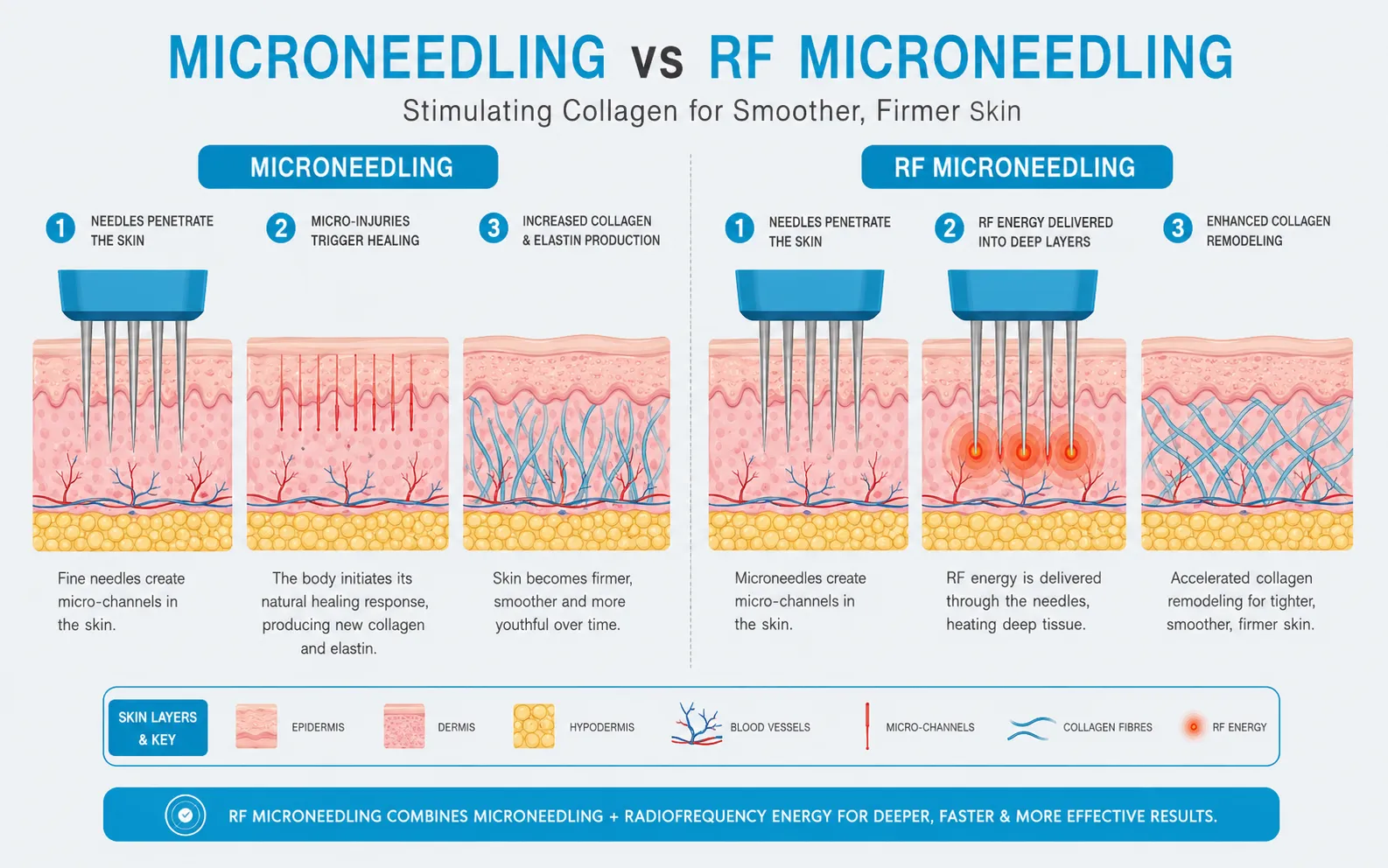
Microneedling uses a device fitted with fine, sterile needles to create thousands of controlled micro-channels in the skin. Each puncture stimulates fibroblasts to produce new collagen and elastin. For stretch marks, needle depths are typically set between 1.5 mm and 2.5 mm to reach the dermis. A course of 4–6 sessions spaced 4 weeks apart is standard, with gradual improvement visible from session 2 onward. Downtime is minimal — mild redness for 24–48 hours.
Microneedling is safe across all skin tones, making it particularly relevant for the diverse skin types seen in Gurugram's population, where laser treatments carry a higher risk of post-inflammatory hyperpigmentation (PIH) in darker complexions (Fitzpatrick types IV–VI).
RF microneedling combines the mechanical stimulus of microneedling with the thermal energy of radiofrequency waves delivered directly into the dermis via insulated needles. The dual action — mechanical micro-injury plus heat-induced collagen contraction — produces more pronounced skin tightening and remodelling than standard microneedling alone. Clinical studies have shown significant improvement in stretch mark depth, width, and colour after 3–4 RF microneedling sessions. It is also colour-blind in terms of energy delivery, making it suitable for darker skin tones.
Profrea's skin specialists, including Dr. Shweta Sharma and Dr. Neha Dhankar, assess each patient's skin type, stretch mark stage, and treatment goals before recommending whether standard microneedling or RF microneedling is the more appropriate starting point.

How microneedling and RF microneedling stimulate collagen remodelling in the dermis
Laser therapy for stretch marks broadly falls into two categories:
Ablative fractional lasers (e.g., fractional CO₂, Er:YAG) — remove microscopic columns of skin tissue, triggering aggressive collagen remodelling. More effective for mature white stretch marks but require 5–7 days of downtime and carry a higher PIH risk in darker skin.
Non-ablative fractional lasers (e.g., 1540 nm, 1550 nm) — deliver heat to the dermis without removing the surface layer. Gentler, with 1–2 days of redness, and suitable for a broader range of skin tones. Typically requires more sessions (5–8) than ablative options.
Pulsed dye laser (PDL) is specifically effective for red/purple (early-stage) stretch marks, targeting the haemoglobin in dilated blood vessels to reduce redness and flatten the mark. A 2019 systematic review noted in the Journal of Clinical and Aesthetic Dermatology (via PubMed) that fractional laser treatments consistently produced statistically significant improvements in stretch mark appearance across multiple controlled studies.
Choosing the right laser type requires a proper skin assessment — a step that Profrea's skin care specialists in Gurugram conduct before any energy-based treatment is scheduled.
Medium-depth chemical peels (glycolic acid, TCA) can improve the surface texture of stretch marks and are sometimes used in combination with microneedling for enhanced results. Prescription-strength tretinoin (a retinoid) has the strongest topical evidence base — it works by increasing epidermal cell turnover and stimulating dermal collagen synthesis, though it is contraindicated in pregnancy. These are best used as adjuncts to, rather than replacements for, energy-based procedures.
PRP involves drawing a small amount of the patient's own blood, concentrating the growth-factor-rich plasma, and injecting or micro-needling it into the stretch mark area. Growth factors in PRP — including PDGF, TGF-β, and VEGF — directly stimulate fibroblast activity and angiogenesis. PRP is frequently combined with microneedling (the "vampire facial" concept applied to stretch marks) for synergistic collagen induction. It is a natural, biocompatible option with a low side-effect profile.
All of the above treatments can be applied to the most common sites where stretch marks develop:
Abdomen — most frequently affected after pregnancy or significant weight change
Thighs and hips — common during puberty and pregnancy
Upper arms — often linked to rapid muscle gain or weight fluctuation
Breasts — particularly during pregnancy and breastfeeding
Lower back and buttocks — associated with growth spurts and weight changes
Treatment parameters (needle depth, laser fluence, RF intensity) are adjusted based on the body site, skin thickness, and individual sensitivity. A personalised plan from a qualified specialist — rather than a one-size-fits-all protocol — consistently delivers better outcomes.
There is no universal answer — it depends on the age of the stretch marks, their severity, the treatment modality chosen, and individual skin biology. As a general guide:
| Treatment | Typical Sessions | Interval | Downtime |
|---|---|---|---|
| Microneedling | 4–6 | 4 weeks | 24–48 hrs |
| RF Microneedling | 3–4 | 4–6 weeks | 2–3 days |
| Non-ablative Fractional Laser | 5–8 | 4 weeks | 1–2 days |
| Ablative Fractional Laser | 2–4 | 6–8 weeks | 5–7 days |
| PRP + Microneedling | 3–5 | 4 weeks | 24–48 hrs |
Results continue to improve for 3–6 months after the final session, as collagen remodelling is a slow biological process. Maintenance sessions once or twice a year help preserve results.
A thorough consultation is essential. Your specialist will assess your skin type (Fitzpatrick scale), the age and severity of your stretch marks, your medical history, and any medications you are taking. Avoid sun exposure, retinoids, and blood-thinning supplements (aspirin, fish oil) for at least one week before treatment. Topical numbing cream is applied 30–45 minutes before energy-based procedures to ensure comfort.
Most stretch mark treatments take 30–60 minutes depending on the area being treated. Microneedling and RF microneedling feel like a mild prickling or warm sensation. Laser treatments may produce a snapping feeling. All procedures are performed in a clinical setting with sterile technique.
Expect redness, mild swelling, and sensitivity for 24–72 hours depending on the modality. Apply SPF 50+ sunscreen diligently — UV exposure immediately after treatment can trigger PIH, especially in Indian skin tones. Avoid swimming pools, saunas, and heavy exercise for 48 hours. Your specialist will provide a personalised post-care protocol, which may include gentle cleansers, barrier-repair moisturisers, and growth-factor serums.
Profrea's care model — supported by its skin care team across 7 Gurugram clinic locations — includes follow-up check-ins via the Profrea mobile app, so patients can share progress photos and receive guidance between in-clinic sessions without needing an additional appointment.
This is one of the most important questions for patients in Gurugram and across India, where Fitzpatrick skin types IV–VI predominate. The key risk with energy-based treatments in darker skin is post-inflammatory hyperpigmentation (PIH) — darkening of the treated area triggered by inflammation.
Microneedling and RF microneedling are the safest first-line options for darker skin tones because they do not target melanin. When lasers are used, non-ablative fractional lasers at conservative settings are preferred over ablative or pigment-targeting lasers. A patch test on a small area is standard practice before treating a larger zone.
Choosing a clinic where specialists have specific experience with Indian skin types — and where treatment parameters are adjusted accordingly — is the single most important safety factor. Profrea's aesthetic skin specialists in Gurugram are trained to customise protocols for the full spectrum of Indian skin tones.
Complete removal is rarely achievable because stretch marks are a form of dermal scarring. However, significant improvement in texture, colour, and depth is realistic with the right treatment plan. Most patients see a 50–80% improvement after a full course of treatment. Setting realistic expectations during the initial consultation is an important part of ethical aesthetic practice.
Yes. Early-stage striae rubrae respond faster and more dramatically to treatment because the tissue is still biologically active and vascular. Pulsed dye laser is particularly effective at this stage. Mature white stretch marks (striae albae) require more sessions and may show more modest improvement, though RF microneedling and fractional lasers still produce meaningful results.
With topical anaesthetic cream applied beforehand, most patients describe microneedling as mildly uncomfortable rather than painful — a sensation of light pressure or warmth. RF microneedling may feel slightly more intense due to the heat component, but remains well-tolerated with numbing cream.
Initial texture improvement may be visible after 2–3 sessions, but the most significant results appear 3–6 months after completing the full course, as collagen remodelling continues long after the treatment sessions end.
No. Energy-based treatments, laser therapy, and PRP are not recommended during pregnancy or breastfeeding. Gentle topical moisturisers (without retinoids) are the only safe option during this period. Treatment can be planned after delivery and the breastfeeding period has ended.
Look for a clinic with qualified dermatologists or aesthetic medicine specialists, documented experience with Indian skin types, a thorough pre-treatment consultation process, and transparent communication about realistic outcomes. Profrea's network of skin specialists across Gurugram offers both in-clinic and video consultations, making it easy to get an expert assessment before committing to a treatment plan.
Profrea's skin specialists across 7 Gurugram clinics offer personalised stretch mark assessments — in-clinic or via video consultation — so you can understand exactly which treatment is right for your skin type and goals.