
From dandruff and dryness to hair thinning, professional scalp therapy addresses the root cause — literally. Here is everything you need to know before your first session.
By Profrea · Published July 2026
Your scalp is far more than the skin beneath your hair. It is a dynamic ecosystem of sebaceous glands, hair follicles, blood vessels, and microbiota that collectively determine whether your hair grows thick and strong or becomes brittle, sparse, and prone to shedding. When this ecosystem falls out of balance — due to stress, hormonal shifts, pollution, product buildup, or nutritional gaps — the consequences show up as dandruff, itching, excess oiliness, inflammation, or visible hair thinning.
Scalp treatment is a specialised therapy designed to restore that balance. Unlike a regular shampoo or home oil massage, professional scalp care begins with a detailed diagnostic assessment, followed by targeted interventions that may range from deep cleansing and exfoliation to advanced growth-factor therapies. The goal is not cosmetic — it is clinical: create the optimal environment for healthy follicle function and sustained hair growth.
According to the National Institutes of Health (NIH), scalp disorders affect a significant proportion of the global population at some point in their lives, with seborrheic dermatitis alone estimated to affect up to 5% of adults worldwide. Yet most people manage these conditions with over-the-counter products that treat symptoms rather than causes.
Understanding your specific scalp condition is the first step toward choosing the right treatment. Here are the most frequently encountered concerns:
Dandruff and seborrheic dermatitis: Characterised by flaking, itching, and redness, often triggered by an overgrowth of the yeast Malassezia on the scalp surface.
Dry scalp: Insufficient sebum production leads to tight, flaky skin that can cause discomfort and dull hair texture.
Oily scalp (seborrhoea): Overactive sebaceous glands produce excess oil, clogging follicles and creating an environment where bacteria and fungi thrive.
Scalp psoriasis: An autoimmune condition causing thick, silvery scales and persistent inflammation that can disrupt the hair growth cycle.
Folliculitis: Bacterial or fungal infection of hair follicles, presenting as small, painful pustules across the scalp.
Hair thinning and alopecia: Reduced follicle activity — whether due to androgenetic alopecia, telogen effluvium, or nutritional deficiency — results in visibly thinner hair density over time.
Product buildup and scalp congestion: Residue from styling products, dry shampoos, and hard water minerals can suffocate follicles and impair healthy growth.
If you have been experiencing any of these concerns, speaking with a specialist at Profrea's hair and scalp care team can help you identify the underlying cause before it progresses.
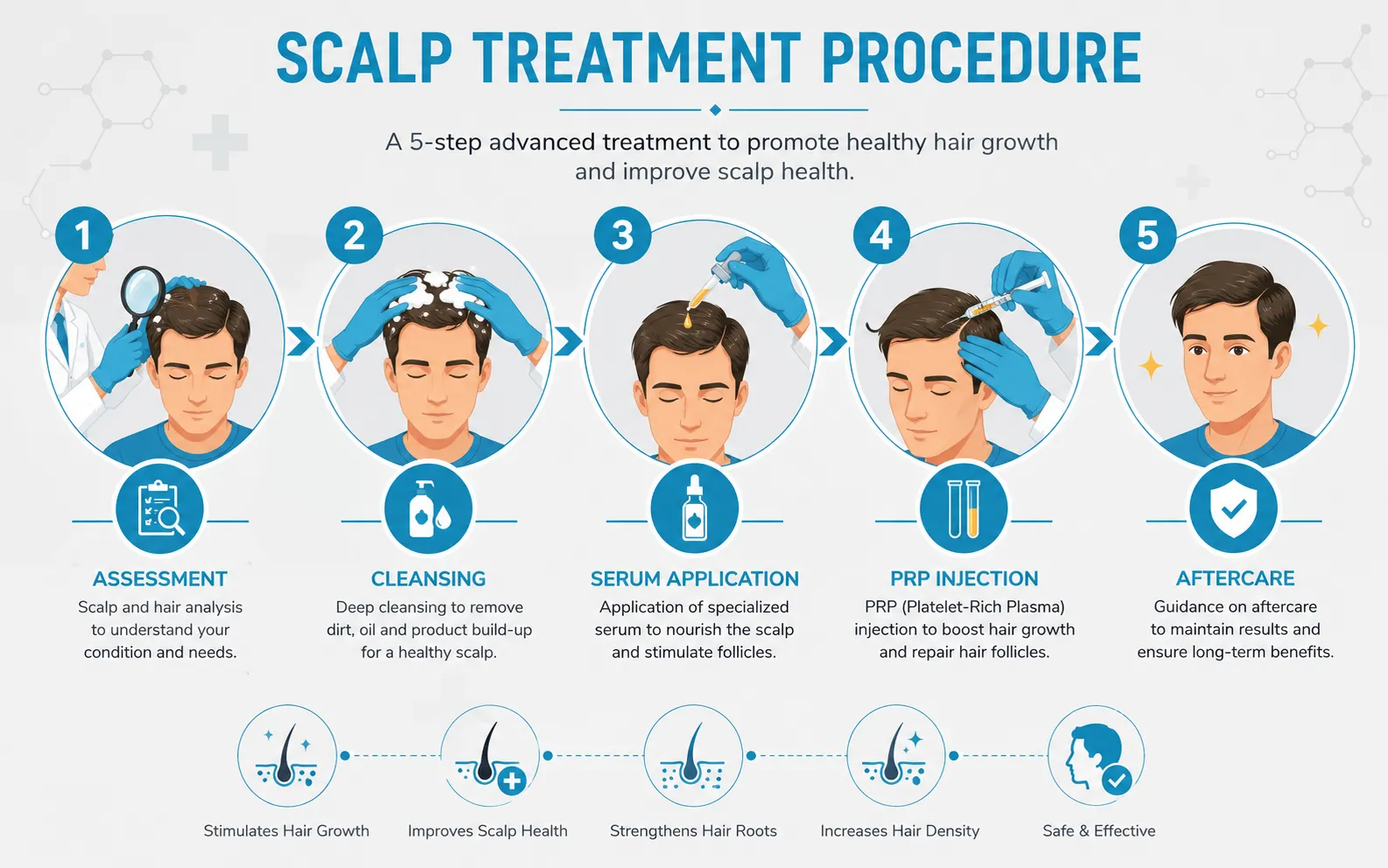
A professional scalp treatment is not a single procedure — it is a structured care pathway tailored to your individual scalp profile. Here is what a typical session looks like:
The session begins with a thorough scalp analysis. Clinicians may use trichoscopy (dermoscopy of the scalp) or digital scalp imaging to evaluate sebum levels, follicle density, inflammation, and the presence of any fungal or bacterial activity. This diagnostic step ensures that the treatment plan is evidence-based rather than generic.
A medicated or enzyme-based cleanser removes product buildup, dead skin cells, and excess sebum from the scalp surface. Physical or chemical exfoliation (using salicylic acid, lactic acid, or gentle scrubs) unclogs follicles and prepares the scalp to absorb active ingredients more effectively.
Depending on the diagnosis, one or more of the following may be applied:
Medicated serums: Antifungal, antibacterial, or anti-inflammatory actives delivered directly to the scalp.
Hydration therapy: Hyaluronic acid or ceramide-based formulations to restore moisture balance in dry or sensitised scalps.
Scalp massage with nourishing oils: Improves microcirculation, delivering oxygen and nutrients to follicle cells.
For moderate to severe hair thinning or persistent scalp conditions, clinicians may recommend advanced interventions:
PRP (Platelet-Rich Plasma) therapy: Concentrated growth factors derived from the patient's own blood are injected into the scalp to stimulate dormant follicles. A 2019 systematic review published on PubMed found PRP to be a promising treatment for androgenetic alopecia, with statistically significant improvements in hair density and thickness.
Mesotherapy: Microinjections of vitamins, minerals, and amino acids directly into the mesoderm layer of the scalp to nourish follicles and reduce inflammation.
Low-Level Laser Therapy (LLLT): Photobiomodulation using red-light wavelengths to energise follicle cells and extend the anagen (growth) phase of the hair cycle.
A good scalp treatment clinic does not end the consultation at the door. Clinicians provide personalised aftercare advice — including product recommendations, dietary guidance, and a maintenance schedule — to sustain the results achieved in-clinic. At Profrea, this continuity of care is supported by video consultations and a dedicated mobile app, so patients can follow up with their specialist without needing to visit in person every time.
Many patients use the terms interchangeably, but there is an important clinical distinction. Hair treatments — such as keratin therapy, deep conditioning, or bond repair — focus on the hair shaft itself: improving texture, reducing breakage, and restoring shine to existing strands. These are largely cosmetic in nature.
Scalp treatments, by contrast, target the skin and follicles beneath the hair. They address the biological environment in which new hair grows. Think of it this way: treating the hair shaft without treating the scalp is like watering the leaves of a plant while ignoring the soil. Long-term hair health depends on a well-nourished, inflammation-free scalp.
The most effective approach combines both — and that is precisely what a comprehensive hair and scalp treatment programme at a specialist clinic is designed to deliver. Profrea's specialists, including Dr. Nupur Gurugoswami and Dr. Shweta Sharma, take an integrated view of scalp and hair health, ensuring that treatment plans address both dimensions simultaneously.
Professional scalp care is not reserved for those with severe hair loss. You may benefit from a scalp treatment clinic consultation if you experience any of the following:
Persistent dandruff that does not respond to medicated shampoos after 4–6 weeks of consistent use
Noticeable hair shedding beyond the normal range of 50–100 strands per day
A receding hairline or widening part that has progressed over 6 months or more
Chronic scalp itching, burning, or tenderness
Visible redness, scaling, or pustules on the scalp
Hair that feels limp, lacks volume, or breaks easily despite good hair care habits
Post-pregnancy hair thinning (telogen effluvium) that has not resolved within 6 months
Early intervention consistently produces better outcomes. Waiting until hair loss is advanced significantly reduces the pool of viable follicles available for stimulation.
Professional scalp therapy delivers the most lasting results when supported by consistent at-home care. Here are clinically grounded habits that complement in-clinic treatment:
Oily scalps benefit from clarifying or salicylic acid-based shampoos used 3–4 times per week. Dry or sensitive scalps do better with sulphate-free, hydrating formulations used 2–3 times per week. Dandruff-prone scalps may require zinc pyrithione, ketoconazole, or selenium sulphide-containing products — but always under clinical guidance to avoid overuse.
A 4-minute daily scalp massage has been shown in small clinical studies to increase hair thickness by improving dermal papilla cell activity. Use the pads of your fingers (not nails) in circular motions, applying gentle but firm pressure across the entire scalp.
Iron deficiency, low ferritin, zinc deficiency, and inadequate protein intake are among the most common nutritional drivers of hair thinning in India. A diet rich in leafy greens, lentils, eggs, nuts, and seeds provides the micronutrients that follicle cells depend on. If you suspect a nutritional gap, a consultation with Dt. Swagata Pahari or Dt. Deepak, Profrea's nutrition and dietetics specialists, can help you build a targeted dietary plan.
Psychological stress is a well-documented trigger for telogen effluvium — a form of diffuse hair shedding in which a large proportion of follicles simultaneously enter the resting phase. Chronic stress also elevates cortisol, which can impair scalp microcirculation. Mindfulness, regular physical activity, and adequate sleep are not optional extras; they are part of a complete scalp care strategy.
Gurugram's urban environment — with its high pollution index and hard water supply — places an additional burden on scalp health. Using a water-softening shower filter, rinsing with diluted apple cider vinegar to remove mineral deposits, and wearing a hat or scarf during peak pollution hours can meaningfully reduce cumulative scalp damage.
Not all scalp clinics are equal. When evaluating where to seek professional scalp care, consider the following criteria:
Diagnostic capability: Does the clinic use trichoscopy or digital scalp analysis, or does it rely solely on visual inspection? Objective diagnostics lead to more accurate treatment selection.
Clinician credentials: Is the treatment delivered by a qualified dermatologist or trichologist, or by a beautician? Hair and scalp conditions are medical in nature and warrant medical expertise.
Personalised protocols: A reputable clinic will not apply the same treatment to every patient. Look for clinics that tailor protocols to your specific scalp profile, lifestyle, and health history.
Continuity of care: Scalp conditions often require multiple sessions and ongoing monitoring. A clinic that offers follow-up consultations — including video consultations for convenience — is better positioned to deliver lasting results.
Transparent communication: Realistic expectations, clear explanations of each procedure, and honest discussion of timelines are hallmarks of a trustworthy clinic.
Profrea's network of 7 clinics across Gurugram is built around exactly these principles. With in-clinic consultation rooms, video consultation facilities, and a smart digital platform connecting patients to their care team, Profrea makes it straightforward to access expert scalp care without logistical friction. You can explore available specialists — including Dr. Divya Dixit and Dr. Soma Kumari — and book appointments directly through the Profrea app or website.
This depends entirely on your condition. Mild dandruff or product buildup may resolve after 2–3 sessions. Moderate hair thinning or seborrheic dermatitis typically requires a course of 6–8 sessions over 2–3 months, followed by maintenance visits every 4–6 weeks. Advanced alopecia may need ongoing treatment combined with medical therapy. Your clinician will outline a realistic timeline at your initial assessment.
Most scalp treatments — including deep cleansing, exfoliation, and hydration therapy — are comfortable and even relaxing. Procedures involving injections, such as PRP or mesotherapy, involve minor discomfort at the injection sites. Topical anaesthetic cream is typically applied beforehand to minimise this. Any post-procedure tenderness usually resolves within 24–48 hours.
Professional scalp therapy can stimulate dormant follicles that are still biologically active — and in many cases, this does result in visible regrowth. However, follicles that have been completely inactive for many years may no longer respond to stimulation. This is why early intervention is so important. A thorough scalp assessment will help determine which follicles are viable and what level of regrowth is realistically achievable.
Scalp conditions such as dandruff and oiliness often improve noticeably after the first 1–2 sessions. Hair growth results take longer — the hair growth cycle spans approximately 3–6 months, so meaningful improvements in density and thickness are typically visible after 3–4 months of consistent treatment. Patience and adherence to the full treatment plan are essential.
Non-invasive scalp treatments carry minimal risk. Mild redness or sensitivity immediately after exfoliation or laser therapy is normal and transient. Injectable procedures such as PRP and mesotherapy carry a small risk of temporary bruising, swelling, or tenderness at injection sites. Serious adverse events are rare when treatments are performed by qualified clinicians in a properly equipped clinic.
Yes — but it is essential to disclose your full medical history, including any diagnosed skin conditions, allergies, or medications, at your initial consultation. Clinicians will adapt the treatment protocol accordingly, selecting ingredients and techniques appropriate for reactive or sensitised scalps.
Profrea's specialist team across 7 Gurugram clinics is here to assess your scalp, identify the root cause of your concerns, and build a personalised treatment plan — with the convenience of in-clinic and video consultations.