

A clinically grounded guide to platelet-rich plasma therapy for hair loss — realistic timelines, honest outcomes, and what the science actually says.
By the Profrea Editorial Team · Published July 2026
If you have been searching for PRP hair treatment before and after photos and timelines, you are not alone. Platelet-rich plasma (PRP) therapy has become one of the most discussed non-surgical options for hair regrowth — and one of the most misunderstood. Before you decide whether it is right for you, it helps to understand what PRP actually does, how long results take, and what a realistic before-and-after journey looks like.
This guide draws on current clinical evidence and the experience of the aesthetic and wellness team at Profrea, a multi-specialty clinic network with 7 locations across Gurugram, Haryana. Whether you are in the early stages of hair thinning or have been dealing with androgenetic alopecia for years, the information below will help you set accurate expectations.
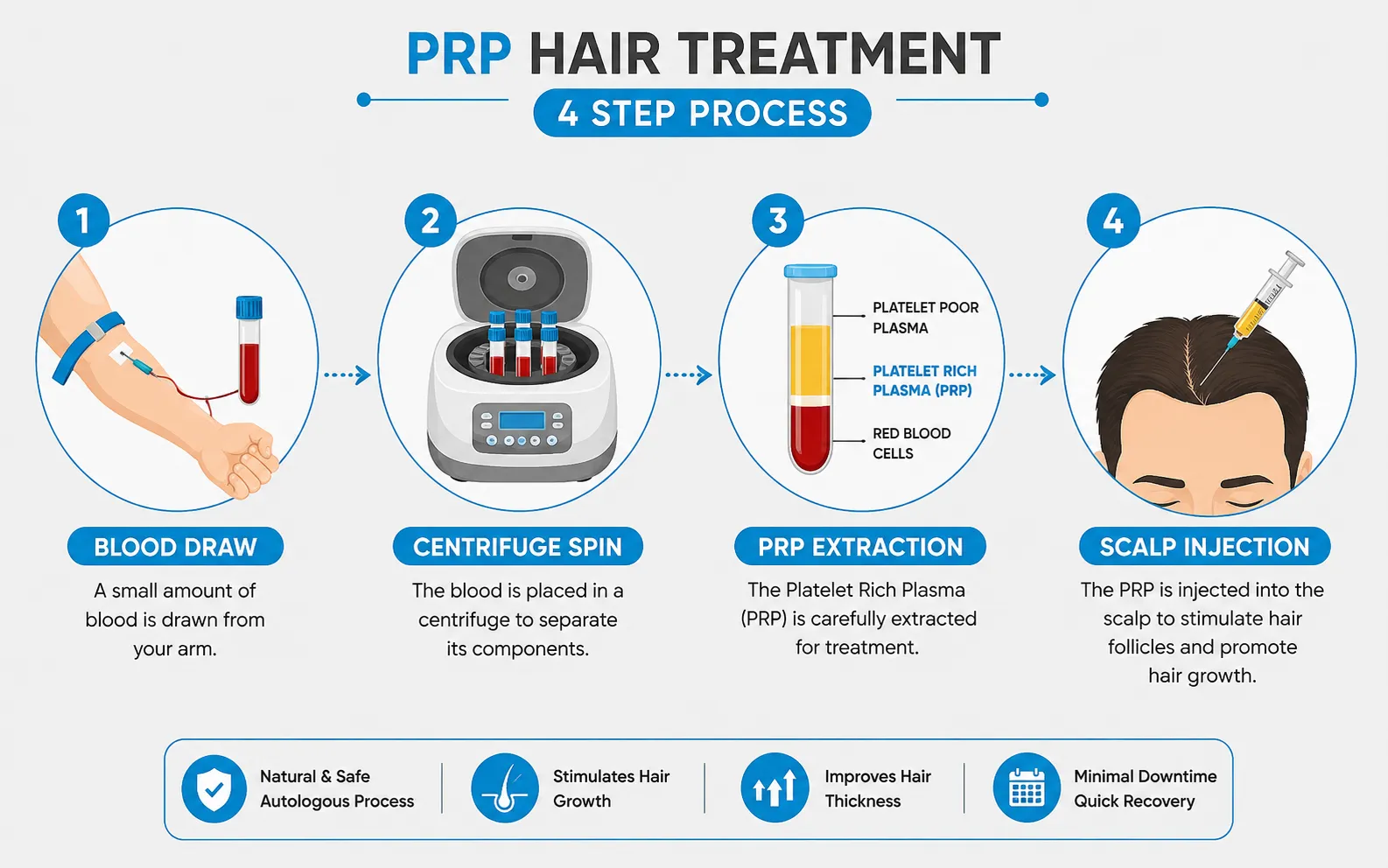
Platelet-rich plasma therapy involves drawing a small amount of your own blood, spinning it in a centrifuge to concentrate the platelets, and then injecting that concentrated plasma directly into the scalp. Platelets contain growth factors — proteins such as PDGF, VEGF, and IGF-1 — that signal hair follicles to shift from a resting (telogen) phase back into an active growth (anagen) phase.
Because PRP uses your own blood, the risk of allergic reaction is extremely low. It is classified as an autologous treatment, meaning the biological material comes from you. This makes it a popular choice for patients who want a minimally invasive, drug-free approach to hair regrowth.
A 2019 systematic review published on PubMed (NCBI) found that PRP injections significantly increased hair density and hair thickness in patients with androgenetic alopecia compared to placebo controls, supporting its use as a viable adjunct treatment for hair loss.
PRP works best when there are still living, albeit dormant, follicles in the scalp. Ideal candidates include:
Men and women in the early-to-moderate stages of androgenetic alopecia (pattern baldness)
Individuals experiencing diffuse thinning rather than complete bald patches
Patients with alopecia areata (in select cases, under specialist guidance)
Those who have had a hair transplant and want to support graft survival and density
PRP is generally less effective in areas where follicles have been completely destroyed (slick bald scalp with no miniaturised hairs). A proper trichoscopy or scalp assessment by a qualified clinician — such as the general medicine and wellness specialists at Profrea — can determine whether your follicles are still responsive.
Understanding the procedure itself helps reduce anxiety and sets realistic expectations for the day of treatment.
Your clinician will review your medical history, assess the pattern and extent of hair loss, and discuss your goals. Blood tests may be ordered to rule out underlying causes such as thyroid dysfunction, iron deficiency, or hormonal imbalance — all of which can independently drive hair loss and should be addressed alongside PRP.
Approximately 10–20 ml of blood is drawn from your arm — similar to a routine blood test. The sample is placed in a centrifuge and spun at high speed for 8–10 minutes, separating the platelet-rich plasma from red blood cells and platelet-poor plasma.
A topical anaesthetic cream is applied to the scalp 20–30 minutes before injections to minimise discomfort. The concentrated PRP is then injected in a grid pattern across the thinning areas using a fine needle. A typical session covers the frontal hairline, crown, and temples as needed.
Most patients can return to normal activities the same day. You will be advised to avoid washing your hair for 24 hours, skip vigorous exercise for 48 hours, and refrain from applying chemical hair products for at least 72 hours. Mild redness or tenderness at injection sites is normal and typically resolves within a day.
This is one of the most common questions patients ask before their first session. The honest answer: most patients describe the sensation as mild to moderate discomfort, not sharp pain. The topical anaesthetic significantly reduces the sting of injections. Some patients report a pressure sensation or a brief burning feeling immediately after injection, which fades quickly.
Patients who are particularly sensitive to needles may find the procedure more uncomfortable, and clinicians can adjust the anaesthetic protocol accordingly. Post-session soreness — similar to a mild headache across the scalp — can last 24–48 hours and is managed with standard over-the-counter pain relief if needed.
.webp)
This is the section most patients are really looking for. Here is an honest, evidence-based breakdown of the PRP hair regrowth timeline:
Do not expect visible regrowth yet. The growth factors are stimulating follicles at a cellular level. Some patients notice reduced hair fall — fewer hairs on the pillow or in the shower drain — which is often the first positive sign that the treatment is working.
Fine, baby hairs (vellus hairs transitioning to terminal hairs) may begin to appear along the hairline and in thinning zones. Hair texture often improves — existing strands may feel thicker and stronger. This is the stage where many patients first notice a difference in photographs.
This is typically when the most visible PRP hair treatment before and after transformation becomes apparent. Hair density increases, the scalp appears less visible through the hair, and the overall volume improves. Clinical studies report that most responders show measurable improvement in hair count and thickness by the 6-month mark.
Results continue to consolidate. Maintenance sessions (typically every 3–6 months) help sustain the gains. Without maintenance, hair loss may gradually resume as the underlying genetic or hormonal drivers continue to act on follicles.
The standard initial protocol used by most clinicians — and consistent with published literature — is 3 sessions spaced 4–6 weeks apart, followed by a reassessment. Some patients with more advanced thinning may require 4–6 sessions in the initial course.
After the initial course, a maintenance session every 3–6 months is generally recommended to preserve results. The exact protocol is personalised based on your response to treatment, the severity of hair loss, and any concurrent therapies (such as minoxidil or finasteride) you may be using.
At Profrea's clinics across Gurugram, the care team — including specialists like Dr. Shikha Bansal (Plastic Surgeon, MCh) and Dr. Soma Kumari — works collaboratively to ensure each patient's treatment plan is tailored rather than templated.
The evidence base for PRP in hair loss has grown substantially over the past decade. Multiple randomised controlled trials and systematic reviews have demonstrated statistically significant improvements in hair density, hair shaft diameter, and patient-reported satisfaction scores compared to placebo injections.
However, it is important to be honest: PRP is not a cure for hair loss. It does not reverse the genetic programming of follicles permanently. It works best as part of a comprehensive hair health strategy that may include nutritional support, hormonal assessment, and — where appropriate — medical therapies. Patients with very advanced baldness (Norwood Scale VI–VII in men) are unlikely to see significant regrowth from PRP alone.
The American Academy of Dermatology (AAD) acknowledges PRP as a promising treatment for androgenetic alopecia, noting that while more large-scale trials are needed, existing evidence supports its use as a safe adjunct therapy.
Published studies report response rates ranging from 60% to 80% of patients experiencing measurable improvement in hair density after a standard course of PRP. The variability reflects differences in patient selection, PRP preparation protocols, and the number of sessions administered.
Factors that predict a better response include:
Earlier stage of hair loss at the time of treatment
Absence of significant scalp scarring or fibrosis
Good overall health and nutritional status
Adherence to the full treatment protocol
Combining PRP with evidence-based medical therapies where indicated
Non-responders do exist, and a reputable clinic will discuss this possibility honestly during your consultation rather than making guarantees. If you are considering a hair growth PRP clinic in Gurugram, look for one that conducts a thorough pre-treatment assessment and sets realistic expectations — as the team at Profrea's diabetology and general medicine specialists do when evaluating systemic contributors to hair loss.
Gurugram's urban lifestyle — high stress levels, hard water, pollution, and dietary patterns common in NCR — contributes to a higher-than-average incidence of hair thinning among both men and women in the 25–45 age group. These environmental and lifestyle factors do not cause androgenetic alopecia, but they can accelerate its progression and worsen diffuse hair shedding.
This is why a holistic assessment matters. At Profrea's 7 clinic locations across Gurugram, patients benefit from access to multi-specialty care under one network — meaning a nutritionist, a psychologist (for stress-related hair loss), and a general physician can all be part of your care team alongside the aesthetic specialist performing PRP. You can explore the psychology and stress management services offered by Dr. Sarika Thakral as a complementary pathway if stress is a contributing factor.
PRP is rarely a standalone solution for best results. Clinicians often recommend combining it with:
Minoxidil (topical): Extends the anagen phase and complements PRP's growth-factor stimulation.
Finasteride or dutasteride (oral, for men): Reduces DHT-driven follicle miniaturisation at the hormonal level.
Nutritional supplementation: Biotin, iron, zinc, and vitamin D deficiencies are common in hair loss patients and should be corrected. Profrea's nutrition and dietetics team, including dietitian Swagata Pahari, can guide personalised supplementation.
Low-level laser therapy (LLLT): Some evidence supports its use alongside PRP for synergistic follicle stimulation.
Your clinician will advise on the most appropriate combination based on your individual hair loss pattern, medical history, and lifestyle.
Not all PRP treatments are equal. The quality of results depends heavily on the PRP preparation protocol (platelet concentration, activation method), the skill of the injecting clinician, and the thoroughness of the pre-treatment assessment. When evaluating a clinic, consider:
Does the clinic conduct a scalp assessment before recommending PRP?
Are blood tests offered to rule out systemic causes of hair loss?
Is the PRP prepared using a validated, medical-grade centrifuge system?
Does the clinic offer multi-specialty support (nutrition, psychology, general medicine)?
Are realistic outcomes discussed, including the possibility of non-response?
Profrea's network in Gurugram is designed to answer yes to all of the above. With specialists across plastic surgery, general medicine, nutrition, and psychology available across its clinics, patients receive a genuinely integrated approach to hair health — not just a single injection session. You can also explore Dr. Deepa Agarwal's profile or Dr. Nupur Gurugoswami's profile to learn more about the clinical team available at Profrea.
Most patients notice a reduction in hair fall within the first 4 weeks. Visible new hair growth typically becomes apparent between months 3 and 6, after completing the initial course of 3 sessions. Full results are usually assessed at the 6-month mark.
The standard initial protocol is 3 sessions spaced 4–6 weeks apart. Some patients with more advanced hair loss may need 4–6 sessions. Maintenance sessions every 3–6 months are recommended thereafter to sustain results.
Yes, for the right candidates. Multiple clinical studies show significant improvement in hair density and thickness in patients with androgenetic alopecia. It is most effective in early-to-moderate stages of hair loss where follicles are still present but dormant.
Published studies report response rates of 60–80% among appropriately selected patients. Results vary based on the stage of hair loss, the PRP preparation protocol, and whether complementary treatments are used alongside PRP.
Most patients describe the procedure as mildly uncomfortable rather than painful. A topical anaesthetic is applied before injections to minimise discomfort. Post-session scalp tenderness is common but typically resolves within 24–48 hours.
Yes, and it is often recommended. PRP works well alongside topical minoxidil, oral DHT blockers (for men), nutritional supplementation, and low-level laser therapy. Your clinician will advise on the best combination for your specific hair loss pattern.
Profrea's multi-specialty team can assess your hair loss holistically and guide you toward the most appropriate, evidence-based treatment plan — with 7 convenient clinic locations across Gurugram.