
A practical, clinician-backed guide to platelet-rich plasma therapy for hair loss — what it costs, how it works, and whether it's right for you.
By the Profrea Editorial Team · Published July 2026
Hair thinning affects millions of people across India, and Gurgaon's fast-paced, high-stress corporate environment only accelerates the problem. If you've been researching solutions, you've almost certainly come across PRP hair treatment — a procedure that uses your own blood's growth factors to stimulate dormant hair follicles. But with so much conflicting information online, it can be hard to separate clinical fact from marketing hype.
This guide covers everything you need to know: how PRP works, realistic results, how many sessions are typically required, who makes a good candidate, and what PRP hair treatment costs in Gurgaon. Where relevant, we've drawn on published clinical evidence and the expertise of Profrea's aesthetic medicine team — so you can make an informed decision.
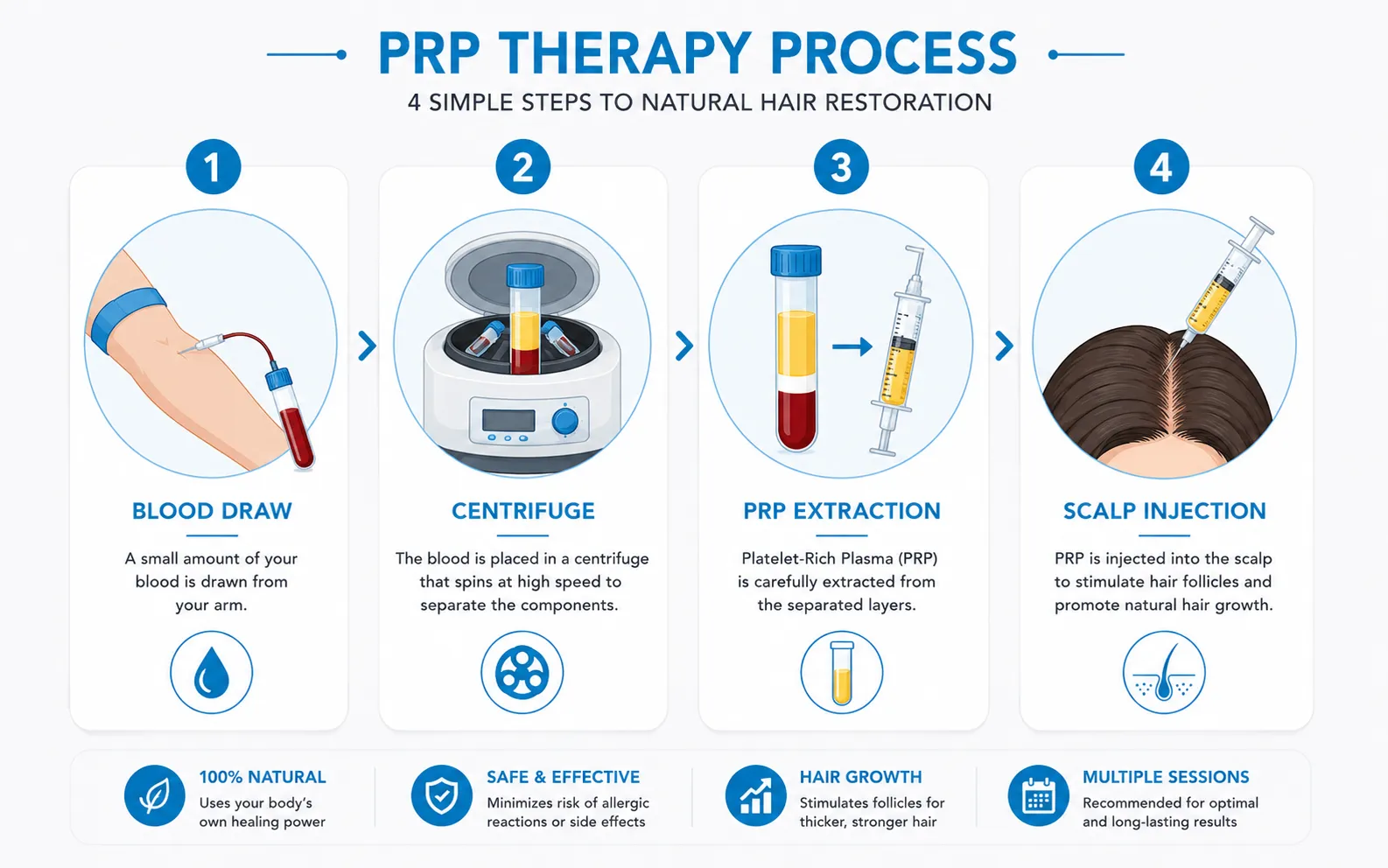
Platelet-Rich Plasma (PRP) therapy is a minimally invasive, non-surgical procedure. A small amount of your blood is drawn, spun in a centrifuge to concentrate the platelets, and then injected into the scalp at the level of the hair follicles. Platelets are packed with growth factors — including PDGF, VEGF, and IGF — that signal follicle cells to proliferate and shift from the resting (telogen) phase back into the active growth (anagen) phase.
Because PRP uses your own blood, the risk of allergic reaction or rejection is extremely low. The entire session — blood draw, centrifugation, and scalp injections — typically takes 45–60 minutes and requires no general anaesthesia.
A 2015 systematic review published on PubMed (NCBI) found that PRP injections significantly increased hair density and thickness in patients with androgenetic alopecia, supporting its growing use in clinical practice.
The honest answer: yes, for the right candidate — but it is not a cure for all types of hair loss, and results vary. PRP works best when hair follicles are still alive but dormant. It cannot regenerate follicles that have been completely destroyed by scarring alopecia or very advanced baldness.
Clinical studies consistently show improvements in:
Hair count per square centimetre of scalp
Hair shaft diameter (thickness)
Reduction in hair fall (telogen effluvium)
Overall patient satisfaction scores
Most patients notice reduced shedding after the first two sessions and visible new growth by the third or fourth session. Full results are typically assessed at the 6-month mark.
PRP is most effective for:
Androgenetic alopecia (male and female pattern baldness) — the most common indication
Alopecia areata — patchy hair loss with an autoimmune component
Telogen effluvium — diffuse shedding triggered by stress, illness, nutritional deficiency, or hormonal changes (common in postpartum women)
Patients in the early-to-moderate stages of hair loss (Norwood Scale I–IV for men; Ludwig Scale I–II for women)
PRP may not be suitable if you have active scalp infections, blood disorders, are on anticoagulant therapy, or have very advanced baldness with no residual follicles. A consultation with a qualified aesthetic physician is essential before proceeding — the team at Dr. Shikha Bansal, Plastic Surgeon at Profrea, can assess your scalp and recommend the most appropriate treatment pathway.
This is one of the most common questions patients ask. The short answer: most people need 3–6 sessions in the initial treatment phase, followed by maintenance sessions every 4–6 months.
A typical PRP hair treatment protocol looks like this:
| Phase | Sessions | Interval |
|---|---|---|
| Initial (Induction) | 3–4 sessions | Once every 4 weeks |
| Consolidation | 1–2 sessions | Once every 6–8 weeks |
| Maintenance | 1 session every 4–6 months | Ongoing |
The exact number depends on the severity of hair loss, your age, underlying causes (hormonal, nutritional, genetic), and how your scalp responds to the initial sessions. Your treating physician will reassess after each session and adjust the plan accordingly.
Patients dealing with stress-related hair loss — a pattern increasingly common among Gurgaon's working professionals — may benefit from a combined approach. The clinical psychology team at Profrea, led by Dr. Sarika Thakral, can address stress and lifestyle factors that contribute to telogen effluvium alongside your PRP programme.
PRP hair treatment cost in Gurgaon typically ranges between ₹3,000 and ₹8,000 per session, depending on the clinic's infrastructure, the physician's qualifications, the quality of the centrifuge and PRP kit used, and whether additional growth factors (such as GFC — Growth Factor Concentrate) are included.
| Treatment Option | Approximate Cost (per session) |
|---|---|
| Standard PRP (3-tube protocol) | ₹3,000 – ₹5,000 |
| Advanced PRP (high-concentration / double-spin) | ₹5,000 – ₹8,000 |
| GFC (Growth Factor Concentrate) — next-gen PRP | ₹6,000 – ₹10,000 |
For a full induction course of 4 sessions, budget approximately ₹15,000 – ₹30,000 in total. Clinics that offer package deals often provide better value than paying per session. Always ask whether the quoted price includes the PRP kit, topical anaesthetic, and follow-up consultation — these can be billed separately at some centres.
What drives cost differences? The single biggest factor is the quality of the centrifuge and the PRP preparation kit. A medical-grade, double-spin centrifuge produces a significantly higher platelet concentration than a basic single-spin device — and higher platelet concentration correlates with better clinical outcomes. Physician experience and the number of injections per session also affect pricing.
Profrea's aesthetic clinics across Gurugram are equipped with in-clinic procedure rooms designed for day-care aesthetic treatments. You can also use Profrea's health screening packages to rule out underlying causes of hair loss — such as thyroid dysfunction, iron deficiency, or hormonal imbalance — before beginning PRP, ensuring your investment is well-targeted.
Patients often ask how PRP compares to a hair transplant. They are fundamentally different interventions:
| Feature | PRP Therapy | Hair Transplant (FUE/FUT) |
|---|---|---|
| Invasiveness | Minimally invasive (injections) | Surgical procedure |
| Downtime | None to minimal (24–48 hrs) | 7–14 days recovery |
| Best for | Early-moderate hair loss; thinning | Advanced baldness; bald patches |
| Cost (full treatment) | ₹15,000 – ₹30,000 | ₹50,000 – ₹1,50,000+ |
| Permanence | Requires maintenance sessions | Transplanted grafts are permanent |
| Anaesthesia | Topical only | Local (sometimes sedation) |
PRP and hair transplants are not mutually exclusive — many surgeons recommend PRP sessions before and after a transplant to improve graft survival and accelerate healing. If you are considering a surgical route, Dr. Shikha Bansal, MCh Plastic Surgeon at Profrea Gurugram, can advise on the most appropriate combination approach for your case.
Avoid anti-inflammatory medications (aspirin, ibuprofen) for at least 3 days before treatment, as these can reduce platelet activity. Stay well-hydrated and avoid alcohol 24 hours prior. Your physician may also recommend a baseline blood test to check platelet count and rule out anaemia.
A topical anaesthetic cream is applied to the scalp 30–45 minutes before injections. Blood is drawn from your arm (typically 10–20 ml), spun in the centrifuge for 8–10 minutes, and the PRP layer is carefully extracted. The concentrated plasma is then injected into the scalp using a fine needle in a grid pattern across the thinning areas. Most patients describe the sensation as mild pressure or a slight sting — not significantly painful.
You can return to work the same day. Avoid washing your hair for 24 hours, and skip the gym or any activity that causes heavy sweating for 48 hours. Some patients experience mild scalp tenderness or temporary redness — this typically resolves within 24 hours. Avoid direct sun exposure on the scalp for 2–3 days.
It is normal to experience a brief increase in shedding 2–3 weeks after the first session — this is a sign that dormant follicles are cycling into the active growth phase, not a sign that the treatment isn't working.
PRP works best when combined with good nutritional support. Deficiencies in iron, vitamin D, zinc, and biotin are among the most common — and reversible — causes of hair loss in urban Indian adults. Before or alongside PRP, it is worth having a nutritional assessment. Profrea's dietetics team can design a personalised nutrition plan to support follicle health and maximise your PRP results.
Similarly, hormonal causes — particularly thyroid disorders and PCOS in women — must be identified and managed. Dr. Soma Kumari, Gynaecologist & Infertility Specialist at Profrea, frequently sees patients whose hair loss is directly linked to hormonal imbalance, and co-managing these conditions alongside PRP dramatically improves outcomes.
A single PRP session in Gurgaon typically costs between ₹3,000 and ₹8,000, depending on the clinic, the PRP protocol used, and whether advanced techniques like GFC are included. A full induction course of 3–4 sessions usually costs ₹15,000–₹30,000 in total.
Most patients require 3–4 initial sessions spaced 4 weeks apart, followed by 1–2 consolidation sessions. After that, maintenance sessions every 4–6 months help sustain results. The exact number depends on the severity of hair loss and individual response.
Yes — for appropriate candidates. Multiple clinical studies support PRP's effectiveness in increasing hair density and reducing shedding, particularly in androgenetic alopecia and telogen effluvium. Results are best when follicles are still present but dormant, not in cases of complete follicle loss.
Ideal candidates are adults with early-to-moderate androgenetic alopecia, alopecia areata, or stress/hormone-related hair shedding. PRP is not recommended for those with active scalp infections, blood clotting disorders, or very advanced baldness with no residual follicles.
PRP is a non-surgical, injection-based treatment that stimulates existing follicles. A hair transplant is a surgical procedure that physically relocates follicles from a donor area. PRP suits early-stage hair loss; transplants are better for advanced baldness. Both can be combined for optimal outcomes.
Most patients find PRP tolerable. A topical anaesthetic cream is applied before the injections, reducing discomfort to mild pressure or a brief sting. Post-procedure tenderness usually resolves within 24 hours.
Profrea's aesthetic medicine team across 7 Gurugram clinic locations can assess your hair loss, identify underlying causes, and design a personalised PRP programme — all in one place.