
A clinician-reviewed guide to platelet-rich plasma therapy for hair loss — what the science says, what to expect, and whether it is right for you.
By the Profrea Editorial Team · Published July 2026
Platelet-rich plasma (PRP) hair treatment is a minimally invasive, non-surgical procedure that uses a concentrated preparation of your own blood platelets to stimulate dormant hair follicles and encourage new hair growth. The therapy has gained significant traction in dermatology and aesthetic medicine over the past decade, and is now one of the most sought-after solutions for androgenetic alopecia (pattern hair loss), telogen effluvium, and thinning hair in both men and women.
The core principle is straightforward: platelets are tiny blood cells packed with growth factors — including platelet-derived growth factor (PDGF), vascular endothelial growth factor (VEGF), and transforming growth factor (TGF-beta) — that play a central role in tissue repair and cellular regeneration. When injected into the scalp at the level of the hair follicle, these growth factors are thought to prolong the anagen (active growth) phase of the hair cycle, increase follicle size, and improve blood supply to the scalp.
At Profrea's clinics across Gurugram, PRP for hair is offered as part of a structured aesthetic and wellness programme, with treatment plans personalised by qualified clinicians based on the degree of hair loss, underlying causes, and individual health profile.
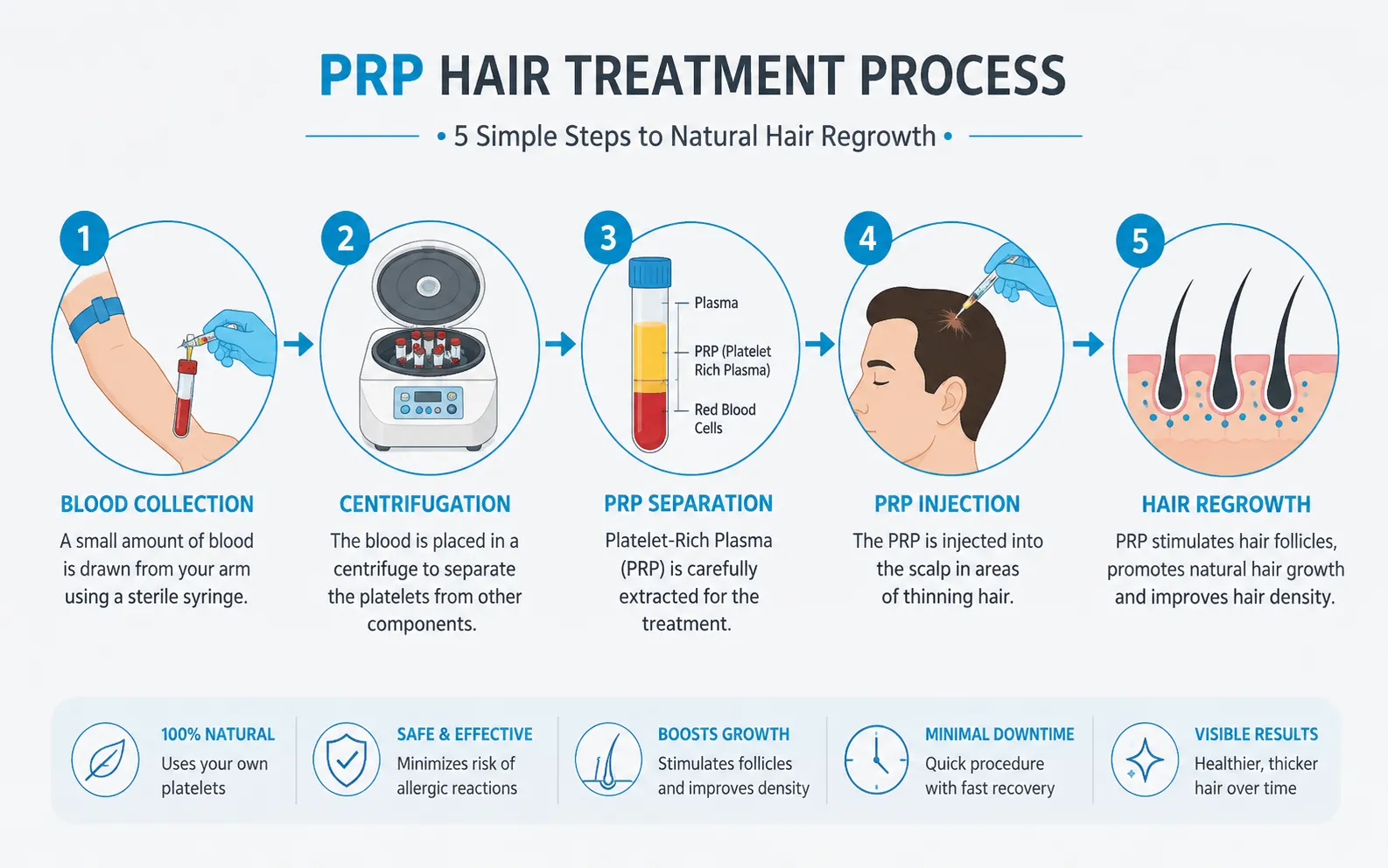
Understanding the procedure helps set realistic expectations. A typical PRP hair treatment session at a clinic follows these stages:
Blood draw: A small amount of blood — usually 15–30 ml — is drawn from your arm, similar to a routine blood test.
Centrifugation: The blood sample is placed in a centrifuge machine that spins at high speed for approximately 10–15 minutes, separating the blood into its components: red blood cells, platelet-poor plasma, and platelet-rich plasma.
Activation (optional): Some protocols include activation of the PRP with calcium chloride or thrombin to release growth factors before injection.
Scalp preparation: The treatment area is cleansed and a topical anaesthetic cream may be applied to minimise discomfort.
Micro-injection: The concentrated PRP is injected into the scalp at approximately 1 cm intervals across the areas of thinning or hair loss, targeting the dermal papilla layer where follicle stem cells reside.
Post-treatment care: The session concludes with basic scalp care instructions. Most patients leave the clinic within 60–90 minutes of arrival.
The entire process uses your own biological material, which significantly reduces the risk of allergic reaction or rejection — a key reason PRP is considered a safe first-line option before more invasive interventions such as hair transplant surgery.
The PRP hair treatment process: from blood draw to scalp injection in under 90 minutes.
PRP for hair is not a marketing trend — it is backed by a growing body of peer-reviewed research. A 2014 study published in the journal Dermatologic Surgery (via PubMed/NIH) found statistically significant improvements in hair count, hair thickness, and hair root strength in patients treated with PRP compared to placebo controls. Here is a summary of the key benefits supported by clinical evidence:
Increased hair density: Multiple randomised controlled trials report a measurable increase in the number of hairs per square centimetre of scalp after a course of PRP sessions.
Reduced hair shedding: Patients with telogen effluvium — stress-related or post-illness hair fall — often report a noticeable reduction in daily shedding within 4–6 weeks of the first session.
Thicker hair shaft diameter: Growth factors in PRP appear to increase the calibre of individual hair strands, making existing hair look fuller and healthier.
Prolonged anagen phase: PRP is believed to extend the active growth phase of the hair cycle, delaying the transition to the resting (telogen) phase.
Improved scalp vascularity: VEGF in PRP promotes the formation of new blood vessels around follicles, improving nutrient and oxygen delivery to the scalp.
Complementary to other treatments: PRP works synergistically with topical minoxidil, oral finasteride (in men), and nutritional supplementation, often enhancing outcomes when used as part of a combined protocol.
It is important to note that PRP works best for early-to-moderate hair loss. Completely bald areas where follicles have been absent for many years are unlikely to respond, as there are no dormant follicles left to stimulate. A thorough scalp assessment — including trichoscopy or dermoscopy — before starting treatment helps identify who will benefit most.
PRP is suitable for a wide range of patients, but it is not a universal solution. You are likely a good candidate if you:
Are in the early or intermediate stages of androgenetic alopecia (male or female pattern baldness)
Are experiencing diffuse thinning or increased shedding due to telogen effluvium
Have alopecia areata (patchy hair loss) — some studies show benefit, though results vary
Want to complement a hair transplant — PRP is frequently used post-transplant to accelerate graft survival and growth
Prefer a non-surgical, drug-free approach as a first step
PRP may not be appropriate if you have active scalp infections, platelet dysfunction disorders, are on blood thinners, have very low platelet counts, or are pregnant. A pre-treatment consultation with a qualified clinician is essential to rule out contraindications. Profrea's team includes specialists such as Dr. Ladli Chatterjee, whose background in general medicine and metabolic health helps identify systemic causes of hair loss — such as thyroid disorders or nutritional deficiencies — that must be addressed alongside PRP for optimal results.
This is one of the most common questions patients ask, and the honest answer is: it depends on the severity of hair loss and individual response. That said, most clinical protocols follow a broadly similar structure:
Induction phase: 3 sessions spaced 4 weeks apart (months 1–3). This is the core treatment phase where the majority of follicle stimulation occurs.
Consolidation phase: 1 session at month 6. This reinforces the gains made during induction.
Maintenance phase: 1 session every 6–12 months thereafter to sustain results long-term.
Most patients begin to notice reduced hair fall after the first or second session. Visible new hair growth — particularly at the hairline and crown — typically becomes apparent between months 3 and 6. Full results are usually assessed at the 6-month mark. Patients with more advanced hair loss or those who have had hair loss for a longer duration may require additional sessions before seeing meaningful improvement.
Consistency matters enormously. Skipping sessions or stopping treatment prematurely is one of the most common reasons patients do not achieve the results they hoped for. Your clinician will track progress using standardised photography and, where available, trichoscopy measurements at each visit.
Because PRP uses your own blood, the side effect profile is generally mild and short-lived. The most commonly reported effects include:
Scalp tenderness and mild pain: The injection sites may feel sore for 24–48 hours. This is the most frequently reported complaint and is managed with over-the-counter analgesics if needed.
Swelling and redness: Localised swelling or erythema at injection points is normal and typically resolves within 24 hours.
Temporary shedding: Some patients notice a brief increase in hair fall in the 2–4 weeks following the first session. This is a known phenomenon (sometimes called a "shock phase") and is usually followed by improved regrowth.
Mild bruising: Occasional bruising at the blood draw site or scalp injection points may occur.
Headache: A mild headache on the day of treatment is occasionally reported, likely related to scalp tension during injections.
Serious complications — such as infection, nerve injury, or calcification at injection sites — are rare when the procedure is performed by a trained clinician using sterile technique. Choosing a reputable clinic with qualified medical professionals, rather than a beauty salon or unregulated provider, is the single most important safety decision you can make.
Profrea's aesthetic and wellness clinics across Gurugram maintain strict clinical protocols for all injectable treatments. If you have concerns about suitability, a pre-treatment consultation with specialists such as Dr. Shweta Sharma or Dr. Divya Dixit at Profrea can help you weigh the benefits against any individual risk factors.
One of PRP's biggest practical advantages is its minimal downtime. There is no surgical incision, no stitches, and no general anaesthesia. Here is what the recovery period typically looks like:
Day of treatment: Avoid washing your hair for at least 8 hours. Refrain from applying any hair products (gels, sprays, serums) to the scalp. Avoid vigorous physical activity that causes heavy sweating.
Days 1–3: Mild scalp tenderness and redness are normal. You can resume normal daily activities, including work, immediately. Avoid direct sun exposure to the scalp and do not use a sauna or steam room.
Days 3–7: Most side effects resolve completely. You can resume your normal hair-washing routine and use gentle, sulphate-free shampoos.
Week 2 onwards: No restrictions. Continue any prescribed topical or oral hair loss medications as directed by your clinician.
Patients who receive PRP as part of a post-hair-transplant protocol may have slightly different recovery guidelines, which their surgeon will outline separately. For standalone PRP sessions, most people return to their full routine the same day or the following morning.
This is the question most patients genuinely want answered. The evidence is encouraging but nuanced. PRP is not a cure for baldness, and it will not regrow hair in areas where follicles have been completely lost. However, for patients with active follicles that are miniaturising or in a prolonged resting phase, PRP can meaningfully slow progression and, in many cases, reverse thinning.
A 2019 systematic review published in Aesthetic Plastic Surgery (via PubMed/NIH) analysed 19 studies on PRP for androgenetic alopecia and concluded that PRP injections are a safe and effective treatment for hair loss, with the majority of studies reporting significant improvements in hair count and patient satisfaction. The review noted that standardisation of PRP preparation protocols remains an area for further research.
Realistic expectations are important. PRP is most effective when:
Started early in the hair loss journey (Norwood scale I–III in men; Ludwig scale I–II in women)
Combined with evidence-based medical treatments (minoxidil, finasteride where appropriate)
Supported by good nutrition, stress management, and treatment of any underlying medical conditions
Administered consistently over the recommended course of sessions
Profrea's multi-specialty approach is particularly relevant here. Because hair loss can be driven by hormonal imbalances, nutritional deficiencies, thyroid dysfunction, or psychological stress, having access to specialists across disciplines — including general medicine, nutrition, and psychology — under one network means the root cause can be addressed alongside the cosmetic treatment. For instance, Dr. Sarika Thakral, Profrea's Consultant Clinical Psychologist with over 15 years of experience, can support patients whose hair loss is significantly stress-related, while the nutrition team can assess and correct deficiencies in iron, vitamin D, or biotin that commonly exacerbate hair thinning.
Patients often ask how PRP stacks up against other popular options. Here is a brief, balanced comparison:
| Treatment | Mechanism | Key Advantage | Limitation |
|---|---|---|---|
| PRP | Growth factor stimulation | Natural, minimal side effects | Multiple sessions needed |
| Minoxidil (topical) | Vasodilation, follicle prolongation | Well-studied, affordable | Daily application required; shedding on cessation |
| Finasteride (oral, men) | DHT inhibition | Effective for androgenetic alopecia | Not suitable for women; potential hormonal side effects |
| Hair Transplant (FUE/FUT) | Surgical follicle relocation | Permanent results in treated areas | Surgical risks, higher cost, recovery time |
| Low-Level Laser Therapy (LLLT) | Photobiomodulation | Non-invasive, painless | Modest evidence base; slow results |
For many patients, a combination approach — PRP alongside minoxidil or nutritional correction — delivers better outcomes than any single treatment alone. Your clinician is best placed to design a protocol based on your specific pattern, stage, and health profile.
PRP hair treatment costs in Gurgaon typically vary based on the clinic's infrastructure, the clinician's expertise, the volume of PRP used per session, and whether any add-ons (such as microneedling or growth factor serums) are included. As a general guide, individual PRP sessions at reputable clinics in Gurugram range from approximately ₹3,000 to ₹8,000 per session, with package deals for a course of 3–6 sessions often available at a reduced per-session rate.
It is worth noting that the cheapest option is rarely the safest. The quality of the centrifuge equipment, the PRP kit used, and the skill of the administering clinician all directly affect both the safety and the efficacy of the treatment. Always ask about the clinician's qualifications and the specific PRP system being used before committing to a course.
Profrea offers transparent pricing and structured care plans. You can explore health screening and wellness packages — including the Profrea Health Screen — to understand how a holistic approach to your health can complement aesthetic treatments like PRP. For a personalised cost estimate based on your specific hair loss pattern, a consultation with one of Profrea's clinicians is the best starting point.
PRP works best in a body that has the nutritional building blocks to support hair growth. Iron deficiency anaemia, low ferritin, vitamin D deficiency, zinc insufficiency, and poor protein intake are all well-documented contributors to hair loss — and they can blunt the response to PRP if left uncorrected.
Before starting PRP, a basic blood panel is advisable to check haemoglobin, ferritin, thyroid function (TSH, free T3/T4), vitamin D, vitamin B12, and fasting blood glucose. At Profrea, clinicians like Dr. Ladli Chatterjee — an MD in General Medicine with a Fellowship in Diabetes from the Royal Liverpool Academy, UK — are well-positioned to interpret these results and address metabolic contributors to hair loss alongside the aesthetic treatment plan. The network's dietetics team can then provide targeted nutritional guidance to support follicle health throughout the treatment course.
Similarly, chronic psychological stress elevates cortisol levels, which can push hair follicles prematurely into the telogen (shedding) phase. Addressing stress through evidence-based psychological support — available through specialists like Dr. Sarika Thakral, a certified NLP Practitioner and Master Practitioner of EFT/TFT with over 15 years of clinical experience — can meaningfully improve the durability of PRP results.
Most protocols recommend 3 sessions spaced 4 weeks apart as an induction course, followed by a maintenance session at 6 months and then every 6–12 months. Visible improvement in hair density is typically seen between months 3 and 6. The exact number depends on the severity of hair loss and individual response.
Recovery is minimal. Most patients return to work and daily activities the same day. Scalp tenderness and mild redness typically resolve within 24–48 hours. You should avoid washing your hair for 8 hours post-treatment and avoid saunas or intense exercise for 48 hours.
PRP is most effective for early-to-moderate hair loss where follicles are still present but miniaturising. It is not effective for completely bald areas where follicles are absent. Multiple clinical studies show significant improvements in hair count and thickness in suitable candidates. It is not a cure for baldness but can meaningfully slow progression and restore density in the right patients.
Common side effects include temporary scalp soreness, mild swelling, redness at injection sites, and occasional bruising — all of which typically resolve within 1–3 days. A brief increase in hair shedding in the first 2–4 weeks after the first session is also reported by some patients and is generally followed by improved regrowth. Serious complications are rare when the procedure is performed by a qualified clinician.
Individual PRP sessions at reputable clinics in Gurgaon typically range from ₹3,000 to ₹8,000 per session. Package pricing for a course of 3–6 sessions is often available at a lower per-session rate. Cost varies based on clinic infrastructure, clinician expertise, and the PRP system used. A consultation is the best way to get an accurate, personalised estimate.
Yes. PRP is equally suitable for women experiencing female pattern hair loss, diffuse thinning, or post-partum hair fall. It is one of the few hair loss treatments that is safe and effective for women without the hormonal side effects associated with some oral medications. A clinician will assess the underlying cause of hair loss before recommending a treatment plan.
If you are noticing increased hair shedding, a receding hairline, or thinning at the crown, the most important first step is a proper clinical assessment — not a rushed treatment decision. A good clinician will examine your scalp, review your medical history, order relevant blood tests, and only then recommend whether PRP is the right intervention for you, and whether it should be combined with other treatments.
Profrea's network of 7 clinics across Gurugram offers in-clinic and video consultations, making it straightforward to get an expert opinion without a long wait. You can also explore the Profrea Health Screen Premium package to get a comprehensive baseline health assessment that can identify systemic contributors to hair loss before treatment begins. For those with specific aesthetic concerns, the team includes qualified plastic surgery and aesthetic specialists — including Dr. Shikha Bansal, MCh in Plastic Surgery from SMS Medical College, Jaipur, with over 9 years of experience — who can advise on the full spectrum of hair restoration options.
Hair loss is rarely just a cosmetic issue — it affects confidence, self-image, and quality of life. Approaching it with the same rigour as any other health concern, with qualified clinicians and an evidence-based plan, gives you the best chance of a meaningful, lasting result.
Book a consultation at one of Profrea's 7 Gurugram clinics and get a personalised assessment of your hair loss — and the right treatment plan to address it.