
A clear, clinically grounded guide to the prostate biopsy procedure — from why it's ordered to what happens after the needle is withdrawn.
By Profrea · Published July 2026
A prostate biopsy is a diagnostic procedure in which a urologist removes small tissue samples from the prostate gland and sends them to a pathology laboratory for microscopic examination. The primary goal is to determine whether cancerous or pre-cancerous cells are present — making it the definitive test for confirming or ruling out prostate cancer.
According to the World Health Organization, prostate cancer is among the most commonly diagnosed cancers in men globally, making early and accurate detection through tests like the prostate biopsy critically important. Understanding what the procedure involves can help patients approach it with confidence rather than anxiety.
At Profrea's multi-specialty clinic network across Gurugram, our experienced urologists guide patients through every step of the diagnostic journey — from initial PSA screening to post-biopsy follow-up.
A urologist may recommend a prostate gland biopsy when one or more of the following clinical findings are present:
Elevated PSA (Prostate-Specific Antigen) levels: A blood test showing PSA above the age-adjusted normal range raises concern and warrants further investigation.
Abnormal Digital Rectal Examination (DRE): If a urologist feels an irregular, hard, or asymmetric area on the prostate during a DRE, a biopsy is often the next step.
Suspicious MRI findings: Multiparametric MRI (mpMRI) of the prostate can identify lesions that appear potentially malignant, guiding targeted biopsy sampling.
Rising PSA trend over time: Even if individual PSA values are borderline, a consistent upward trend (PSA velocity) can prompt a biopsy recommendation.
Active surveillance monitoring: Men already diagnosed with low-risk prostate cancer and under active surveillance may require periodic repeat biopsies to track disease progression.
It is important to note that an elevated PSA alone does not confirm cancer — conditions such as benign prostatic hyperplasia (BPH) and prostatitis can also raise PSA levels. The biopsy provides the tissue evidence needed to make a definitive diagnosis. A specialist consultation helps determine whether a biopsy is truly indicated in your individual case.
Most prostate biopsies are performed as outpatient procedures and take between 10 and 30 minutes. Here is a step-by-step overview of what typically happens:
Your urologist will review your medications — particularly blood thinners such as aspirin or warfarin — and may ask you to pause them for a few days before the biopsy. An antibiotic is usually prescribed beforehand to reduce the risk of infection. You may also be asked to use an enema to clear the rectum if a transrectal approach is planned.
You will typically lie on your side with your knees drawn toward your chest, or on your back with legs elevated. Local anesthesia is injected near the prostate to numb the area and minimize discomfort during the procedure.
In the most common approach — the transrectal biopsy — a thin ultrasound probe is gently inserted into the rectum. This probe produces real-time images of the prostate, allowing the urologist to visualize the gland's size, shape, and any suspicious zones with precision.
In the transperineal biopsy, biopsy needles pass through the skin of the perineum (the area between the scrotum and anus) rather than through the rectum. This approach is increasingly preferred in many centres because it carries a lower risk of post-procedure infection, particularly sepsis. It may be performed under local or general anaesthesia depending on the clinical setting.
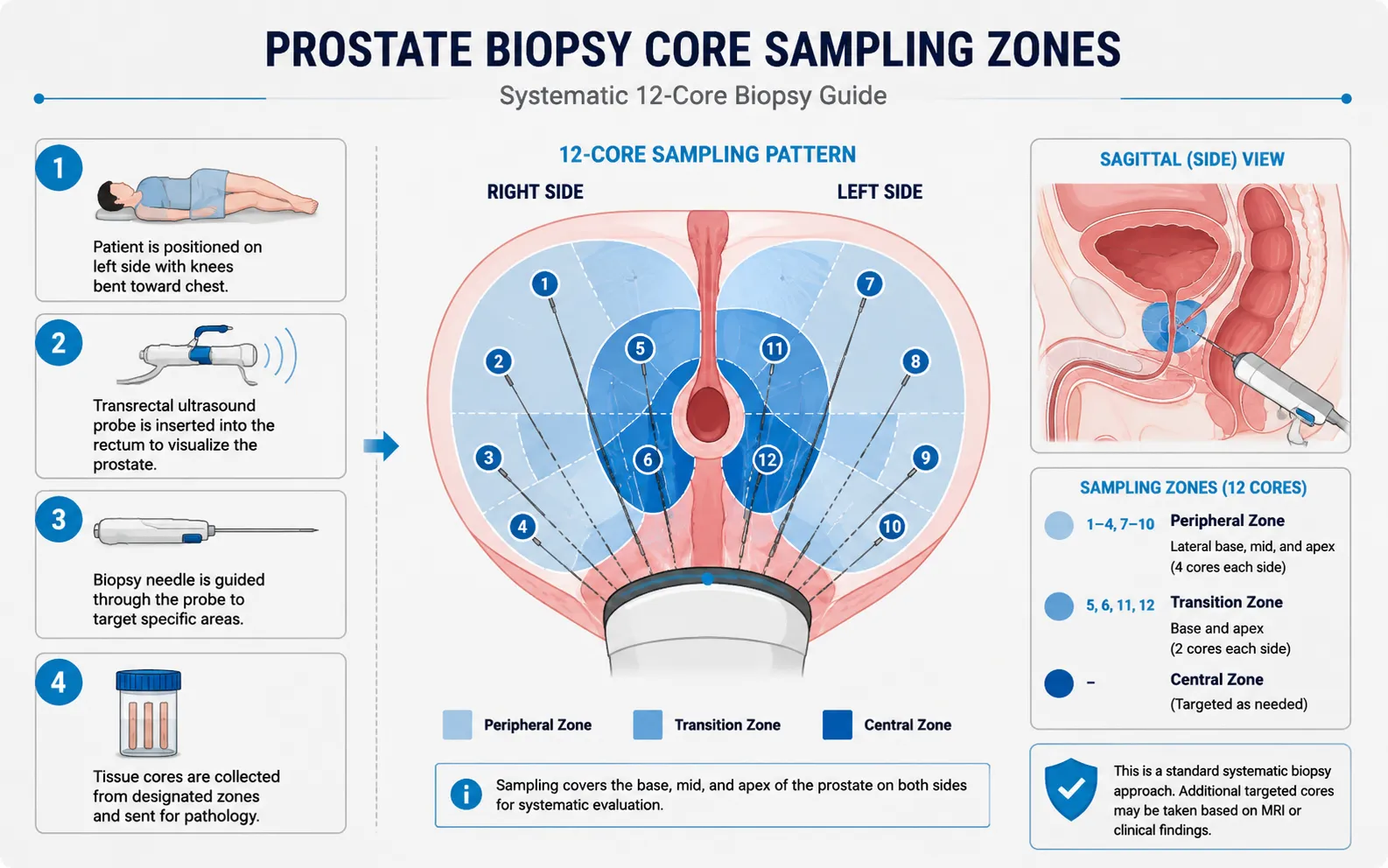
A spring-loaded biopsy needle is used to rapidly extract thin cores of prostate tissue. Typically, 10 to 14 or more cores are taken from systematically mapped areas of the prostate — including the apex, mid-gland, and base on both sides. If MRI has identified a specific suspicious lesion, targeted cores from that region are also obtained. Each needle pass takes a fraction of a second and produces a brief clicking sound.

How tissue cores are systematically sampled from the prostate gland during a biopsy.
In centres with advanced imaging capability, MRI-TRUS fusion biopsy overlays pre-procedure MRI images onto the live ultrasound feed, enabling the urologist to target suspicious lesions with greater accuracy than systematic sampling alone. Research published on PubMed has demonstrated that MRI-targeted biopsy detects clinically significant prostate cancer more reliably than standard TRUS-guided biopsy in men with elevated PSA.
The tissue cores are placed in labelled containers and sent to a pathology laboratory. Results typically return within 5 to 10 working days. Your urologist will discuss the findings with you and outline the next steps — whether that is active surveillance, further imaging, or treatment planning.
If cancer cells are found, the pathologist assigns a Gleason score — a grading system that reflects how aggressive the cancer appears under the microscope. Scores range from 6 (low-grade, slow-growing) to 10 (high-grade, aggressive). The Gleason score, combined with PSA level and clinical staging, guides treatment decisions.
A negative biopsy result does not always mean cancer is completely absent — some tumours may be missed due to sampling limitations. Your urologist will advise whether repeat testing or continued monitoring is appropriate based on your overall clinical picture. Consulting a urologist at Profrea ensures your results are interpreted in the full context of your health history.
Most men return to normal activities within a day or two. Here is what is commonly experienced in the days following the procedure:
Mild discomfort or soreness in the rectal or perineal area for 2–3 days.
Blood in the urine (haematuria) — usually light and resolving within a few days.
Blood in the stool — small amounts are normal after a transrectal biopsy and typically clear within 1–2 days.
Blood in the semen (haematospermia) — this is common and may persist for several weeks; it is not harmful.
Increased urinary frequency — mild irritation of the urethra can cause temporary urgency.
Drinking plenty of fluids helps flush the urinary tract and reduces discomfort. Completing the full course of prescribed antibiotics is essential to prevent infection.
Contact your urologist or go to an emergency department promptly if you experience any of the following:
Fever above 38°C (100.4°F) or chills — a potential sign of infection or sepsis.
Heavy or persistent bleeding from the rectum or in the urine.
Inability to urinate (urinary retention).
Severe pain not controlled by over-the-counter pain relief.
Signs of systemic infection: rapid heartbeat, confusion, or extreme fatigue.
Post-biopsy sepsis, while uncommon, is a serious complication — particularly with the transrectal approach. The transperineal technique has a significantly lower infection risk and is increasingly recommended in current urological practice. If you have concerns after your procedure, the team at Profrea's urology clinic is available for prompt follow-up consultations, including via video.
Like any invasive procedure, a prostate biopsy carries a small set of risks that patients should discuss with their urologist before consenting:
Infection: The most serious risk, particularly with the transrectal route. Antibiotic prophylaxis substantially reduces this risk.
Bleeding: Minor bleeding is expected; significant haemorrhage is rare.
Urinary retention: Temporary difficulty urinating due to prostate swelling; more common in men with pre-existing BPH.
Anxiety and psychological impact: Waiting for results can be stressful. Profrea's integrated psychology and counselling services are available to support patients through the diagnostic process.
Sampling error: A small tumour may be missed if it is not in the path of any biopsy needle — a limitation that MRI-fusion techniques help address.
The prostate biopsy remains the gold standard for confirming prostate cancer, but it is rarely the first test ordered. Here is how it fits into the broader diagnostic pathway:
PSA blood test: A simple, non-invasive screening tool. Elevated results prompt further evaluation but cannot diagnose cancer on their own.
Digital Rectal Examination (DRE): A quick physical assessment that can detect palpable abnormalities in the prostate.
Multiparametric MRI (mpMRI): Increasingly used before biopsy to identify suspicious lesions and reduce unnecessary sampling. A normal mpMRI in a low-risk patient may allow deferral of biopsy.
Liquid biopsy / biomarker tests: Emerging blood and urine tests (such as the Prostate Health Index or 4Kscore) help refine the decision to biopsy, reducing procedures in men unlikely to have clinically significant cancer.
Your urologist will weigh your PSA level, DRE findings, MRI results, age, family history, and personal preferences before recommending a biopsy. Profrea's urology specialists in Gurugram follow evidence-based protocols to ensure the biopsy is performed only when clinically justified.
Most men experience mild to moderate discomfort rather than severe pain. Local anaesthesia is administered before the needle passes, and the actual biopsy takes only a fraction of a second per core. Some men describe a brief pressure or stinging sensation. Post-procedure soreness is usually manageable with standard pain relief and resolves within a few days.
The procedure itself typically takes between 10 and 30 minutes. Including preparation and recovery observation, most patients are at the clinic for 1–2 hours in total. It is performed on an outpatient basis, so no overnight hospital stay is required in the vast majority of cases.
Standard systematic biopsies typically involve 10 to 14 core samples taken from mapped zones across both lobes of the prostate. If MRI has identified a specific suspicious area, additional targeted cores from that lesion are also collected, potentially increasing the total number of samples.
Pathology results are generally available within 5 to 10 working days. Your urologist will schedule a follow-up appointment to discuss the findings, explain what they mean, and outline the recommended next steps — whether that is reassurance, active surveillance, or treatment planning.
If the procedure is performed under local anaesthesia only, many men are able to drive themselves home. However, if sedation or general anaesthesia is used — as is sometimes the case with the transperineal approach — you will need someone to drive you. Your urologist will advise you on this during the pre-procedure consultation.
In a transrectal biopsy, the needle passes through the rectal wall to reach the prostate — the traditional and most widely performed approach. In a transperineal biopsy, the needle enters through the skin of the perineum, avoiding the rectum entirely. The transperineal route carries a substantially lower risk of post-biopsy infection and is increasingly preferred in contemporary urological practice.
No — haematospermia (blood in the semen) is a very common and expected side effect of prostate biopsy. It occurs because small blood vessels in the prostate are disrupted during sampling. It is harmless and typically resolves on its own within a few weeks, though in some men it may persist for up to 6–8 weeks.
If you have been told your PSA is elevated, noticed changes in urinary function, or simply want to discuss your prostate health proactively, the right first step is a conversation with a qualified urologist. Profrea's multi-specialty clinics across Gurugram offer both in-clinic and video consultations — making it straightforward to get expert guidance without delay. Early evaluation, when needed, leads to better outcomes.
You can also explore Profrea's comprehensive health screening packages that include PSA testing as part of a broader men's health assessment — a practical way to stay ahead of conditions that are far more treatable when caught early.
Profrea's urology team in Gurugram is here to help you understand your options and make informed decisions about your care.