

A practical, clinician-informed guide for anyone exploring IPL skin rejuvenation in Gurugram — covering real costs, session timelines, skin-type safety, and recovery.
By the Profrea Editorial Team · Published July 2026
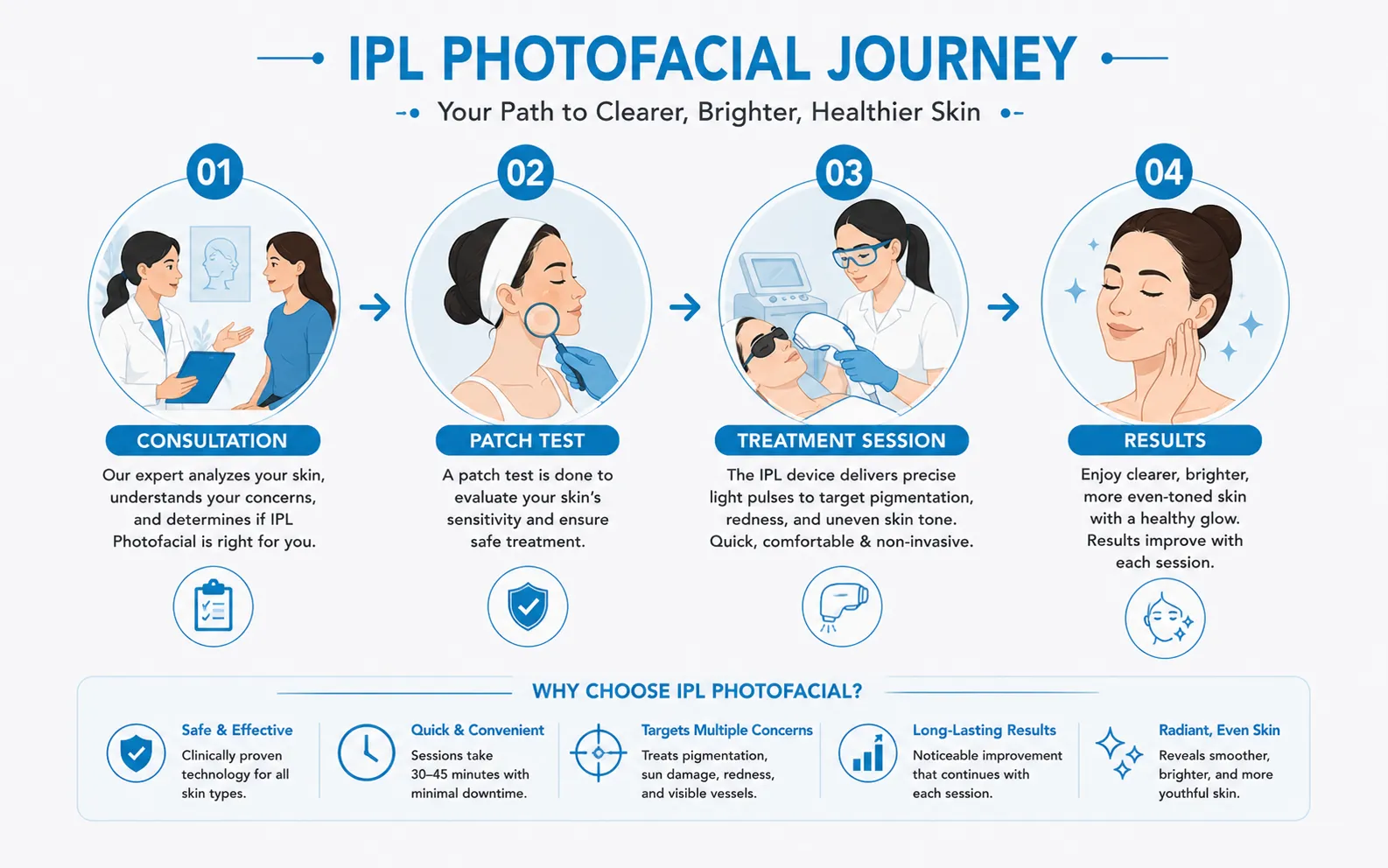
A photofacial — most commonly delivered using Intense Pulsed Light (IPL) technology — is a non-invasive skin treatment that uses broad-spectrum light pulses to target pigmentation, redness, sun damage, and uneven skin tone. Unlike a laser, which emits a single wavelength, IPL releases multiple wavelengths simultaneously, allowing it to address several concerns in a single session.
The light energy is absorbed by melanin (responsible for dark spots) and oxyhaemoglobin (responsible for redness and visible vessels), heating and breaking down these targets without damaging the surrounding skin. The result is a progressively clearer, more even complexion over a series of sessions.
In Gurgaon's urban environment — where prolonged sun exposure, pollution, and stress accelerate skin ageing — IPL photofacial has become one of the most requested aesthetic procedures. According to the National Institutes of Health (NIH), IPL is well-established for treating photoageing, pigmented lesions, and vascular irregularities with a strong safety profile when performed by trained practitioners.
IPL photofacial is a versatile treatment that addresses a wide spectrum of skin concerns. Here is what it is clinically used for:
Sun damage & age spots: Hyperpigmentation caused by UV exposure is one of the most common reasons people seek IPL in Gurugram.
Rosacea & facial redness: IPL targets dilated blood vessels that cause persistent flushing and redness.
Freckles & melasma: Superficial pigment irregularities respond well to IPL, though melasma requires careful parameter selection.
Fine lines & skin texture: The heat stimulus triggers collagen remodelling, gradually improving skin firmness and smoothness.
Enlarged pores: Collagen stimulation around pores can reduce their visible size over multiple sessions.
Acne & post-acne marks: Certain IPL protocols target the bacteria that cause acne (P. acnes) and reduce post-inflammatory redness.
Uneven skin tone: Overall dullness and patchy tone caused by pollution and lifestyle factors common in urban Gurgaon.
At Profrea's clinics across Gurugram, a qualified plastic surgeon or aesthetic physician assesses your skin type and concern before recommending an IPL protocol. Dr. Shikha Bansal, MCh Plastic Surgeon with 9+ years of experience, is among the specialists who guide aesthetic treatment planning at Profrea.
Photofacial pricing in Gurgaon varies based on the area treated, the number of sessions, the technology used, and the clinic's expertise. Below is a realistic cost range you can expect across reputable clinics in Gurugram:
| Treatment Option | Approximate Cost (per session) |
|---|---|
| IPL Photofacial – Face only | ₹3,000 – ₹8,000 |
| IPL Photofacial – Face & Neck | ₹5,000 – ₹12,000 |
| Full Face + Décolletage | ₹7,000 – ₹15,000 |
| Package of 3–5 sessions (face) | ₹12,000 – ₹35,000 |
Factors that influence the final price:
Clinic credentials: A clinic with board-certified plastic surgeons or dermatologists typically charges more — and for good reason.
Technology generation: Newer IPL platforms with skin-cooling systems and precise cut-off filters cost more to operate but deliver safer, more comfortable results.
Treatment area size: Larger areas (neck, chest, hands) add to the session cost.
Number of sessions: Package deals often reduce the per-session cost by 15–25%.
Pre- and post-care products: Some clinics include medical-grade sunscreen and soothing serums; others charge separately.
Always request a detailed breakdown before committing. A reputable clinic will offer a skin consultation — often at low or no cost — before recommending a session count and pricing plan.
Most patients begin to notice improvement after their first or second session, but a full course typically involves 3 to 6 sessions spaced 3–4 weeks apart. Here is what the typical treatment journey looks like:
Session 1: Skin feels smoother; some pigmented spots may temporarily darken before flaking off (a normal response).
Sessions 2–3: Visible reduction in redness, spots, and uneven tone; collagen remodelling begins.
Sessions 4–6: Cumulative improvement in texture, firmness, and overall luminosity.
Maintenance: One session every 6–12 months is typically recommended to sustain results, especially in sun-exposed environments like Gurgaon.
The exact number of sessions depends on the severity of your concern, your skin type, and how consistently you follow post-treatment sun protection advice. Your treating physician at Profrea will map out a personalised plan after a thorough skin assessment.
This is one of the most important questions for patients in India, where Fitzpatrick skin types IV–VI are common. Traditional IPL carries a higher risk of post-inflammatory hyperpigmentation (PIH) and burns on darker skin tones if not performed with appropriate settings.
However, advances in IPL technology — including longer wavelength cut-off filters, lower fluence settings, and integrated skin-cooling systems — have made IPL significantly safer for Indian skin when administered by an experienced practitioner. The American Academy of Dermatology (AAD) notes that patient selection and operator expertise are the most critical safety variables in IPL outcomes.
Key safety considerations for darker skin tones:
Always undergo a patch test before a full session.
Avoid IPL if you have an active tan — wait at least 4 weeks after significant sun exposure.
Inform your practitioner about any recent use of retinoids, AHAs, or photosensitising medications.
Choose a clinic where the physician — not just a technician — calibrates the device settings for your Fitzpatrick type.
At Profrea, aesthetic consultations involve a detailed skin-type assessment. For patients with Fitzpatrick IV–V skin, the team evaluates whether IPL, a gentler alternative (such as a chemical peel or laser toning), or a combination approach is most appropriate. You can also speak with Dr. Soma Kumari or other Profrea specialists for a holistic skin health review.
One of the biggest advantages of IPL photofacial is its minimal downtime — it is often called a "lunchtime procedure" because most patients return to work the same day. Here is a realistic timeline of what to expect:
Immediately after: Mild redness and warmth, similar to a light sunburn. This typically subsides within 1–4 hours.
Days 1–3: Pigmented spots may appear darker (a process called "peppering") — this is normal and indicates the treatment is working.
Days 3–7: Darkened spots begin to flake off naturally. Do not pick or scrub the skin.
Week 2 onwards: Skin looks clearer and more even as the treated pigment exits the skin surface.
Post-treatment care tips:
Apply a broad-spectrum SPF 50+ sunscreen every morning — non-negotiable in Gurgaon's sunny climate.
Avoid direct sun exposure for at least 2 weeks post-treatment.
Skip active skincare ingredients (retinoids, AHAs, BHAs) for 5–7 days.
Use a gentle, fragrance-free moisturiser to support the skin barrier.
Avoid saunas, steam rooms, and intense exercise for 48 hours.
Gurgaon's aesthetic clinics offer a wide menu of skin rejuvenation options. Here is how IPL photofacial stacks up against common alternatives:
| Treatment | Best For | Downtime | Sessions Needed |
|---|---|---|---|
| IPL Photofacial | Pigmentation, redness, sun damage | Minimal (1–3 days) | 3–6 |
| Chemical Peel | Texture, acne marks, mild pigmentation | 3–7 days (peeling) | 4–6 |
| Laser Toning (Q-Switch) | Melasma, deeper pigmentation | Minimal | 6–10 |
| Microneedling / RF | Skin laxity, scars, pores | 2–5 days | 3–4 |
IPL is often the preferred starting point for patients with multiple surface-level concerns because it addresses pigmentation, redness, and texture simultaneously. A combination approach — for example, IPL followed by a collagen-stimulating treatment — may be recommended for more advanced photoageing.
Gurugram's fast-paced corporate lifestyle, high pollution index, and year-round UV exposure create a perfect storm for accelerated skin ageing. Many residents in sectors like Sector 45, South City-I, and Sector 52 — where Profrea clinics are located — are increasingly turning to evidence-based aesthetic treatments that fit into a busy schedule.
IPL photofacial fits this profile well: sessions typically last 20–45 minutes, require no anaesthesia, and allow an immediate return to daily activities. The cumulative results — clearer, more youthful-looking skin — build over weeks, making it a practical investment rather than a dramatic intervention.
Profrea's multi-specialty model also means that if your skin concerns have an underlying cause — hormonal imbalance, nutritional deficiency, or chronic stress — specialists such as Dr. Ladli Chatterjee (General Physician & Diabetologist) or Dr. Sarika Thakral (Clinical Psychologist) can address those root factors alongside your aesthetic treatment plan.
Not all photofacial treatments are equal. Here are the questions to ask before booking:
Who performs the treatment? A qualified plastic surgeon, dermatologist, or trained aesthetic physician should calibrate the device and supervise the session.
What IPL platform is used? Ask about the device brand, wavelength range, and whether it has a skin-cooling mechanism.
Is a patch test offered? Any reputable clinic will conduct a patch test, especially for darker skin tones.
Is a pre-treatment consultation included? A thorough skin assessment should precede any treatment recommendation.
What aftercare support is provided? Post-treatment guidance and follow-up access to the treating physician matter for safety and results.
Profrea's network of 7 clinics across Gurugram offers both in-clinic and video consultations, making it easy to get a professional skin assessment before committing to a treatment plan. The team includes specialists such as Dr. Shikha Bansal, MCh Plastic Surgeon, who brings surgical precision to aesthetic treatment planning.
A single IPL photofacial session for the face typically costs between ₹3,000 and ₹8,000 in Gurgaon, depending on the clinic's expertise, technology used, and treatment area. Package deals for 3–5 sessions usually offer a 15–25% saving over individual session pricing.
IPL photofacial is clinically used to treat sun damage, age spots, freckles, rosacea, facial redness, fine lines, enlarged pores, acne-related redness, and overall uneven skin tone. It works by targeting melanin and oxyhaemoglobin in the skin using broad-spectrum light pulses.
Most patients see noticeable improvement after 2–3 sessions, with a full course of 3–6 sessions (spaced 3–4 weeks apart) recommended for optimal results. Maintenance sessions every 6–12 months help sustain the outcome, particularly in sun-exposed environments like Gurugram.
IPL can be safely performed on darker Indian skin tones (Fitzpatrick IV–V) when the practitioner uses appropriate wavelength filters, lower fluence settings, and skin-cooling technology. A patch test is essential. Always choose a clinic where a qualified physician — not just a technician — manages the device settings for your specific skin type.
Downtime is minimal. Most patients experience mild redness and warmth for a few hours after the session. Pigmented spots may temporarily darken over days 1–3 before naturally flaking off by day 7. Strict sun protection (SPF 50+) is essential for at least two weeks post-treatment.
Yes — IPL is frequently combined with collagen-stimulating treatments such as microneedling or radiofrequency for more comprehensive rejuvenation. Your treating physician will advise on the appropriate sequencing and interval between treatments to ensure safety and maximise results.
Book a skin consultation at any of Profrea's 7 Gurugram clinics — in-person or via video — and get a personalised assessment from a qualified aesthetic physician.