

A clinically grounded guide to understanding polycystic ovary syndrome — from first symptoms to personalised treatment — written for women in Gurugram navigating this common but complex condition.
By the Profrea Clinical Editorial Team · Published July 2026
Polycystic ovary syndrome (PCOS) — also referred to as polycystic ovarian disease (PCOD) — is one of the most prevalent hormonal disorders among women of reproductive age in India. According to the World Health Organization, PCOS affects an estimated 8–13% of women of reproductive age globally, with a significant proportion remaining undiagnosed. In urban centres like Gurgaon, sedentary lifestyles, high-stress work environments, and dietary shifts have contributed to rising prevalence among women in their 20s and 30s.
Despite being so common, PCOS is frequently misunderstood, misdiagnosed, or managed only superficially. This article aims to give you a clear, evidence-informed picture of what PCOS is, how it is diagnosed, and what a structured treatment pathway at a dedicated women's health clinic in Gurgaon actually looks like.
The terms PCOS and PCOD are often used interchangeably in India, but there is a clinical distinction worth understanding.
PCOD (Polycystic Ovarian Disease) refers to a condition in which the ovaries release immature or partially mature eggs, which accumulate and form cysts. It is considered a more common and relatively milder ovarian dysfunction that can often be managed with lifestyle changes.
PCOS (Polycystic Ovary Syndrome) is a broader endocrine disorder involving hormonal imbalance — particularly elevated androgens (male hormones) — along with metabolic dysfunction. It carries a higher risk of long-term complications including insulin resistance, type 2 diabetes, cardiovascular disease, and infertility if left unaddressed.
In clinical practice, a gynaecologist will assess which presentation applies to you and tailor the treatment plan accordingly. If you have been told you have "PCOD" but continue to experience irregular periods, weight gain, and difficulty conceiving, a formal PCOS evaluation is warranted.
PCOS presents differently in different women, which is one reason it is so often missed or delayed in diagnosis. Common symptoms include:
Irregular or absent menstrual cycles — fewer than 8 periods per year, or cycles longer than 35 days
Excess androgen effects — unwanted facial or body hair (hirsutism), acne, or male-pattern hair thinning
Polycystic ovaries on ultrasound — ovaries that appear enlarged with multiple small follicles
Weight gain or difficulty losing weight — particularly around the abdomen
Skin changes — darkening of skin in skin folds (acanthosis nigricans), a sign of insulin resistance
Mood disturbances — anxiety, depression, and low energy are frequently reported alongside hormonal fluctuations
Difficulty conceiving — anovulation (lack of ovulation) is a primary driver of PCOS-related infertility
It is important to note that you do not need to have all of these symptoms to receive a PCOS diagnosis. The internationally accepted Rotterdam Criteria require just two of three features: irregular ovulation, elevated androgens (clinical or biochemical), and polycystic ovaries on scan.
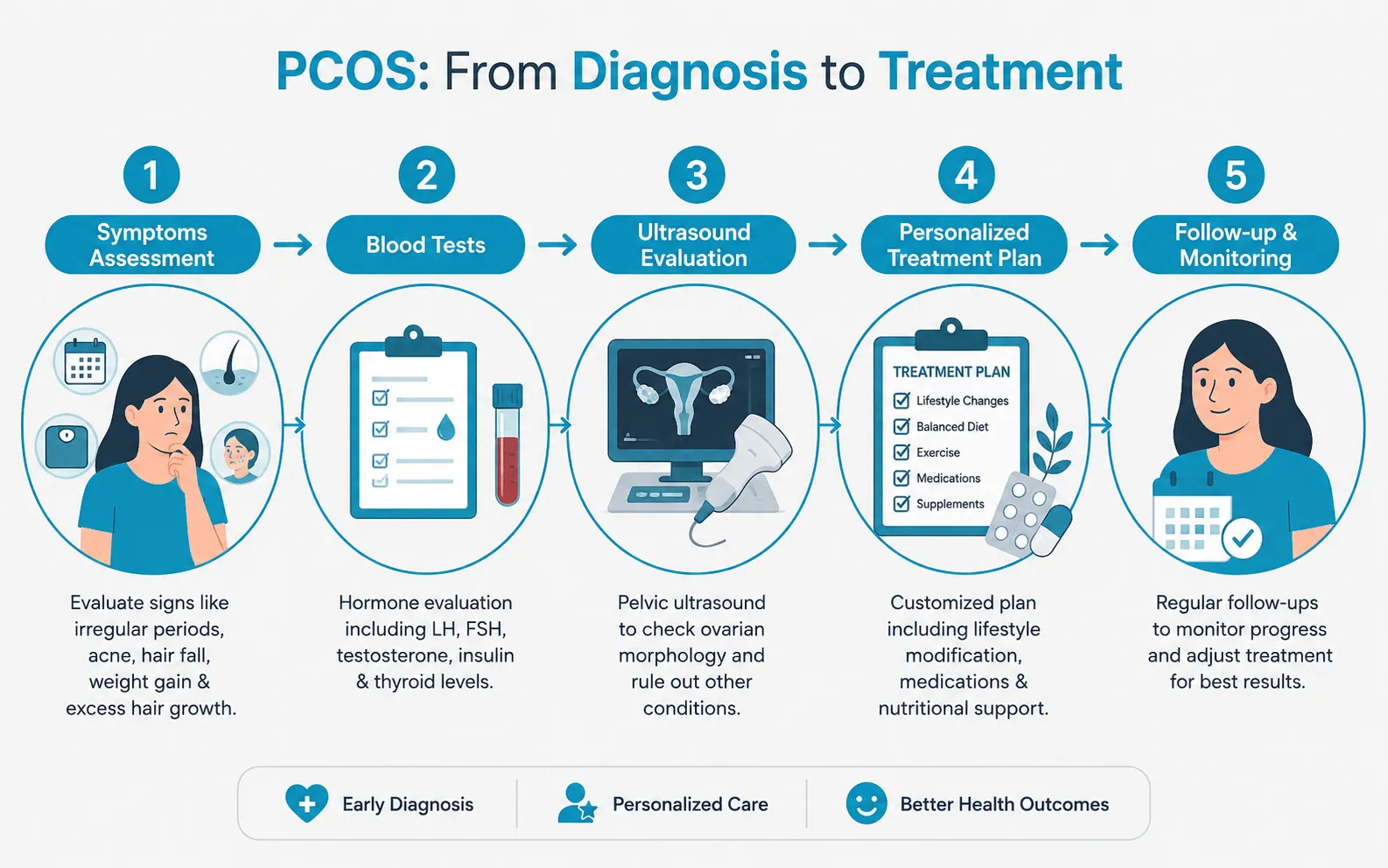
A thorough PCOS workup at a women's health clinic typically involves a combination of clinical assessment, blood tests, and imaging. Here is what to expect:
Your gynaecologist will ask about the regularity of your periods, any recent weight changes, family history of diabetes or hormonal disorders, and symptoms such as hair growth patterns or acne. This history guides which investigations are prioritised.
Key blood tests include: LH (luteinising hormone) and FSH (follicle-stimulating hormone) ratio, total and free testosterone, DHEA-S, prolactin, thyroid function tests (TSH, T3, T4), fasting insulin, and fasting blood glucose. An elevated LH:FSH ratio and raised androgens are classic PCOS markers, though not universally present.
A transvaginal or transabdominal ultrasound assesses ovarian morphology. The presence of 12 or more follicles measuring 2–9 mm in diameter in one or both ovaries, or an ovarian volume greater than 10 mL, supports a PCOS diagnosis.
Because PCOS significantly raises the risk of insulin resistance and metabolic syndrome, your doctor may also request a lipid profile, HbA1c, and an oral glucose tolerance test (OGTT). This is particularly relevant for women in Gurgaon who may have sedentary desk jobs or a family history of type 2 diabetes — a concern that Dr. Ladli Chatterjee, Profrea's General Physician and Diabetologist, frequently addresses in co-managed PCOS care plans.

A step-by-step overview of the PCOS diagnosis and treatment pathway
There is no single cure for PCOS, but it is very effectively managed. The goal of treatment is to address your specific symptoms, reduce long-term metabolic risk, and — where relevant — support fertility. A well-designed care plan at a women's health clinic in Gurgaon will typically combine the following approaches:
Research consistently shows that even a 5–10% reduction in body weight in women with PCOS can restore ovulation, improve menstrual regularity, and reduce androgen levels. A structured nutrition plan — ideally designed by a registered dietitian — combined with 150 minutes of moderate aerobic exercise per week forms the backbone of PCOS management. Profrea's integrated model means your gynaecologist can coordinate directly with the clinic's nutrition and dietetics team for a cohesive plan.
For women not currently trying to conceive, combined oral contraceptive pills (OCPs) are commonly prescribed to regulate periods, reduce androgen levels, and manage acne and hirsutism. Anti-androgen medications such as spironolactone may be added for persistent hair and skin symptoms. These are prescribed and monitored by your gynaecologist based on your individual hormonal profile.
Metformin — a medication widely used in diabetes management — is frequently prescribed in PCOS to improve insulin sensitivity, lower androgen levels, and support ovulation. Its use is especially relevant for women with confirmed insulin resistance or a strong family history of diabetes. This is an area where Profrea's gynaecology and diabetology teams work in close coordination.
For women with PCOS who are trying to conceive, ovulation induction with medications such as letrozole or clomiphene citrate is typically the first step. If these do not achieve pregnancy, the pathway may progress to injectable gonadotropins with monitored cycles, intrauterine insemination (IUI), or in vitro fertilisation (IVF). Dr. Soma Kumari, Profrea's Obstetrician, Gynaecologist and Infertility Specialist, holds a Fellowship in Assisted Reproductive Technology (ART) from RISSA IVF Center, Delhi, and has 7+ years of experience managing PCOS-related infertility. She has previously worked at Paras Hospital and Rainbow Hospital, Gurgaon.
In cases where medication-based ovulation induction fails, laparoscopic ovarian drilling is a minimally invasive surgical option that can restore ovulation in a significant proportion of women with PCOS. The procedure involves making small punctures in the ovary using a laser or electrosurgical needle to reduce androgen-producing tissue. Profrea's surgical gynaecology team is experienced in minimally invasive procedures, and Dr. Simantini Sircar is available for consultation on surgical management options.
Living with PCOS — particularly when it affects fertility, body image, or weight — can take a significant toll on mental health. Anxiety and depression are disproportionately common in women with PCOS. Profrea's integrated model includes access to clinical psychology services. Dr. Sarika Thakral, Consultant Clinical Psychologist with 15+ years of experience and certifications in NLP and EFT/TFT, is available for counselling support as part of a holistic PCOS care plan.
PCOS is one of the leading causes of anovulatory infertility — meaning infertility caused by the absence of ovulation. However, it is important to understand that PCOS does not mean you cannot conceive. The majority of women with PCOS who receive appropriate treatment do achieve pregnancy, either naturally or with medical assistance.
During pregnancy, women with PCOS carry a higher risk of gestational diabetes, pregnancy-induced hypertension, and preterm birth. This is why pre-conception counselling and close antenatal monitoring are strongly recommended. A gynaecologist with a sub-specialty in infertility and ART — such as Dr. Soma Kumari at Profrea — will guide you through both the conception journey and early pregnancy care with appropriate risk stratification.
If you have been trying to conceive for more than 12 months (or 6 months if you are over 35) without success, and you have known or suspected PCOS, a formal fertility evaluation is the recommended next step. Early intervention significantly improves outcomes.
This is one of the most frequently asked questions — and the honest answer is: PCOS cannot be permanently cured in the traditional sense, because it is a chronic hormonal condition with a genetic component. However, it can be very effectively controlled, and many women achieve complete resolution of symptoms with the right combination of lifestyle changes and medical management.
Some women find that their PCOS symptoms improve significantly after pregnancy or as they approach perimenopause, though the underlying metabolic risk (particularly for type 2 diabetes and cardiovascular disease) persists and requires long-term monitoring. The key is not to wait for a cure, but to manage the condition proactively with a specialist who understands its full complexity.
A 2019 review published on PubMed Central confirmed that lifestyle intervention remains the most effective long-term strategy for managing PCOS, with sustained weight loss producing measurable improvements in menstrual regularity, hormonal profiles, and metabolic markers.
Navigating PCOS care in a busy city like Gurgaon can feel overwhelming, particularly when different specialists give conflicting advice. A structured, multi-disciplinary women's health clinic simplifies this by bringing gynaecology, nutrition, endocrinology support, and mental health under one roof.
At Profrea, which operates across 7 clinic locations in Gurugram, the PCOS care pathway is designed to be comprehensive from the first consultation. Your initial appointment with a gynaecologist will typically last 30–45 minutes and cover your full medical history, symptom timeline, and goals — whether that is regulating your cycle, managing weight, improving skin and hair, or planning a pregnancy.
Follow-up appointments are structured around your treatment milestones, with blood test reviews, ultrasound monitoring (if on ovulation induction), and nutrition check-ins coordinated through Profrea's clinic network or via video consultation for convenience. The clinic's dietetics team and clinical psychology services are available as part of an integrated care plan, ensuring that the hormonal, metabolic, and emotional dimensions of PCOS are all addressed.
Profrea also offers a Profrea Health Screen package, which can serve as a useful starting point for women who want a comprehensive baseline assessment before beginning PCOS-specific investigations.
PCOD refers to a condition where the ovaries produce immature eggs that form cysts, often manageable with lifestyle changes. PCOS is a broader endocrine syndrome involving hormonal imbalance, elevated androgens, and metabolic dysfunction, with a higher risk of long-term complications. Both require gynaecological evaluation, but PCOS typically warrants more comprehensive management.
Dr. Soma Kumari at Profrea is an Obstetrician, Gynaecologist, and Infertility Specialist with 7+ years of experience and a Fellowship in ART. She manages PCOS comprehensively — from hormonal regulation to fertility treatment. Dr. Simantini Sircar is also available for consultations, including surgical management options such as laparoscopic ovarian drilling.
PCOS is a chronic condition without a permanent cure, but it is highly manageable. With the right combination of lifestyle changes, medication, and specialist monitoring, most women achieve significant symptom relief and can lead full, healthy lives — including successful pregnancies. Long-term metabolic monitoring remains important even when symptoms are well controlled.
PCOS is a leading cause of anovulatory infertility, but most women with PCOS can conceive with appropriate treatment — ranging from ovulation induction medications to IVF. During pregnancy, PCOS increases the risk of gestational diabetes and hypertension, making pre-conception counselling and close antenatal monitoring essential.
A standard PCOS diagnostic workup includes a hormonal blood panel (LH, FSH, testosterone, prolactin, thyroid function), fasting insulin and glucose, a lipid profile, and a pelvic ultrasound to assess ovarian morphology. Your gynaecologist will interpret these results in the context of your symptoms and menstrual history to confirm the diagnosis using the Rotterdam Criteria.
Whether you are newly diagnosed, struggling with symptoms, or planning a pregnancy, Profrea's gynaecology team is here to build a care plan that works for you.