

A clinician-backed comparison of two of the most searched aesthetic treatments — so you can choose the right path for your skin goals.
By the Profrea Clinical Team · Published July 2026
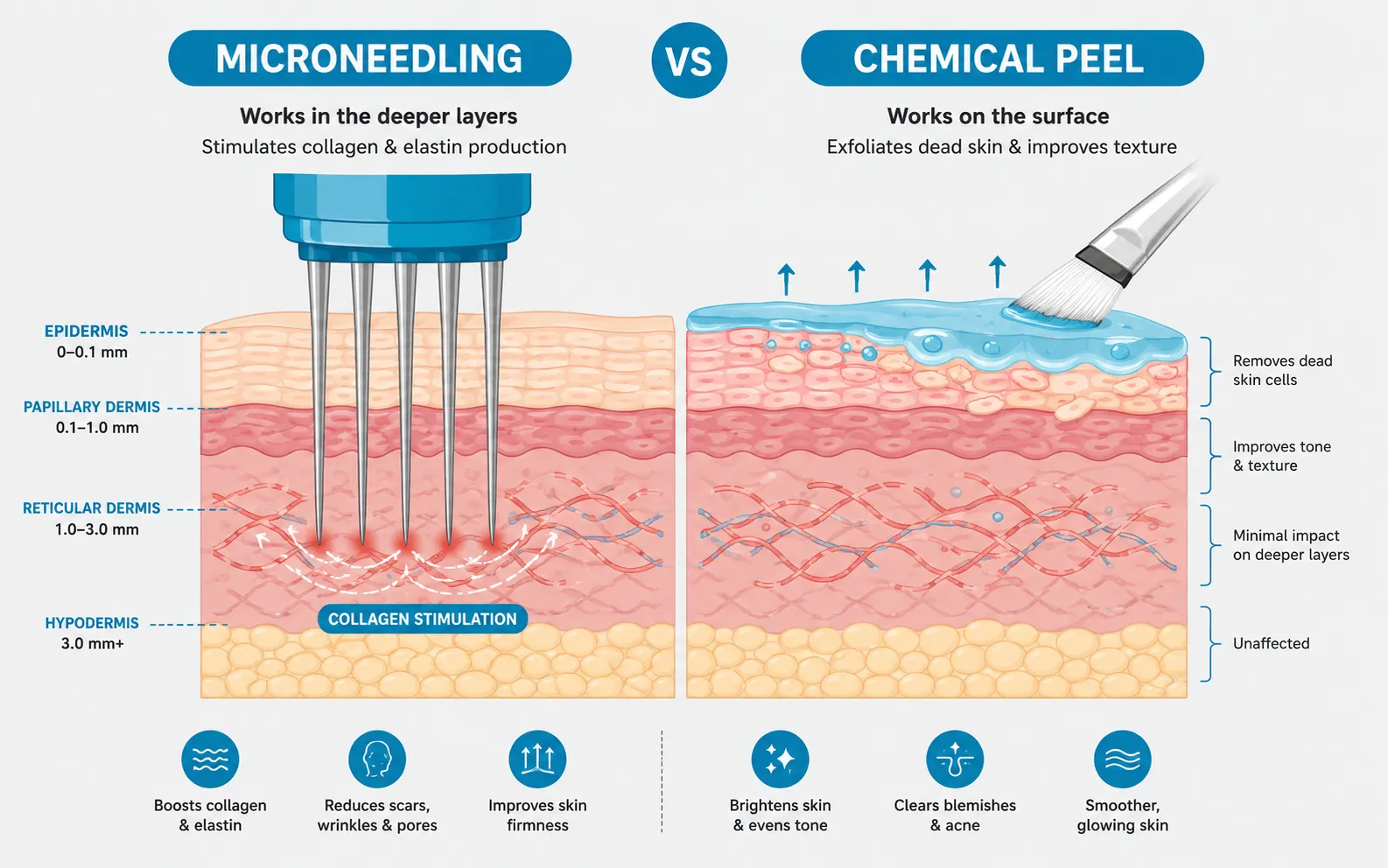
If you have typed “microneedling before and after” or “chemical peel before and after” into a search engine recently, you are not alone. These two treatments consistently rank among the most researched aesthetic procedures in India, and for good reason — both can produce visible, photograph-worthy improvements in skin texture, tone, and clarity. But they work through entirely different mechanisms, suit different skin concerns, and carry different recovery timelines.
At Profrea, our multi-specialty clinic network across Gurugram offers both treatments under physician-supervised care plans. This article draws on clinical evidence and the real-world experience of our aesthetic medicine team to help you understand what each procedure actually delivers — and which one (or combination) may be right for you.
According to a peer-reviewed study published on PubMed (National Library of Medicine), microneedling induces controlled dermal injury that stimulates collagen and elastin synthesis — a process that continues for weeks after each session. Chemical peels, by contrast, work by chemically exfoliating the outermost layers of skin to accelerate cellular turnover and reduce surface-level pigmentation.
Microneedling (also called collagen induction therapy) uses a device fitted with fine, sterile needles to create thousands of micro-channels in the skin. This controlled injury triggers the body’s natural wound-healing cascade — flooding the treated area with growth factors, collagen, and elastin.
Acne scars and post-inflammatory hyperpigmentation
Fine lines and early wrinkles
Enlarged pores and uneven skin texture
Stretch marks
Dull, lacklustre skin tone
Immediately after: Skin appears red and slightly swollen — similar to a mild sunburn. This typically resolves within 24–48 hours.
Days 3–7: Skin may feel tight or slightly dry as the healing process progresses. Most patients return to work within 1–2 days.
Weeks 2–4: Collagen remodelling begins. Patients often notice improved skin texture and a subtle glow.
After a full course (3–6 sessions, spaced 4 weeks apart): Significant reduction in acne scarring, visibly refined pores, and smoother overall skin surface. Results continue to improve for up to 6 months after the final session as collagen matures.
Most patients at Profrea’s Gurugram clinics require 3 to 6 sessions to achieve their target outcome, depending on the severity of the concern being treated. Patients with deeper atrophic acne scars may benefit from additional sessions.
A chemical peel applies a precisely formulated acid solution — such as glycolic acid, salicylic acid, lactic acid, or trichloroacetic acid (TCA) — to the skin surface. The solution loosens the bonds between dead skin cells, prompting controlled exfoliation and revealing fresher, more evenly pigmented skin beneath.
Peels are classified by depth: superficial (targets the epidermis only), medium (reaches the upper dermis), and deep (penetrates into the mid-dermis). The depth selected depends on your skin concern, skin type, and the clinician’s assessment.
Melasma and sun-induced pigmentation
Uneven skin tone and dullness
Superficial acne and comedones
Mild fine lines and surface texture irregularities
Post-inflammatory hyperpigmentation (PIH)
.webp)
Immediately after: Skin may appear red, tight, or slightly stinging. Superficial peels often have minimal visible reaction; medium peels may cause more pronounced redness.
Days 2–5: Peeling and flaking begin — this is the exfoliation phase. Avoid picking or peeling skin manually, as this can cause post-inflammatory marks.
Day 7 onwards: Fresh, smoother skin is revealed. Pigmentation appears lighter and skin tone more even.
After a course of peels (4–6 sessions for superficial peels): Cumulative brightening, significant reduction in pigmentation patches, and noticeably more uniform skin texture. Medium and deep peels may deliver comparable results in fewer sessions but require longer downtime.
It is important to note that chemical peels — particularly medium and deep formulations — carry a higher risk of post-inflammatory hyperpigmentation in darker Indian skin tones (Fitzpatrick types IV–VI). At Profrea, our clinicians carefully select peel formulations appropriate for each patient’s skin type to minimise this risk.
| Factor | Microneedling | Chemical Peel |
|---|---|---|
| Primary mechanism | Collagen induction via micro-injury | Chemical exfoliation and cell turnover |
| Best for | Acne scars, texture, pores, fine lines | Pigmentation, dullness, uneven tone |
| Downtime | 1–2 days (redness) | 3–7 days (peeling/flaking) |
| Sessions needed | 3–6 sessions | 4–6 sessions (superficial) |
| Suitable for darker skin tones | Generally yes | Depends on peel depth and formulation |
| Results visible | From session 2–3 onwards | After first peel (brightening); cumulative improvement |
| Pain level | Mild (topical anaesthetic applied) | Mild to moderate (tingling/stinging) |
| Can be combined? | Yes, with appropriate spacing | Yes, with appropriate spacing |
Yes — and for many patients, a combination protocol delivers superior before-and-after results compared to either treatment alone. The two modalities are complementary: chemical peels address surface pigmentation and tone, while microneedling works deeper in the dermis to rebuild structural collagen and smooth textural irregularities.
A common approach used in clinical practice is to alternate sessions — for example, a superficial peel one month, followed by a microneedling session the next — allowing the skin adequate recovery time between treatments. Some protocols also use a light peel as a preparatory step before microneedling to enhance product penetration through the micro-channels created.
However, combining treatments should always be done under physician guidance. Attempting both on the same day without clinical supervision can compromise the skin barrier and increase the risk of adverse reactions. At Profrea, our plastic surgeon Dr. Shikha Bansal (MCh, SMS Medical College, Jaipur; 9+ years of experience) and our aesthetic medicine team design personalised treatment plans that sequence procedures safely for each patient’s skin type and concern.
Skin texture concerns — including enlarged pores, rough patches, and acne scarring — are among the most common reasons patients seek microneedling in Gurugram. The treatment’s ability to stimulate new collagen without removing the outer skin layer makes it particularly well-suited for patients who cannot afford extended downtime.
In clinical practice, patients with rolling or boxcar acne scars typically see the most dramatic before-and-after transformations. After 4–6 sessions, the scar edges soften, the skin surface becomes more uniform, and the overall appearance of the complexion is noticeably improved. Patients with ice-pick scars (narrow, deep scars) may require additional modalities such as subcision or TCA cross in conjunction with microneedling for optimal results.
For patients concerned about pore size, microneedling helps by tightening the surrounding collagen matrix, which physically reduces the appearance of enlarged pores over successive sessions. Results are gradual but cumulative.
Our general medicine and diabetology team, led by Dr. Ladli Chatterjee (MD, Fellowship in Diabetes — Royal Liverpool Academy, UK), also notes that patients with diabetes-related skin changes benefit from a thorough medical review before undergoing any skin procedure, as healing capacity can be affected by blood glucose control.
Pigmentation concerns — including melasma, sun spots, and post-acne marks — respond particularly well to chemical peels when the correct formulation is matched to the patient’s skin type and the depth of pigmentation.
Superficial peels (glycolic acid 20–70%, lactic acid, mandelic acid) are the most commonly used for Indian skin tones. They are gentle enough for regular monthly use and produce a progressive brightening effect with minimal risk of post-inflammatory hyperpigmentation.
Medium-depth peels (TCA 15–35%) are reserved for more stubborn pigmentation and are typically performed less frequently, with a longer recovery period of 7–10 days. These produce more dramatic before-and-after results but require careful patient selection.
Patients with melasma should be aware that this condition has a hormonal component and may recur without ongoing sun protection and maintenance treatments. A chemical peel is not a permanent cure for melasma — it is one component of a broader management strategy that includes daily SPF 50+ sunscreen, topical agents, and lifestyle modifications.
For patients navigating hormonal skin changes, Profrea’s gynaecology team — including Dr. Soma Kumari (DNB Obstetrics & Gynaecology, Fellowship in ART) — can assess whether underlying hormonal factors are contributing to pigmentation patterns and coordinate care accordingly.
Profrea operates 7 clinic locations across Gurugram, offering both in-clinic and video consultations for aesthetic medicine. Our approach to skin rejuvenation is grounded in three principles:
Physician-led assessment: Every treatment plan begins with a clinical skin assessment by a qualified doctor — not a technician. This ensures the right treatment is selected for your specific skin type, concern, and medical history.
Personalised protocols: We do not offer one-size-fits-all packages. Peel depth, needle depth, and session frequency are individualised based on your skin’s response at each visit.
Integrated care: Where skin concerns have an underlying medical component — hormonal imbalance, diabetes, nutritional deficiency — our multi-specialty team coordinates care across departments. Patients can access Dr. Sarika Thakral (M.Phil Clinical Psychology, 15+ years experience) for stress-related skin concerns, or our nutrition team for diet-related skin health support.
Patients can book consultations through the Profrea mobile app, the corporate portal, or directly at any of our Gurugram clinic locations. Smart In-clinic Consultation slots (limited availability) are also offered for patients who prefer a structured, time-efficient appointment format.
For a comprehensive health baseline before starting any aesthetic treatment, consider exploring our Profrea Health Screen packages, which can identify underlying conditions that may affect treatment outcomes.
Neither is universally “better” — the right choice depends on your primary concern. Microneedling excels at improving skin texture, acne scars, and pore size by stimulating collagen production in the dermis. Chemical peels are more effective for surface pigmentation, dullness, and uneven tone. Many patients benefit most from a combination of both, sequenced appropriately by a clinician.
Most patients begin to notice visible improvement in skin texture and tone after their second or third session. A full course of 3–6 sessions, spaced approximately 4 weeks apart, is typically recommended for optimal before-and-after results. Collagen remodelling continues for up to 6 months after the final session.
Immediately after a superficial peel, skin may appear slightly pink or feel tight. Over the following 3–5 days, light flaking or peeling occurs as the outer skin layer sheds. After peeling is complete, skin typically looks brighter, smoother, and more even in tone. Medium-depth peels involve more pronounced peeling and redness lasting up to 7–10 days.
Yes, and for many patients this combination delivers superior results. The two treatments are typically alternated — one per month — rather than performed on the same day. Combining them on the same day without clinical supervision can compromise the skin barrier. Always follow your clinician’s recommended protocol.
Recovery from microneedling is generally brief. Most patients experience redness and mild swelling for 24–48 hours, similar to a sunburn. Skin may feel slightly dry or tight for a few days. The majority of patients return to work and normal activities within 1–2 days, making microneedling a popular choice for those with busy schedules.
Microneedling is generally considered safe across all skin tones, including darker Indian skin types (Fitzpatrick IV–VI). Chemical peels require more careful selection — superficial peels with appropriate formulations are generally safe, while medium and deep peels carry a higher risk of post-inflammatory hyperpigmentation in darker skin tones. A thorough pre-treatment skin assessment by a qualified clinician is essential.
Book a skin consultation at any of Profrea’s 7 Gurugram clinic locations and let our physicians design a personalised microneedling or chemical peel plan for your skin goals.