

A mental health assessment is often the first and most important step toward understanding your emotional and psychological well-being — and finding the right path forward.
By Profrea·Published July 2026
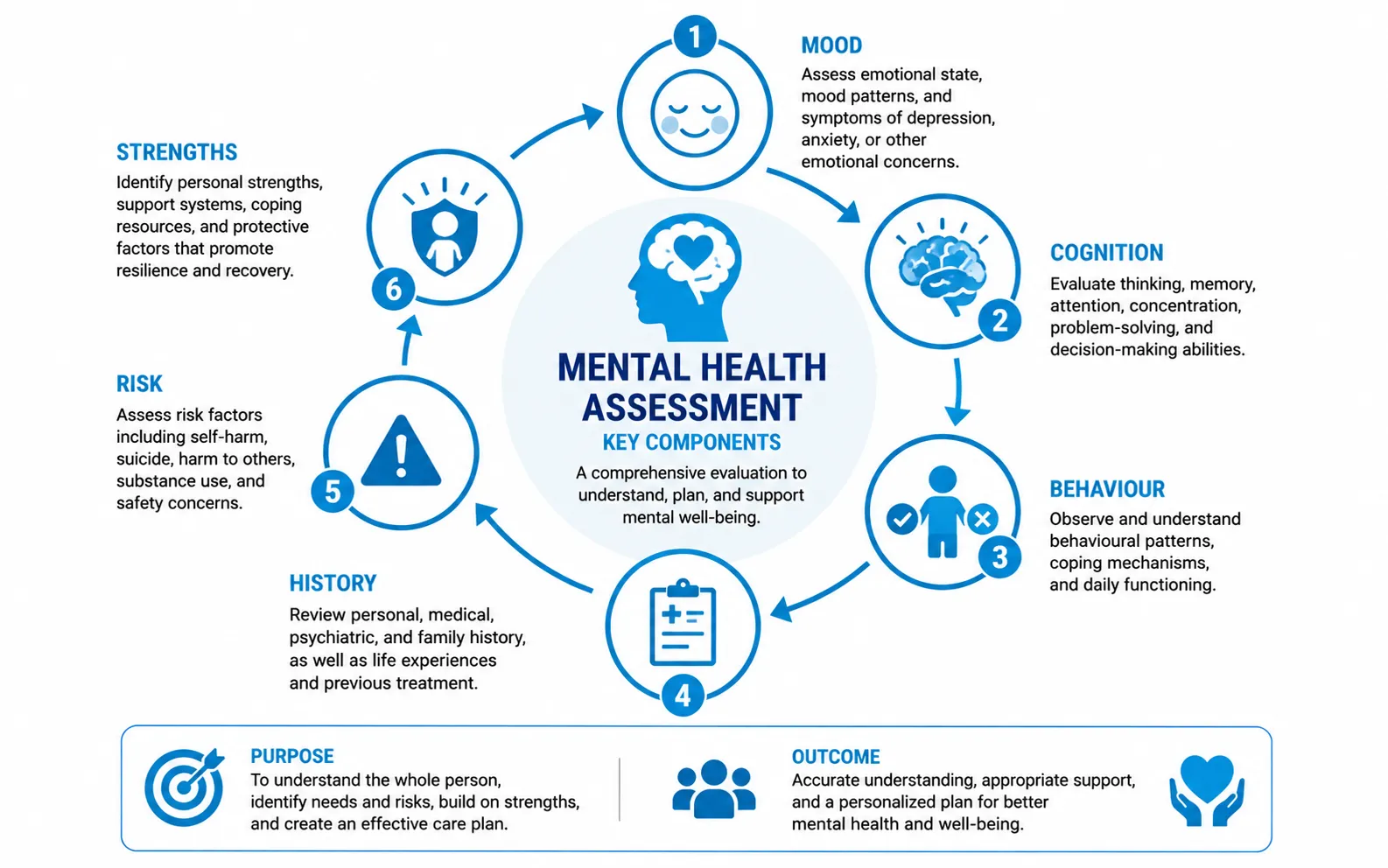
A mental health assessment — also called a psychological assessment or behavioral health evaluation — is a structured process in which a qualified clinician gathers detailed information about your emotional, cognitive, and behavioral functioning. Unlike a routine physical check-up, a mental health evaluation looks inward: it examines how you think, feel, and cope with the demands of everyday life.
According to the National Institute of Mental Health (NIMH), nearly one in five adults in the United States lives with a mental illness in any given year — and the pattern is broadly similar across South Asian populations. Yet a significant proportion of people never receive a formal evaluation, often because they are unsure what the process involves or whether their concerns are serious enough to warrant professional attention.
The short answer: if something feels persistently off — in your mood, your relationships, your sleep, or your ability to function — a mental health screening is worth pursuing. It is not a test you can pass or fail. It is a conversation designed to help a clinician understand you.
Mental health conditions — including depression, anxiety disorders, bipolar disorder, ADHD, PTSD, and psychotic disorders — rarely announce themselves with obvious, unmistakable symptoms. More often, they show up as persistent fatigue, irritability, difficulty concentrating, changes in appetite, or a vague sense that something is wrong. Without a formal evaluation, these signs are easy to dismiss or misattribute to stress or physical illness.
A comprehensive mental health screening serves several critical purposes:
Accurate diagnosis: It distinguishes between conditions that can look similar on the surface — for example, differentiating clinical depression from hypothyroidism-related low mood, or ADHD from anxiety-driven inattention.
Risk identification: It surfaces risk factors such as suicidal ideation, self-harm, substance use, or domestic stress that require immediate attention.
Treatment planning: It gives the clinician the information needed to recommend the right intervention — whether that is therapy, medication, lifestyle changes, or a combination.
Baseline measurement: It creates a documented starting point so that progress can be tracked over time.
The World Health Organization estimates that mental disorders affect approximately one in eight people globally, yet treatment gaps remain large — particularly in low- and middle-income settings. Early, structured assessment is one of the most effective tools for closing that gap.
A mental health evaluation may be conducted by a range of qualified professionals depending on the complexity of the concern:
Psychiatrists — medical doctors specialised in mental health who can diagnose conditions, prescribe medication, and coordinate care with other specialists.
Clinical psychologists — doctoral-level professionals trained in psychological testing, psychotherapy, and behavioural assessment.
Counsellors and therapists — trained to conduct initial screenings and provide ongoing talk therapy.
General physicians — often the first point of contact; they may administer validated screening tools and refer to specialists when needed.
At Profrea's clinics across Gurugram, psychiatrists and psychologists work in close collaboration, ensuring that every patient who comes in for a psychological assessment receives a thorough, multi-dimensional evaluation rather than a cursory questionnaire. You can learn more about our experienced psychiatry team and book a consultation at any of our seven clinic locations.
A thorough behavioral health assessment is not a single questionnaire — it is a structured clinical conversation supported by validated tools. Here is what a comprehensive evaluation typically examines:
The clinician begins by asking about the specific symptoms or difficulties that brought you in — when they started, how often they occur, and how they affect your daily life. This is not an interrogation; it is a guided conversation in which you set the pace.
The clinician assesses your current mood (e.g., sadness, anxiety, irritability, euphoria), its intensity, and its duration. They may use standardised tools such as the PHQ-9 for depression or the GAD-7 for anxiety to quantify severity.
This covers memory, concentration, decision-making, and thought patterns. Cognitive difficulties can be a symptom of depression, anxiety, ADHD, or early neurodegenerative conditions — making this component essential for accurate diagnosis.
The clinician looks at sleep habits, appetite changes, social withdrawal, substance use, self-harm, and any compulsive or avoidant behaviours. These patterns often reveal what words alone cannot.
A family history of mental illness, trauma, significant life events, and previous episodes of mental health difficulty all inform the diagnostic picture. This context helps the clinician understand predisposing and perpetuating factors.
Relationships, work stress, financial pressures, living situation, and cultural context are all relevant. Mental health does not exist in a vacuum — social determinants play a powerful role in both the onset and recovery from psychological conditions.
Every comprehensive mental health evaluation includes a structured risk assessment covering suicidal ideation, self-harm, harm to others, and vulnerability factors. This is conducted with sensitivity and without judgment — its purpose is safety, not surveillance.
A good assessment is not only about deficits. Clinicians also explore your existing coping strategies, support networks, resilience factors, and personal strengths — all of which inform a realistic and empowering care plan.
Clinicians use a range of validated, evidence-based instruments to supplement the clinical interview. Some of the most widely used include:
PHQ-9 (Patient Health Questionnaire-9) — screens for depression severity
GAD-7 (Generalised Anxiety Disorder-7) — measures anxiety symptoms
MMSE / MoCA — brief cognitive screening tools used when memory or cognition is a concern
AUDIT (Alcohol Use Disorders Identification Test) — screens for harmful alcohol use
PCL-5 — screens for PTSD symptoms following trauma
ASRS — Adult ADHD Self-Report Scale for attention and hyperactivity concerns
These tools are not diagnostic in isolation — they are used alongside the clinical interview to build a complete picture. At Profrea, our psychiatry and psychology specialists select and interpret these instruments based on each patient's individual presentation.
Once the evaluation is complete, the clinician will share their findings with you — clearly and in plain language. This typically includes:
A summary of identified concerns or a provisional diagnosis, if applicable
An explanation of what the findings mean in practical terms
A personalised care plan that may include psychotherapy, medication, lifestyle recommendations, or referral to another specialist
A follow-up schedule to monitor progress
Importantly, receiving a diagnosis is not a label — it is a starting point. It gives both you and your clinician a shared language and a direction of travel. Many people describe the post-assessment conversation as a relief: finally having a name for what they have been experiencing, and a plan for what comes next.
Profrea's care model is built around continuity. After your initial mental health evaluation, your clinician remains involved in monitoring your progress — whether through in-clinic follow-ups at any of our seven Gurugram locations or via our video consultation facility. Our mental health specialists coordinate care across psychiatry, psychology, and allied health disciplines so that your treatment plan evolves with your needs.
You do not need to be in crisis to seek a mental health assessment. Consider booking an evaluation if you notice any of the following:
Persistent low mood, sadness, or feelings of hopelessness lasting more than two weeks
Excessive worry or anxiety that interferes with work, relationships, or sleep
Significant changes in appetite, weight, or sleep patterns
Difficulty concentrating, making decisions, or remembering things
Withdrawal from social activities or relationships you previously enjoyed
Unexplained physical symptoms (headaches, fatigue, digestive issues) with no clear medical cause
Thoughts of self-harm or suicide — seek help immediately if this applies to you
Increased use of alcohol, substances, or other escapist behaviours
A major life transition — bereavement, divorce, job loss, new parenthood — that feels overwhelming
You can also consider a mental health screening proactively — as part of an annual health check, before starting a high-stress role, or simply because you want a clearer understanding of your psychological baseline. Profrea's health screening packages include options that incorporate mental wellness components alongside physical health markers.
There is no special preparation required — but a few steps can help you get the most from your appointment:
Write down your concerns beforehand. Note when symptoms started, how often they occur, and how they affect your daily life. It is easy to forget details in the moment.
Bring a list of any medications you are currently taking, including supplements — some can affect mood and cognition.
Be honest. The assessment is confidential. The more openly you share, the more useful the evaluation will be.
Bring a trusted person if that helps you feel more comfortable — a family member or close friend can also provide useful context with your permission.
Expect the session to take time. A thorough evaluation is rarely a 15-minute appointment. Allow 45–90 minutes for an initial assessment.
Mental health concerns do not only affect adults. Children and teenagers can experience anxiety, depression, ADHD, learning difficulties, behavioural challenges, and trauma responses — and early identification makes a significant difference to long-term outcomes.
A psychological assessment for a child or adolescent follows a similar structure to an adult evaluation but is adapted to the developmental stage. It typically involves separate conversations with the child and the parents or caregivers, and may include input from teachers or school counsellors. Age-appropriate tools — such as the Conners Rating Scales for ADHD or the SCARED for childhood anxiety — are used alongside clinical observation.
Profrea's paediatric and child psychiatry team in Gurugram is experienced in assessing young people across a wide range of presentations. If you are concerned about your child's emotional or behavioural development, speaking with one of our child health specialists is a good first step.
In many communities — including across urban India — seeking a mental health assessment still carries stigma. People worry about being judged, labelled, or seen as weak. These fears are understandable, but they are also one of the biggest barriers to timely care.
It helps to reframe the assessment for what it actually is: a clinical tool, no different in purpose from a blood test or an ECG. Just as you would not ignore persistent chest pain, you should not ignore persistent psychological distress. Seeking an evaluation is an act of self-awareness and courage — not a sign of failure.
At Profrea, we have created a clinical environment across our Gurugram network that prioritises discretion, dignity, and respect. Our psychiatry and counselling professionals are trained to make every patient feel heard — regardless of the nature or severity of their concern. Video consultations are also available for those who prefer to begin the process from the privacy of their own home.
An initial comprehensive assessment typically takes between 45 and 90 minutes. More detailed neuropsychological or psychoeducational assessments may require multiple sessions spread over several days.
Yes. Everything you share during a mental health evaluation is confidential. Information is only shared with other healthcare providers involved in your care, and only with your consent — except in rare circumstances where there is an immediate risk to your safety or the safety of others.
No referral is required to book a mental health assessment at Profrea. You can self-refer by contacting any of our seven Gurugram clinic locations or booking through the Profrea app or website.
A mental health assessment is a broad clinical evaluation that includes a structured interview, symptom review, and history-taking. A psychological test refers to a specific standardised instrument (such as an IQ test or personality inventory) that may be administered as part of a more detailed psychological assessment. The two are complementary — not interchangeable.
Yes. Profrea offers video consultations for initial mental health evaluations. While some components of a very detailed neuropsychological assessment may require an in-person visit, the majority of mental health screenings and follow-up reviews can be conducted effectively via video. Book a video consultation through the Profrea health screening portal.
If the assessment identifies a significant mental health condition or an immediate risk, your clinician will discuss the findings with you immediately and outline the next steps — which may include urgent referral, medication, or a structured therapy programme. You will never be left without a clear plan.
If you have been wondering whether a mental health assessment is right for you, the answer is almost always: yes — and the sooner, the better. Profrea's experienced psychiatry and psychology team across Gurugram is here to help you understand what you are experiencing and find a way forward.