

Evidence-based insights on why medically supervised weight loss delivers lasting results — and how Profrea's doctor-managed care model is helping patients across Gurugram achieve their health goals safely.
By Dr. Ladli Chatterjee, General Physician & Diabetologist, Profrea · Published July 2026
Every January, millions of Indians resolve to lose weight. By March, most have quietly abandoned the plan. The problem is rarely willpower — it is the approach. Crash diets, unregulated supplements, and generic meal plans ignore the single most important variable in weight management: your individual biology.
Medical weight loss is different. It starts with a doctor who investigates why you are gaining weight — whether that is insulin resistance, thyroid dysfunction, hormonal imbalance, sleep disruption, or medication side effects — and then builds a personalised, evidence-based plan around your specific physiology. In Gurgaon, where sedentary corporate lifestyles, high-stress environments, and processed-food availability combine to drive rising obesity rates, this distinction matters enormously.
According to the World Health Organization, worldwide obesity has more than doubled since 1990, and India now carries one of the largest burdens of metabolic disease globally. Yet the solution is not simply eating less — it is understanding more.
A regular diet plan tells you what to eat. A medical weight loss programme tells you why your body is storing fat and what needs to change at a clinical level to reverse that process.
The key differences are:
Diagnostic foundation: Blood panels, metabolic assessments, and body composition analysis identify underlying conditions such as pre-diabetes, hypothyroidism, or polycystic ovarian syndrome (PCOS) that make weight loss difficult without medical intervention.
Physician oversight: A qualified doctor — not a wellness coach — monitors your progress, adjusts medications if needed, and flags any cardiovascular or metabolic risks before they become emergencies.
Integrated care: Nutrition counselling, behavioural support, and, where appropriate, pharmacotherapy or referral to specialists work in concert rather than in isolation.
Long-term accountability: Regular follow-up appointments replace the "start and forget" model of most commercial diet programmes.
A review published on PubMed (NIH) found that patients enrolled in physician-supervised weight management programmes lost significantly more weight and maintained those losses longer than those following self-directed diet plans — largely because medical supervision enabled early identification and correction of metabolic barriers.
When you drastically cut calories without medical guidance, your body interprets the deficit as a famine signal. Basal metabolic rate drops, muscle mass is preferentially broken down for energy, and hunger hormones — particularly ghrelin — surge. The result is the familiar cycle: rapid initial loss, plateau, rebound weight gain, and often a higher set-point than before you started.
This metabolic adaptation is not a character flaw. It is a survival mechanism. Overriding it safely requires understanding your resting metabolic rate, your hormonal profile, and your body's specific insulin sensitivity — information that only a clinical assessment can provide.
For patients with type 2 diabetes or pre-diabetes — a population that is disproportionately large in urban Gurgaon — unsupervised caloric restriction can also cause dangerous blood glucose fluctuations. This is precisely where a physician with dual expertise in general medicine and diabetology becomes indispensable.
The right starting point for most patients is a general physician with a specialisation in metabolic health or diabetology. This specialist can order and interpret the full diagnostic picture — thyroid function, fasting insulin, HbA1c, lipid profile, liver enzymes, and more — before designing your weight management plan.
At Profrea, Dr. Ladli Chatterjee leads weight management consultations across multiple Gurugram locations. Dr. Chatterjee holds an MBBS and MD in General Medicine from Dr. D. Y. Patil University, a Fellowship in Diabetes from the Royal Liverpool Academy, UK (2018), and carries the FIDD and FAM credentials. Her dual expertise in general medicine and diabetology means she can simultaneously address weight gain and its most common metabolic companion — insulin resistance and blood sugar dysregulation — within a single, coherent care plan.
Depending on your individual profile, your care team at Profrea may also include a registered dietitian, a physiotherapist for structured movement prescription, and — where psychological factors such as emotional eating are present — a clinical psychologist. Dr. Sarika Thakral, Profrea's Consultant Clinical Psychologist with 15+ years of experience and certifications in NLP and EFT/TFT, supports patients for whom stress, anxiety, or disordered eating patterns are contributing to weight challenges.
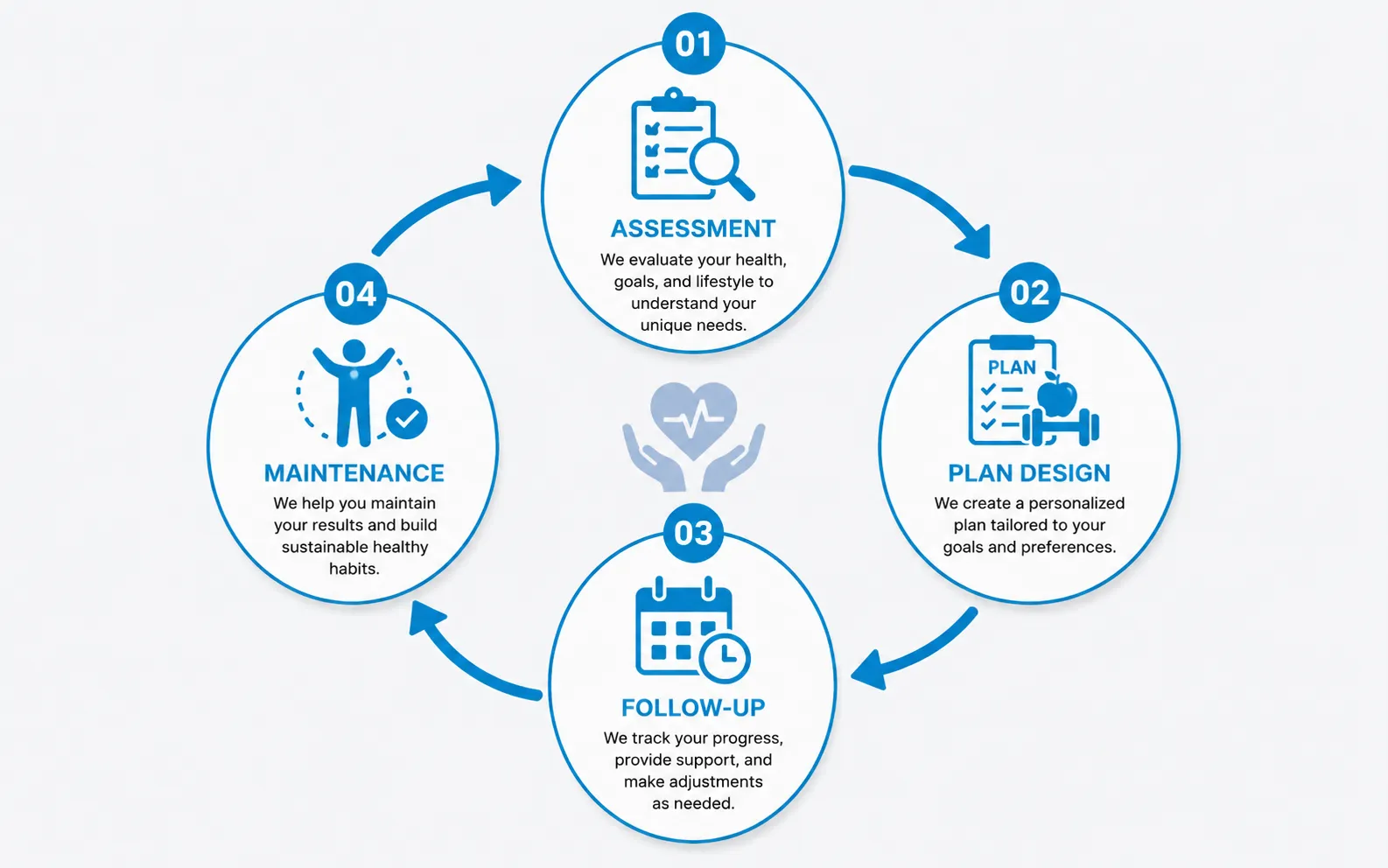
A well-structured medical weight loss programme typically unfolds in four phases:
Your first consultation involves a detailed medical history, a review of current medications (many common drugs — antidepressants, corticosteroids, beta-blockers — cause weight gain as a side effect), and a targeted blood panel. Body composition is assessed beyond simple BMI, which is a notoriously poor predictor of metabolic health in South Asian populations.
Based on your results, your doctor designs a caloric and macronutrient target that preserves muscle mass while creating a sustainable deficit. If a condition such as hypothyroidism or PCOS is identified, it is treated concurrently — because no diet will work optimally against an untreated hormonal disorder. Where appropriate, evidence-based pharmacotherapy (such as GLP-1 receptor agonists for patients with diabetes or obesity) may be considered.
Regular check-ins — fortnightly initially, then monthly — allow your doctor to track progress, repeat relevant blood tests, and adjust the plan as your metabolism adapts. This is the phase that most commercial programmes skip entirely, and it is the phase that determines long-term success.
Once target weight is achieved, the focus shifts to consolidation: recalibrating caloric targets for maintenance, reinforcing behavioural habits, and scheduling periodic metabolic reviews to catch early signs of regain before they become significant.
Profrea's doctor-managed care model — supported across 7 clinic locations in Gurugram plus a video consultation facility — means patients can access follow-up appointments conveniently, whether in-person at Sector 45, South City-I, Sector 52, or remotely via the Profrea app. Continuity of care, which is the single strongest predictor of weight loss maintenance, is built into the model rather than left to chance.
When delivered by qualified physicians, medically supervised weight loss is both safe and significantly more effective than unsupervised approaches. The safety advantage comes from continuous monitoring: your doctor can detect and respond to electrolyte imbalances, cardiac changes, or medication interactions before they cause harm — something no diet book or wellness app can do.
The effectiveness advantage comes from personalisation. A 2022 analysis in The Lancet confirmed that interventions combining dietary modification, physical activity, and behavioural support — the three pillars of a medical weight loss programme — produced clinically meaningful weight loss (≥5% of body weight) in a majority of participants, with sustained results at two-year follow-up.
For patients with obesity-related comorbidities such as type 2 diabetes, hypertension, or fatty liver disease, even a 5–10% reduction in body weight produces measurable improvements in blood glucose control, blood pressure, and liver enzyme levels — benefits that extend well beyond aesthetics.
Gurgaon's rapid urbanisation has created a specific metabolic risk profile among its residents. Long commutes, desk-bound work, late-night dining, high ambient stress, and easy access to calorie-dense food have combined to make obesity, pre-diabetes, and metabolic syndrome increasingly common — even among people in their 30s and early 40s.
South Asian populations carry additional genetic risk: fat tends to accumulate viscerally (around the organs) at lower BMI thresholds than in Western populations, meaning metabolic damage can occur at body weights that appear "normal" on standard charts. This makes early, medically informed intervention particularly important for Gurgaon residents.
Profrea's multi-specialty network — covering General Medicine, Gynecology and women's hormonal health, additional specialist consultations, Nutrition & Dietetics, Physiotherapy, and Psychology — means that the full spectrum of factors contributing to weight gain can be addressed within a single coordinated care network, without patients needing to navigate multiple disconnected providers across the city.
Consultation fees at Profrea vary by specialist and appointment type (in-clinic or video). For accurate, up-to-date pricing for a weight loss consultation with Dr. Ladli Chatterjee or another Profrea physician, the most reliable approach is to check availability directly through the Profrea website or app, where current fees and slot availability are displayed in real time.
It is also worth considering the cost of not seeking medical guidance: the downstream expenses of managing type 2 diabetes, cardiovascular disease, or joint damage caused by prolonged obesity typically far exceed the cost of early preventive intervention. Profrea also offers health screening packages that can serve as a cost-effective entry point, providing the baseline diagnostics needed to begin a medically informed weight management plan.
Medical weight loss is a physician-supervised programme that begins with diagnostic testing to identify the biological reasons behind weight gain — such as insulin resistance, thyroid disorders, or hormonal imbalances — and then builds a personalised plan that may include dietary modification, physical activity prescription, behavioural support, and, where appropriate, medication. Unlike generic diet plans, it is tailored to your individual physiology and monitored by a qualified doctor throughout.
A general physician with expertise in metabolic health or diabetology is the ideal first point of contact. At Profrea, Dr. Ladli Chatterjee — MD in General Medicine and Fellow in Diabetes from the Royal Liverpool Academy, UK — specialises in exactly this area and is available at multiple Gurugram clinic locations as well as via video consultation.
It typically involves four phases: a comprehensive medical assessment, a personalised plan designed around your diagnostic results, structured follow-up appointments to monitor progress and adjust the plan, and a maintenance phase to consolidate results and prevent relapse. The entire process is overseen by a physician, with additional support from dietitians, physiotherapists, or psychologists as needed.
Yes — when delivered by qualified physicians, medically supervised weight loss is both safe and more effective long-term than unsupervised approaches. Continuous monitoring allows doctors to detect and address complications early, while personalisation ensures the plan works with your biology rather than against it. Evidence consistently shows that programmes combining dietary, physical activity, and behavioural components produce sustained weight loss at two-year follow-up.
Consultation fees vary by specialist and appointment format. Profrea offers both in-clinic and video consultations, with current pricing visible on the Profrea website and app. Health screening packages are also available as a cost-effective starting point that includes the baseline diagnostics needed for a medically informed weight management plan.
Book a consultation with Dr. Ladli Chatterjee or another Profrea physician at any of our 7 Gurugram locations — or speak to us from home via video consultation.