A clinically grounded guide to understanding laser scar treatments — what to expect, how much it costs in Gurugram, and how to choose the right approach for your skin.
By Dr. Shikha Bansal, Plastic Surgeon (MCh, SMS Medical College, Jaipur) · Published July 2026
Scars are more than skin deep. Whether left behind by acne, surgery, burns, or injury, they can affect confidence and quality of life in ways that go well beyond appearance. Laser scar removal has emerged as one of the most evidence-backed, non-invasive options for significantly reducing the visibility of scars — and Gurgaon's growing network of specialist clinics means patients no longer need to travel to Delhi for advanced care.
This guide covers everything a patient in Gurugram should know before booking a consultation: the types of scars that respond best to laser treatment, realistic session counts, what the procedure feels like, recovery expectations, and a transparent look at costs in the local market.
Laser scar resurfacing uses focused beams of light energy to break down damaged skin tissue and stimulate the body's natural collagen remodelling process. Depending on the laser type, the energy either ablates (removes) the outer skin layers or penetrates deeper without surface disruption — a distinction that determines both the results and the recovery time.
The two broad categories used in clinical practice are:
Ablative lasers (e.g., CO₂, Er:YAG) — remove the top skin layer, delivering more dramatic results in fewer sessions but requiring a longer healing period of 7–14 days.
Non-ablative lasers (e.g., Nd:YAG, pulsed-dye) — heat the deeper dermis without breaking the surface, offering a gentler experience with minimal downtime, though typically requiring more sessions.
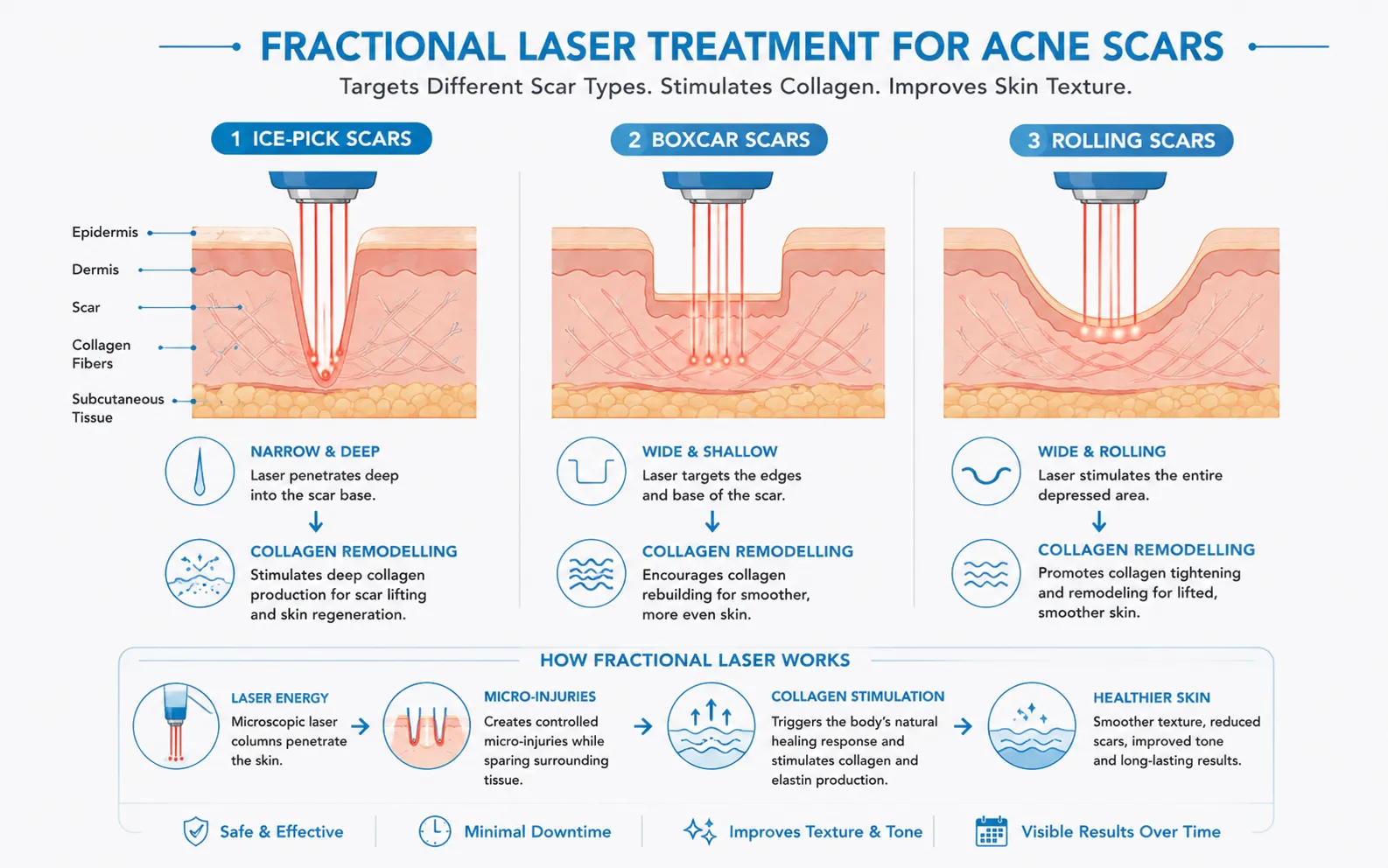
Fractional laser technology — which delivers energy in a grid of micro-columns rather than a continuous beam — has become the standard of care for most scar types. It preserves surrounding healthy tissue, accelerating healing while still triggering meaningful collagen remodelling. A review published on PubMed confirms that fractional laser resurfacing produces statistically significant improvement in atrophic acne scars with a favourable safety profile across skin types.
Not every scar is the same, and the laser protocol must be matched to the scar type. Here is a practical breakdown:
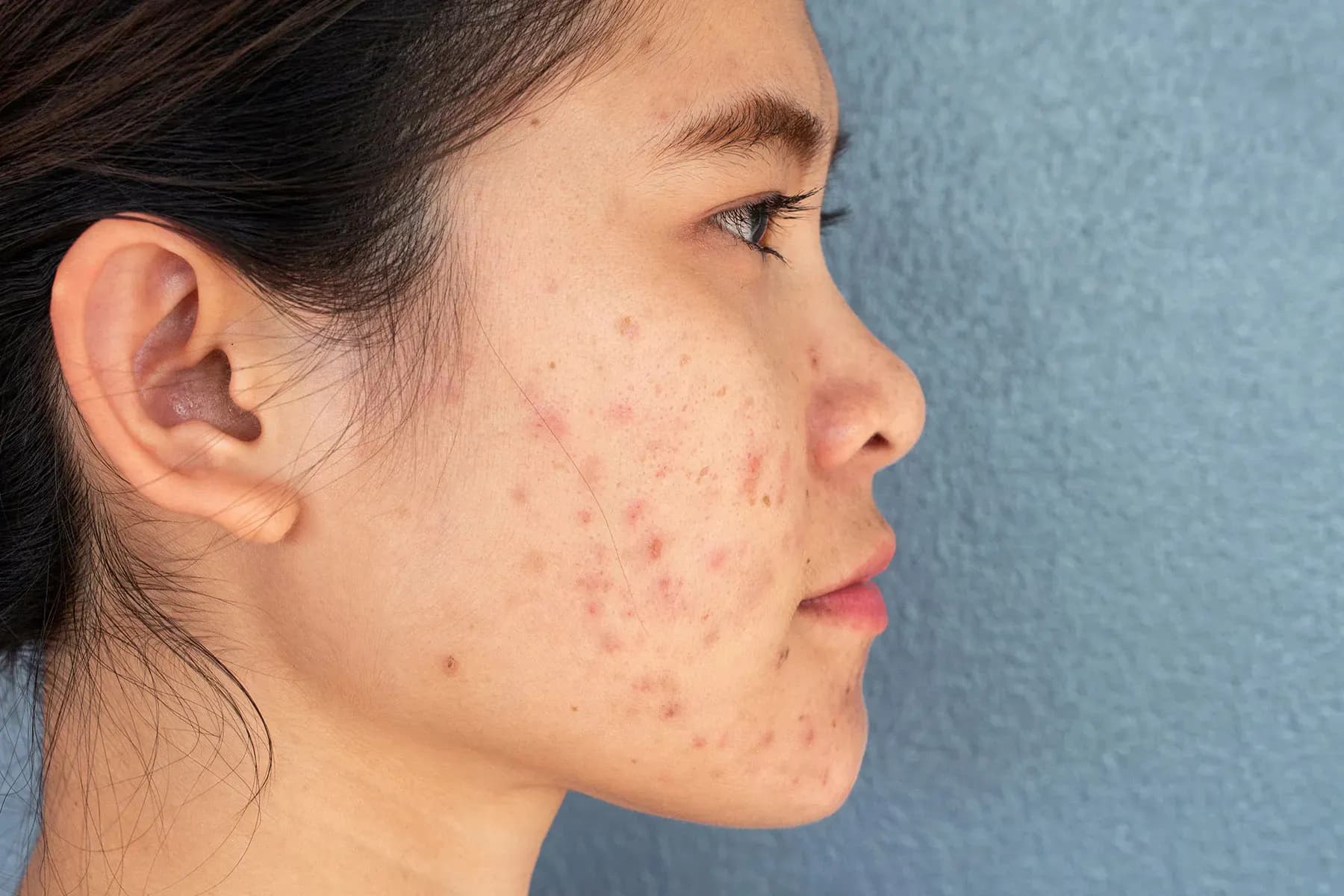
Ice-pick, boxcar, and rolling acne scars are among the most commonly treated with laser resurfacing. Fractional CO₂ and fractional Er:YAG lasers are particularly effective for these depressed (atrophic) scars by stimulating new collagen to fill the depressions. Most patients see 40–70% improvement over a course of 3–5 sessions.
Post-operative scars — including those from caesarean sections, appendectomies, or cosmetic procedures — respond well to pulsed-dye laser (PDL) in the early, red phase, and to fractional lasers once the scar has matured. Early intervention (3–6 months post-surgery) generally yields better outcomes.
Raised, thickened scars require a more cautious approach. PDL and Nd:YAG lasers can flatten hypertrophic scars and reduce redness, often combined with intralesional steroid injections. True keloids — which extend beyond the original wound boundary — are harder to treat and carry a risk of recurrence; a plastic surgeon's assessment is essential before proceeding.
Superficial burn scars with textural irregularity and pigmentation can be significantly improved with fractional ablative lasers. Deeper burn scars may require a combination of laser and surgical scar revision for optimal results.
While not classic scars, stretch marks share a similar pathology and respond to fractional non-ablative lasers, particularly in the early, red (striae rubra) phase. Results in the white (striae alba) phase are more modest.
This is the question every patient asks first — and the honest answer is: it depends on the scar type, depth, skin tone, and the laser technology used. As a general guide:
Mild acne scarring: 2–3 sessions of fractional laser, spaced 4–6 weeks apart.
Moderate to severe acne scarring: 4–6 sessions, sometimes combined with microneedling or chemical peels between laser sessions.
Surgical or traumatic scars: 3–5 sessions depending on scar maturity and size.
Hypertrophic scars: 4–8 sessions, often with adjunct treatments.
Patients with darker skin tones (Fitzpatrick types IV–VI, common in North India) require lower fluence settings and longer intervals between sessions to minimise the risk of post-inflammatory hyperpigmentation (PIH). An experienced plastic surgeon or dermatologist will calibrate the protocol accordingly — this is not a one-size-fits-all treatment.
At Profrea, Dr. Shikha Bansal — a plastic surgeon with an MCh from SMS Medical College, Jaipur, and over 9 years of surgical experience — conducts a thorough scar assessment before recommending any laser protocol, ensuring the treatment plan is matched to your specific scar morphology and skin type.
Pain tolerance varies, but most patients describe the sensation as a series of brief, sharp snaps — similar to a rubber band flicking against the skin — during non-ablative sessions. Ablative laser treatments are more intense and are typically performed under topical anaesthetic cream applied 30–45 minutes before the procedure. Some clinics also offer nerve blocks for larger treatment areas.
A typical session lasts 20–45 minutes depending on the area treated. Immediately after, the skin appears red and feels warm — similar to a mild sunburn. This settles within a few hours for non-ablative treatments and within 2–5 days for ablative procedures.
Key things to communicate to your doctor before treatment:
Any history of cold sores (herpes simplex) — antiviral prophylaxis may be needed.
Current use of retinoids or isotretinoin (Accutane) — treatment should be deferred for at least 6 months after stopping isotretinoin.
Any autoimmune conditions or medications that affect wound healing.
Recent sun exposure or tanning.
Recovery varies significantly by laser type:
Non-ablative fractional laser: Minimal downtime. Redness and mild swelling resolve within 24–48 hours. Most patients return to work the next day.
Ablative fractional laser (e.g., fractional CO₂): 5–10 days of healing. The skin will crust, peel, and feel sensitive. Sun avoidance and a gentle skincare routine are essential.
Full-field ablative laser: 10–14 days of significant downtime. Reserved for severe scarring and performed less frequently in routine practice.
Regardless of laser type, broad-spectrum SPF 50+ sunscreen is non-negotiable for at least 3 months post-treatment. Gurgaon's high UV index — particularly from March through October — makes this especially important. Skipping sun protection is the single most common reason patients experience PIH after laser treatment in Indian skin.
Results continue to improve for 3–6 months after each session as collagen remodelling progresses beneath the surface. Final results are typically assessed 6 months after the last session.
Pricing in Gurugram varies based on the laser technology used, the size and number of scars, the number of sessions, and the seniority of the treating clinician. Here is a realistic range for the Gurgaon market:
| Treatment Type | Approx. Cost Per Session |
|---|---|
| Non-ablative fractional laser (face) | ₹3,000 – ₹8,000 |
| Ablative fractional CO₂ laser (face) | ₹8,000 – ₹20,000 |
| Pulsed-dye laser (surgical/hypertrophic scars) | ₹5,000 – ₹15,000 |
| Full-course package (3–5 sessions, acne scars) | ₹20,000 – ₹60,000 |
These figures are indicative. The actual cost depends on a clinical assessment of your scar burden, the specific laser protocol recommended, and whether combination treatments (microneedling, PRP, chemical peels) are included. Clinics offering very low per-session prices may be using older technology or lower energy settings that deliver suboptimal results — always ask about the specific laser device and the treating clinician's qualifications.
Most laser scar treatments are considered cosmetic and are not covered by standard health insurance in India. However, some surgical scar treatments — particularly post-burn or post-trauma — may attract partial coverage depending on your insurer and policy terms. It is worth checking with your provider before your first session.
For a precise cost estimate tailored to your scar type and treatment goals, a consultation with Dr. Shikha Bansal at Profrea Gurugram is the most reliable starting point. She will assess the scar, recommend the appropriate laser modality, and provide a session-by-session plan with transparent pricing.
Laser resurfacing is not the only tool in the scar reduction toolkit. Depending on the scar type, your doctor may recommend one of the following — or a combination:
Microneedling (Collagen Induction Therapy): Effective for mild to moderate atrophic acne scars, particularly in darker skin tones where laser carries a higher PIH risk. Often combined with PRP (platelet-rich plasma) for enhanced results.
Chemical peels: Superficial to medium-depth peels improve surface texture and pigmentation in post-acne marks. Less effective for deep, structural scars.
Subcision: A minor surgical technique that releases the fibrous bands tethering rolling acne scars to deeper tissue. Highly effective when combined with laser or filler.
Dermal fillers: Temporary volume restoration for depressed scars, particularly rolling and boxcar types. Results last 9–18 months.
Surgical scar revision: For wide, distorted, or poorly placed scars, surgical excision and re-closure by a plastic surgeon can dramatically improve appearance. Dr. Shikha Bansal's plastic surgery expertise means she can assess whether a surgical approach would yield better long-term results than laser alone.
The most effective scar treatment programmes typically combine modalities — for example, subcision followed by fractional laser, or microneedling alternating with chemical peels between laser sessions. A single-modality approach rarely delivers the best possible outcome for moderate to severe scarring.
The quality of laser scar treatment is heavily operator-dependent. The same laser device in the hands of an experienced plastic surgeon versus an undertrained technician can produce dramatically different outcomes — and, in the case of darker skin tones, dramatically different risks.
Gurgaon's healthcare landscape has matured considerably over the past decade. Patients now have access to multi-specialty clinic networks like Profrea, which bring together plastic surgeons, gynaecologists, psychologists, and general physicians under one roof across 7 clinic locations in the city. This integrated model matters for scar patients because acne scarring, for example, often requires concurrent dermatological management of active acne — treating the scars without addressing the underlying cause is a common and costly mistake.
Profrea's network also includes specialists like Dr. Soma Kumari (Obstetrics & Gynaecology) for patients seeking post-caesarean scar management, and Dr. Sarika Thakral (Clinical Psychologist) for patients whose scarring has had a significant psychological impact — a dimension of scar care that is frequently overlooked in purely cosmetic settings.
For patients managing chronic conditions that affect skin healing — such as diabetes — coordinated care with a physician like Dr. Ladli Chatterjee, Profrea's General Physician and Diabetologist (Fellowship in Diabetes, Royal Liverpool Academy, UK), ensures that metabolic factors are optimised before and during laser treatment.
To make the most of your initial consultation, come prepared with:
A clear history of how and when the scar formed.
Photographs of the scar over time, if available — progression photos help the clinician assess scar maturity.
A list of current skincare products and medications.
Any previous treatments you have tried and their outcomes.
Your realistic expectations — laser scar treatment improves scars significantly, but complete erasure is rarely achievable. A good clinician will set honest expectations from the outset.
Profrea offers both in-clinic consultations across its Gurugram locations and video consultations for patients who prefer an initial remote assessment before committing to an in-person visit. The Profrea health screening packages can also be useful for patients who want a comprehensive baseline assessment — particularly relevant if you have underlying skin or metabolic conditions that may influence your treatment plan.
Costs range from approximately ₹3,000 per session for non-ablative fractional laser to ₹20,000 per session for ablative CO₂ laser treatments. Full-course packages for acne scar treatment typically range from ₹20,000 to ₹60,000 depending on the number of sessions and the technology used. A clinical assessment is needed for an accurate quote.
Most patients with moderate acne scarring require 3–5 sessions spaced 4–6 weeks apart. Severe or deep scarring may require 6 or more sessions, sometimes combined with other treatments such as subcision or microneedling. Results continue to improve for up to 6 months after the final session.
Laser resurfacing is effective for atrophic acne scars (ice-pick, boxcar, rolling), surgical scars, traumatic scars, hypertrophic scars, burn scars, and stretch marks. The specific laser type and protocol must be matched to the scar type — a one-size-fits-all approach is not appropriate.
Non-ablative laser sessions are generally well-tolerated with topical anaesthetic cream. Ablative laser treatments are more intense and require adequate numbing. Most patients describe the sensation as a series of brief, sharp snaps. Post-procedure, the skin feels warm and sensitive for 24–48 hours (non-ablative) or up to 10 days (ablative).
Non-ablative fractional laser: 24–48 hours of redness, minimal downtime. Ablative fractional CO₂ laser: 5–10 days of peeling and sensitivity. Full-field ablative laser: 10–14 days. Strict sun protection for 3 months post-treatment is essential regardless of the laser type, particularly in Gurgaon's high-UV climate.
If performed at inappropriate settings, laser treatment can cause post-inflammatory hyperpigmentation (PIH) in darker skin tones (Fitzpatrick IV–VI). This is why it is critical to choose a clinician experienced with Indian skin types. Lower fluence settings, longer intervals between sessions, and pre-treatment skin preparation with depigmenting agents significantly reduce this risk.
Book an in-clinic or video consultation with Dr. Shikha Bansal at Profrea Gurugram for a personalised scar assessment and treatment plan.