
Honest before-and-after insights, session-by-session progress, and everything you need to know before booking your first laser hair removal appointment in Gurugram.
By the Profrea Editorial Team · Published July 2026
If you have spent years managing unwanted hair with razors, wax strips, or threading appointments, you have probably wondered whether laser hair reduction actually delivers on its promise. The honest answer: yes — but results depend on your skin tone, hair type, the technology used, and how consistently you complete your sessions. At Profrea's multi-specialty clinic network across Gurugram, patients routinely share their before-and-after journeys, and the patterns are remarkably consistent.
This article walks you through what real patients experience — from the first session to the final one — so you can set accurate expectations before you begin.
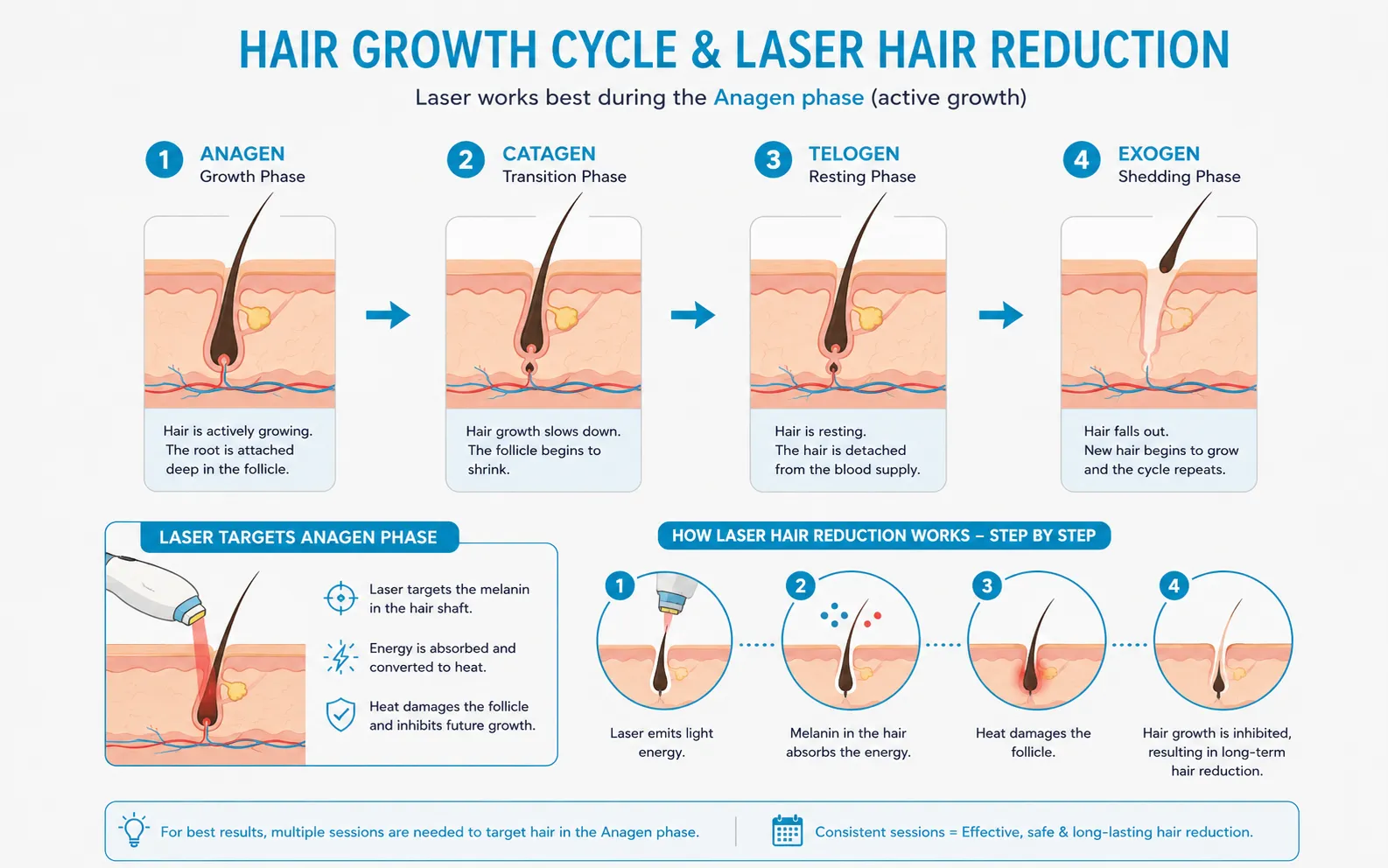
Laser hair reduction uses concentrated light energy to target the melanin (pigment) inside each hair follicle. The heat generated damages the follicle's ability to produce new hair without harming the surrounding skin. Because hair grows in cycles — anagen (active), catagen (transitional), and telogen (resting) — the laser is only effective on follicles in the active growth phase. This is precisely why multiple sessions are required.
Modern diode and Nd:YAG lasers have made the treatment significantly safer for South Asian and darker skin tones, which historically carried a higher risk of post-inflammatory hyperpigmentation with older technologies. According to guidance published by the National Institutes of Health (NIH), longer-wavelength lasers such as Nd:YAG are considered the gold standard for Fitzpatrick skin types IV–VI, which includes most patients of Indian origin.
Most patients notice that treated hair does not fall out immediately. Over the following 7–14 days, the damaged hair sheds naturally. The skin may appear slightly red or feel like mild sunburn for 24–48 hours — this is normal and resolves quickly. At this stage, you are unlikely to see dramatic visual change, but the process has begun.
This is where most patients first notice a visible difference. Hair regrowth is sparser, finer, and lighter in colour. Patients treating areas like the upper lip, chin, or underarms often report a 30–50% reduction in visible hair density by the third session. Regrowth intervals also lengthen — you may find you need to shave or wax far less frequently between appointments.
The most dramatic before-and-after transformation typically occurs in this window. Patients treating larger areas — full legs, back, or abdomen — see 60–80% hair reduction. Smaller, hormonally sensitive areas like the chin or bikini line may require additional sessions. Skin texture in treated areas often appears smoother because the repeated trauma of shaving or waxing has stopped.
A complete course of 6–8 sessions, spaced 4–8 weeks apart depending on the body area, typically delivers 80–90% permanent hair reduction for suitable candidates. Remaining hair is usually finer and lighter. Annual maintenance sessions may be recommended for areas influenced by hormonal fluctuations, such as the face or PCOS-related growth patterns.
.webp)
This is one of the most common concerns among patients in Gurugram, and it is a valid one. Indian skin tones span Fitzpatrick types III–VI, and earlier laser technologies carried real risks of burns or pigmentation changes on darker skin. However, the landscape has changed substantially.
When performed by trained practitioners using appropriate wavelengths and settings, laser hair reduction is considered safe for Indian skin. The key variables are: the correct laser type for your skin tone, conservative energy settings, proper cooling, and a thorough pre-treatment assessment. A patch test before the first full session is standard practice and helps identify any unusual skin sensitivity.
Patients with conditions such as PCOS, hormonal imbalances, or those on certain medications should disclose their full medical history before starting. At Profrea, consultations with specialists — including Dr. Ladli Chatterjee, General Physician and Diabetologist — can help identify whether any underlying health conditions might affect treatment outcomes or require co-management.
Patient feedback from Profrea's Gurugram clinics reflects experiences consistent with clinical literature. Here are three paraphrased accounts shared with consent:
Priya, 28 (full face and underarms): "By my fourth session, I had almost completely stopped threading. My skin felt so much calmer — no more ingrown hairs or dark patches from waxing. I wish I had started sooner."
Rahul, 34 (back and shoulders): "I was sceptical because I have a darker complexion and had heard horror stories. The team did a patch test first and adjusted the settings carefully. Six sessions in, the difference is night and day."
Meera, 31 (legs and bikini line): "I have PCOS so I was told I might need more sessions. I did eight in total. The results are not 100% gone but probably 85% — and what grows back is so fine I barely notice it."
The number of sessions varies by body area, hair colour, hair thickness, and hormonal factors. As a general guide:
| Body Area | Typical Sessions | Session Gap |
|---|---|---|
| Upper lip / chin | 6–10 | 4 weeks |
| Underarms | 6–8 | 4–6 weeks |
| Full legs | 6–8 | 6–8 weeks |
| Back / chest (men) | 6–8 | 6–8 weeks |
| Bikini / Brazilian | 6–10 | 4–6 weeks |
Patients with PCOS or hormonal hair growth may need 2–4 additional sessions and should ideally have their hormonal profile reviewed. Profrea's multi-specialty structure means you can access a gynaecologist and infertility specialist like Dr. Soma Kumari under the same roof if hormonal management is part of your care plan.
Immediately after treatment, the treated area typically shows:
Redness and mild swelling around the hair follicles (perifollicular oedema) — this usually resolves within a few hours to 24 hours.
A sensation similar to mild sunburn — cool compresses and aloe vera gel provide relief.
Hair appearing to grow for 7–14 days post-session — this is actually the treated hair being pushed out, not new growth.
Temporary darkening of the skin in some cases, particularly in patients with darker skin tones — this is usually transient and resolves within days to weeks with proper aftercare.
Sun protection is non-negotiable after each session. Applying SPF 30 or higher daily and avoiding direct sun exposure for at least two weeks post-treatment significantly reduces the risk of hyperpigmentation.
Laser hair reduction is increasingly popular among men in Gurugram, particularly for the back, shoulders, chest, and beard shaping. Male patients typically have coarser, denser hair, which means sessions may take slightly longer and energy settings are often higher. Results are equally impressive — many men report an 80%+ reduction after a full course.
One important note for men: beard-area laser treatment requires particular care around the jawline and neck, where hair growth patterns are complex and hormonal sensitivity is high. A thorough consultation is essential before treating these zones.
For general health concerns that might affect treatment — such as skin conditions, medication interactions, or metabolic issues — Profrea's general medicine team, including specialist doctors across Gurugram clinics, can provide pre-treatment clearance.
The technically accurate term is permanent hair reduction, not permanent hair removal. Regulatory bodies including the U.S. Food and Drug Administration (FDA) permit the claim of "permanent reduction" — meaning a significant, long-lasting decrease in the number of hairs — but not "permanent removal," since some follicles may eventually reactivate, particularly under hormonal influence.
In practice, most patients enjoy years of near-hairlessness after completing their course, with only occasional maintenance sessions needed. For areas unaffected by hormonal changes — such as the legs or back — results tend to be the most durable.
Patients who complete a full course of laser hair reduction often report benefits that go beyond the obvious:
Elimination of ingrown hairs — a major concern for patients who previously waxed or shaved regularly.
Reduction in post-inflammatory hyperpigmentation caused by repeated waxing or threading trauma.
Smoother skin texture in treated areas over time.
Significant cost savings over a lifetime compared to ongoing salon appointments.
Time savings — no more monthly waxing bookings or daily shaving routines.
For patients who have struggled with skin sensitivity, razor bumps, or post-wax breakouts, laser hair reduction often represents a meaningful improvement in skin health and confidence.
Shave the area 24 hours before your session (do not wax or thread — the root must be intact).
Avoid sun exposure for at least 2 weeks before treatment.
Discontinue retinoids or exfoliating acids 5–7 days before your session.
Inform your practitioner of any medications, particularly photosensitising drugs.
Arrive with clean, product-free skin — no deodorant, lotion, or perfume on the treatment area.
Disclose any history of cold sores if treating the face — antiviral prophylaxis may be recommended.
Most patients notice visible hair reduction after 2–3 sessions, with significant results (60–80% reduction) by sessions 4–6. A full course of 6–8 sessions is typically recommended for optimal, long-lasting outcomes. Hormonally sensitive areas may require additional sessions.
Laser hair reduction delivers permanent hair reduction — a long-lasting, significant decrease in hair density. It is not classified as permanent removal, as some follicles may reactivate over time, particularly in hormonally influenced areas. Most patients require only occasional maintenance sessions after completing their initial course.
Immediately after a session, the skin may appear red and slightly swollen around the follicles, similar to mild sunburn. This typically resolves within 24 hours. Over the following 1–2 weeks, treated hairs shed naturally. After completing a full course, skin in treated areas is typically smoother, with fewer ingrown hairs and reduced pigmentation from prior waxing trauma.
Yes, when performed with appropriate laser technology (such as Nd:YAG or diode lasers with suitable settings) by trained practitioners, laser hair removal is safe for Indian skin tones. A patch test before the first full session is standard practice. Choosing a clinic with experienced practitioners who understand South Asian skin is essential for safe, effective results.
Costs in Gurugram vary depending on the body area, number of sessions, and clinic. Smaller areas such as the upper lip may start from ₹1,000–₹2,500 per session, while larger areas like full legs or back can range from ₹5,000–₹15,000 per session. Package deals across multiple sessions typically offer better value. A consultation at Profrea will provide a personalised quote based on your specific needs.
Yes, but patients with PCOS often require more sessions due to ongoing hormonal stimulation of hair follicles. Combining laser hair reduction with appropriate hormonal management — ideally under the guidance of a gynaecologist — tends to produce better long-term results. Profrea's multi-specialty structure allows for coordinated care across relevant specialties.
Book a consultation at any of Profrea's 7 Gurugram clinic locations — in-person or via video — and get a personalised treatment plan from experienced practitioners who understand Indian skin.