

A transparent, clinician-backed look at what High Intensity Focused Ultrasound actually delivers — and what patients in Gurugram can realistically expect.
By the Profrea Clinical Editorial Team · Published July 2026
Scroll through any aesthetic clinic's social feed and you'll find dramatic before-and-after photos promising a decade-younger face in a single lunch break. The reality of HIFU skin tightening is more nuanced — and, for the right candidate, genuinely impressive. At Profrea's multi-specialty aesthetic clinics across Gurugram, our approach is to set honest expectations first and let the results speak for themselves.
This article walks you through exactly how HIFU works, what before-and-after changes are clinically realistic, how many sessions most patients need, and how the experience at Profrea differs from a standard aesthetic chain.
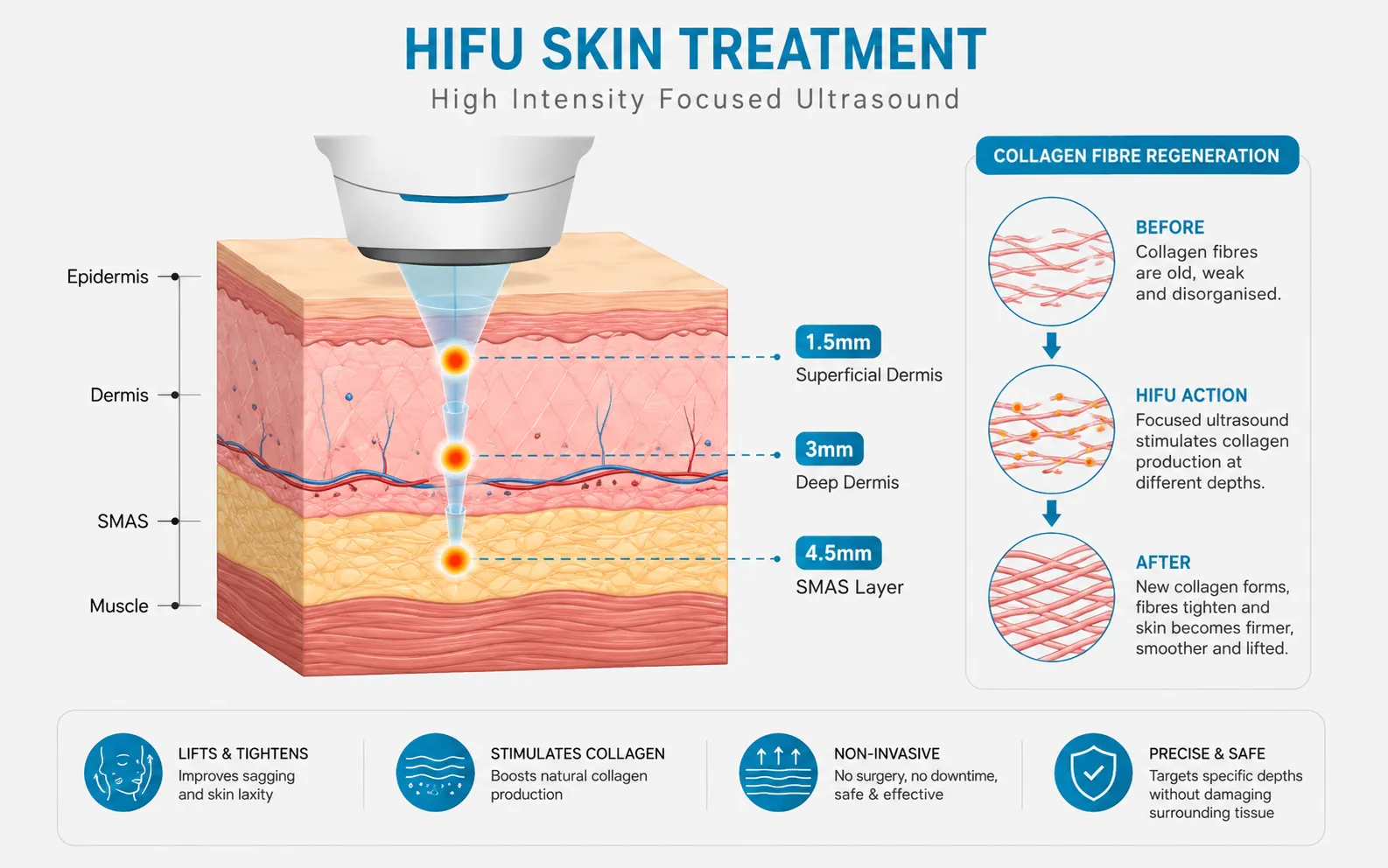
High Intensity Focused Ultrasound (HIFU) delivers precisely focused ultrasound energy to the deep dermis and the superficial musculoaponeurotic system (SMAS) — the same tissue layer surgeons target during a traditional facelift. The thermal micro-injury triggers the body's natural wound-healing response: fibroblasts produce fresh collagen and elastin, gradually lifting and firming the overlying skin.
Unlike radiofrequency devices that heat only the superficial dermis, HIFU can reach depths of 1.5 mm, 3 mm, and 4.5 mm in a single session, making it uniquely suited to address jowling, brow ptosis, and neck laxity without incisions. A peer-reviewed review published on PubMed confirmed that focused ultrasound produces measurable collagen remodelling at the SMAS level, supporting its use as a non-surgical lifting modality.
Patients often ask whether the before-and-after photos they see online are representative. Here is what clinical literature and Profrea's own patient outcomes consistently show:
Brow lift: A measurable elevation of 1–2 mm is commonly documented at 90 days post-treatment, reducing the hooded appearance around the eyes.
Jawline definition: Reduction in jowl volume and improved mandibular contour are among the most visually striking changes, particularly in patients aged 35–55.
Neck and décolletage: Skin texture improves and horizontal neck bands soften, though results here are more gradual than on the face.
Overall skin quality: Pore size, fine lines, and skin luminosity improve as collagen density increases over 3–6 months.
It is equally important to be clear about what HIFU does not do: it will not replicate the degree of lift achievable with a surgical rhytidectomy, it does not address excess skin volume (only laxity), and results vary significantly with age, skin quality, and baseline collagen reserve.
.webp)
Understanding the patient journey helps set the right expectations from day one. Here is how a typical HIFU course unfolds at Profrea's Gurugram clinics:
A detailed skin assessment is conducted by a qualified clinician. Photographs are taken under standardised lighting — these are the honest baseline images used to track your progress. Contraindications (active skin infections, implanted devices, pregnancy) are ruled out, and a personalised treatment plan is documented.
A topical numbing cream is applied 30 minutes before treatment. The HIFU handpiece is moved systematically across mapped zones of the face and neck, delivering focused energy at the pre-selected depths. Most patients describe the sensation as a warm, prickling feeling that is entirely tolerable. There is no downtime — patients return to work the same day.
This is the phase most patients underestimate. Collagen synthesis is a biological process; the most significant lifting and tightening typically becomes visible between 6 and 12 weeks after treatment. Profrea's care team schedules a follow-up at 8 weeks to photograph progress and address any questions.
At the 3-month mark, standardised comparison photographs are reviewed with the patient. For most individuals, a single annual session maintains results. Those with more advanced laxity may benefit from a second session at 6 months.
This is the most frequently asked question — and the honest answer is: 12 to 18 months for most patients, with some individuals maintaining visible improvement for up to 2 years. The duration depends on the rate of natural ageing, sun exposure, lifestyle factors (smoking, hydration, nutrition), and the number of sessions completed.
Profrea's aesthetic team, which includes Dr. Shweta Sharma and other experienced clinicians, recommends pairing HIFU with a personalised skincare regimen — including SPF 50 daily and a retinoid-based night routine — to extend the collagen-building benefits.
For patients in their 30s with mild-to-moderate laxity, a single session often produces satisfying results visible by the 3-month mark. Patients in their 40s and 50s with moderate laxity typically see the best outcomes with two sessions spaced 6 months apart. Those with significant skin redundancy are counselled that HIFU alone may not achieve their goals and that a combination approach — or a surgical consultation — may be more appropriate.
Profrea's multi-specialty network means that if a patient is better served by a surgical option, they can be referred directly to a plastic surgery specialist within the Profrea network without starting from scratch with a new provider.
Yes — with an important qualifier. HIFU produces measurable, clinically documented skin tightening in appropriately selected patients. It is not a placebo, and it is not merely a temporary surface effect. The ultrasound energy creates genuine thermal coagulation points in the deep dermis and SMAS, which heal with new collagen.
However, the degree of tightening is proportional to the amount of liftable tissue present. A 38-year-old with early jowling will see a more dramatic percentage improvement than a 62-year-old with advanced ptosis — even though both may be genuinely satisfied with their results relative to their starting point.
At Profrea, every consultation includes a frank discussion of expected outcomes using the patient's own baseline photographs, so there are no surprises at the 3-month review.
HIFU has a well-established safety profile when performed by trained clinicians using calibrated equipment. Common, expected effects include:
Mild redness and swelling lasting 2–24 hours post-treatment
Tenderness to touch along the treated zones for 3–5 days
Tingling or numbness that resolves within 1–2 weeks in most cases
Rare bruising in patients on blood thinners or with fragile capillaries
Serious adverse events — such as nerve injury or fat atrophy — are rare and are almost exclusively associated with incorrect depth settings or undertrained operators. Profrea's clinical protocols require that HIFU treatments are performed or directly supervised by qualified medical professionals, not beauticians, which is a meaningful distinction in the Gurugram aesthetic market.
Patients with any underlying health conditions — including diabetes or autoimmune skin conditions — are assessed by a general physician before aesthetic procedures. Profrea's in-house diabetologist Dr. Ladli Chatterjee (MBBS, MD, Fellowship in Diabetes — Royal Liverpool Academy, UK) is available across multiple Gurugram clinic locations for pre-procedure medical clearance when needed.
This is not a competition — it is a spectrum. HIFU and surgical facelifts address different degrees of facial ageing, and the right choice depends on the patient's anatomy, goals, tolerance for downtime, and budget.
| Factor | HIFU | Surgical Facelift |
|---|---|---|
| Downtime | None (same-day return to work) | 2–4 weeks recovery |
| Degree of lift | Mild to moderate | Moderate to significant |
| Results duration | 12–18 months | 5–10 years |
| Anaesthesia | Topical numbing only | General or local with sedation |
| Ideal candidate age | 30s–50s, early-moderate laxity | 50s+, significant laxity |
For patients who are not yet ready for surgery — or who want to delay it — HIFU is an evidence-based bridge. For those who have already had a surgical facelift, HIFU is an excellent maintenance tool to preserve the surgical result between procedures. Profrea's plastic surgery team, led by our plastic surgery specialists in Gurugram, can provide a combined assessment when the decision is genuinely complex.
Priya, 44, Sector 45 Gurugram: "I was sceptical after seeing overpromised results elsewhere. At Profrea, the doctor showed me exactly what to expect using my own photos. At 3 months, my jawline was noticeably sharper and my colleagues kept asking if I'd lost weight. I hadn't — it was just the lift."
Rahul, 39, DLF Phase 2: "I had a lot of questions about whether HIFU was safe for my skin type. The team took time to explain the depth settings and why they chose a specific protocol for me. The tingling during treatment was manageable and there was zero downtime. Results at 10 weeks were genuinely impressive."
Aesthetic medicine does not exist in isolation. Skin quality is influenced by hormonal health, metabolic conditions, nutritional status, and psychological wellbeing. Profrea's network of 7 clinics across Gurugram brings together specialists in gynaecology and hormonal health, clinical psychology, nutrition, and general medicine — all under one umbrella.
This means that if a patient's skin laxity is partly driven by rapid weight loss, hormonal changes, or nutritional deficiency, those underlying factors can be addressed concurrently — producing better and longer-lasting aesthetic results than a standalone aesthetic clinic could achieve.
Profrea also offers video consultations and a dedicated mobile app, so follow-up care and progress reviews can happen conveniently between in-clinic visits. For patients with busy corporate schedules in Gurugram, this continuity of care is a practical differentiator. You can also explore Profrea's health screening packages to get a comprehensive baseline before starting any aesthetic programme.
Most patients see results lasting 12 to 18 months. Factors that extend longevity include consistent sun protection, a collagen-supportive skincare routine, and annual maintenance sessions. Some patients in their 30s with good baseline skin quality report visible improvement for up to 2 years after a single treatment.
One session is sufficient for most patients with mild-to-moderate laxity. Those with moderate-to-advanced laxity typically benefit from two sessions spaced 4–6 months apart. Your Profrea clinician will recommend a protocol based on your specific skin assessment, not a one-size-fits-all package.
Yes. HIFU produces clinically documented collagen remodelling at the SMAS level — the same tissue targeted in surgical facelifts. The tightening is real, measurable, and progressive over 3–6 months. It is not a surface-only effect, and it is not temporary in the way that a topical firming cream would be.
Common side effects include mild redness, swelling, and tenderness lasting 24–72 hours. Tingling or temporary numbness along treated areas can persist for 1–2 weeks. Serious complications are rare and are associated with incorrect technique. At Profrea, all HIFU treatments are performed under qualified medical supervision.
"Better" depends on your goals and degree of skin laxity. HIFU offers zero downtime and is ideal for mild-to-moderate laxity in patients aged 30–55. A surgical facelift produces a more dramatic and longer-lasting lift for significant laxity. Many patients use HIFU to delay surgery or maintain surgical results. Profrea's team can help you determine which option — or combination — is right for you.
HIFU is generally safe across all Fitzpatrick skin types, including the deeper skin tones common among patients in India. Unlike laser treatments, HIFU energy targets depth rather than skin pigment, making it a low-risk option for darker skin tones when performed correctly. A pre-treatment consultation at Profrea will confirm your suitability.
Book a no-obligation skin assessment at any of Profrea's 7 Gurugram clinic locations — or speak to a clinician via video consultation from wherever you are.