
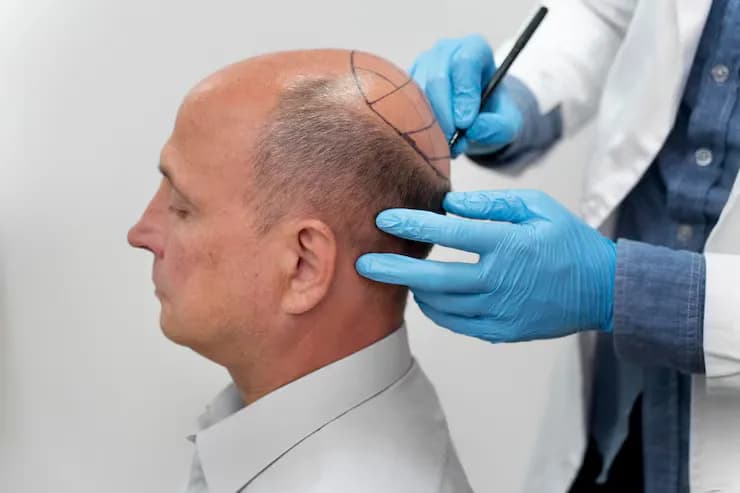
From understanding FUE and FUT techniques to knowing what to expect during recovery — everything you need before booking your first consultation.
By Profrea · Published July 2026
Hair loss affects an estimated 50% of men and 25% of women at some point in their lives, according to data published by the National Institutes of Health (NIH). In a city like Gurugram — where professional visibility, social confidence, and personal presentation matter enormously — hair thinning or baldness can quietly erode self-esteem long before it becomes visually obvious to others.
The good news is that modern hair transplant surgery has advanced dramatically over the past decade. Today's techniques are minimally invasive, produce natural-looking results, and require surprisingly little downtime. Yet many patients in Gurugram still delay treatment because they are unsure which procedure is right for them, what realistic outcomes look like, or how to find a qualified specialist they can trust.
This guide cuts through the noise. Whether you are just beginning to notice a receding hairline or have been researching hair restoration for months, you will find clear, clinically grounded answers here — without the marketing fluff.
A hair transplant is a surgical procedure in which healthy hair follicles are harvested from a donor area — typically the back or sides of the scalp, where hair is genetically resistant to balding — and implanted into areas experiencing thinning or complete hair loss. Because the transplanted follicles retain their original genetic characteristics, they continue to grow naturally in their new location for the rest of the patient's life.
The procedure is performed under local anaesthesia, making it comfortable for most patients. It is classified as a day-care procedure, meaning you go home the same day. The transplanted hair initially sheds within the first few weeks — this is entirely normal — and new, permanent growth begins to emerge from around the third month onward. Full, mature results are typically visible between 9 and 12 months after the procedure.
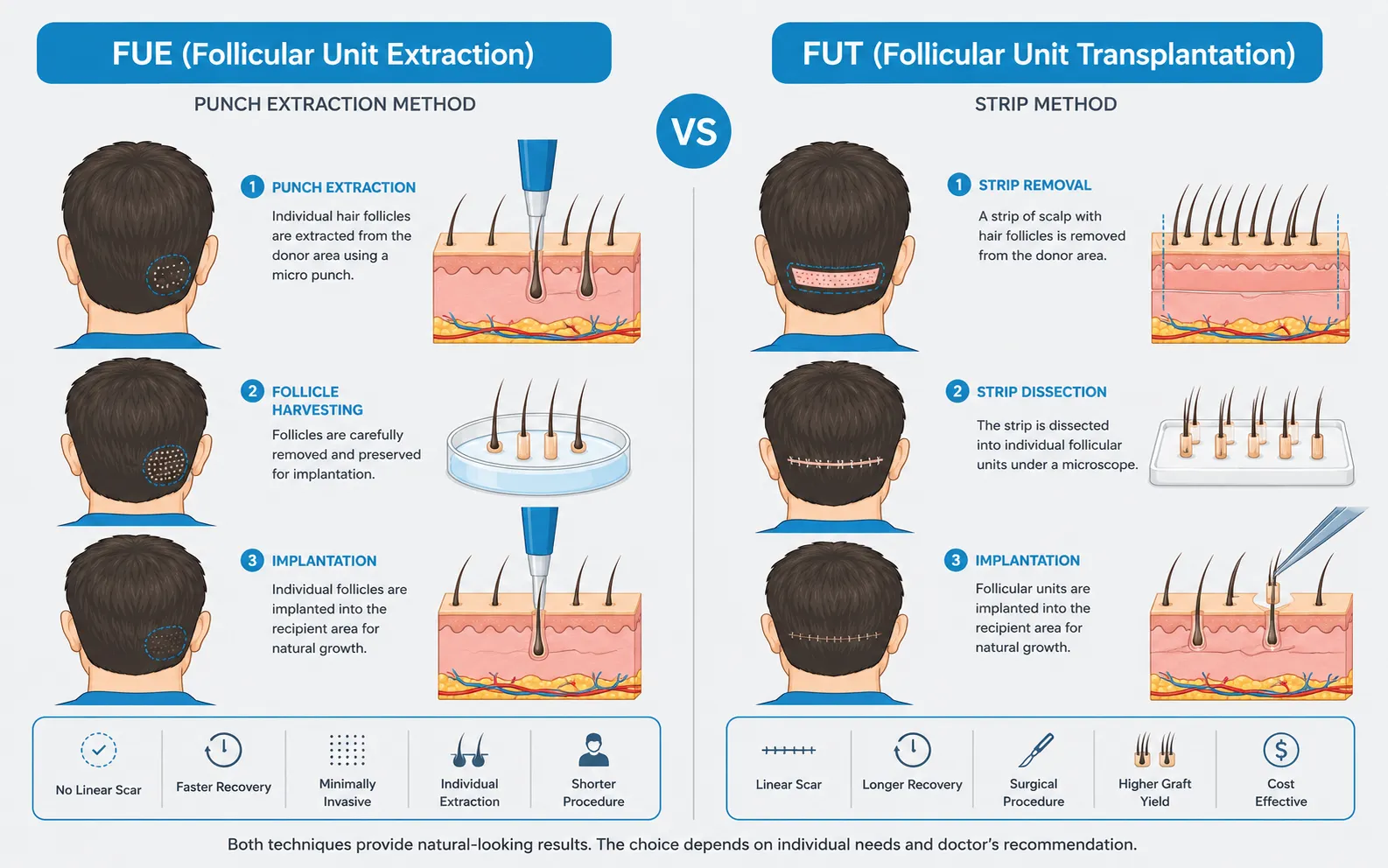
The two most widely used hair transplant methods are Follicular Unit Extraction (FUE) and Follicular Unit Transplantation (FUT). Both are effective, but they differ in how follicles are harvested, the type of scarring involved, and the ideal candidate profile.
In FUE, individual follicular units are extracted one by one using a micro-punch tool, typically 0.6–1.0 mm in diameter. There is no linear incision, so scarring is minimal — small, dot-like marks that are virtually invisible even with a closely shaved head. FUE is the preferred technique for patients who want to wear their hair short, those with limited donor density, or anyone seeking a quicker recovery. The procedure can take 6–10 hours for larger sessions and may be spread across two days.
FUT involves removing a thin strip of scalp from the donor area, which is then dissected under a microscope into individual follicular units before implantation. This technique allows a larger number of grafts to be harvested in a single session and is often recommended for patients requiring high graft counts. The trade-off is a linear scar at the back of the scalp, which is concealed by surrounding hair at normal lengths. FUT is still considered the gold standard for maximum graft yield in advanced hair loss cases.

A side-by-side comparison of FUE and FUT hair transplant techniques
The honest answer is: it depends on your individual hair loss pattern, donor density, lifestyle, and aesthetic goals. A qualified hair restoration specialist will assess your scalp under magnification, evaluate your donor area, and recommend the technique — or combination of techniques — most likely to achieve your desired outcome. There is no universally superior method; the best technique is the one matched to your specific anatomy and expectations.
Hair transplantation is not suitable for everyone, and a thorough pre-operative assessment is essential. In general, good candidates share the following characteristics:
Stable hair loss: Hair loss should be relatively stable, not rapidly progressing. Transplanting into an actively receding hairline risks the appearance of unnatural gaps as surrounding native hair continues to fall.
Adequate donor density: A sufficient supply of healthy, genetically stable follicles in the donor zone is essential. Patients with very diffuse thinning across the entire scalp may have limited donor availability.
Realistic expectations: A transplant restores density and coverage — it does not create the hair volume of your teenage years. Understanding what is achievable is critical to satisfaction.
Good general health: Uncontrolled diabetes, active scalp infections, or bleeding disorders may need to be addressed before surgery.
Age consideration: Most specialists prefer to wait until hair loss has stabilised, which is typically in the mid-to-late twenties for men with androgenetic alopecia.
Women experiencing hair thinning — particularly diffuse thinning associated with hormonal changes, nutritional deficiencies, or post-partum hair loss — may also be candidates, though the evaluation process differs from that for male pattern baldness. A consultation with a specialist in hair and scalp health at Profrea can help determine whether surgical or non-surgical restoration is the right path.
The process begins with a detailed consultation. Your specialist will examine your scalp, assess your Norwood scale classification (for men) or Ludwig scale (for women), estimate the number of grafts required, and discuss your goals. Blood tests may be ordered to rule out underlying causes of hair loss such as thyroid dysfunction, iron deficiency, or hormonal imbalance.
In the days leading up to surgery, you will typically be advised to avoid blood-thinning medications (such as aspirin and ibuprofen), refrain from smoking and alcohol, and wash your hair with a prescribed shampoo. Minoxidil or finasteride may be recommended to stabilise ongoing hair loss before and after the procedure.
On the day of surgery, local anaesthesia is administered to both the donor and recipient areas. Depending on the technique and graft count, the procedure takes between 4 and 10 hours. Most patients watch films, listen to music, or simply rest during the session. You will be discharged the same day with post-operative care instructions and medications.
Mild swelling, redness, and scabbing in the recipient area are normal in the first week. Most patients return to desk work within 3–5 days. Strenuous exercise, swimming, and direct sun exposure should be avoided for 2–4 weeks. The transplanted hair sheds between weeks 2 and 6 — this is called shock loss and is a completely expected part of the process. New growth begins around month 3, with significant improvement visible by month 6 and full results by 12 months.
Transplanted hair is permanent, but the native hair surrounding it may continue to thin over time. Many specialists recommend ongoing medical therapy — such as topical minoxidil or oral finasteride — to preserve existing hair and maximise the longevity of your results. Annual follow-up appointments allow your doctor to monitor progress and adjust your care plan as needed.
Not every patient with hair loss needs — or is ready for — surgery. A range of non-surgical hair regrowth treatments can be highly effective, particularly in the early stages of hair loss or as adjuncts to transplant surgery:
Minoxidil (topical or oral): One of the most evidence-backed treatments for androgenetic alopecia in both men and women. It prolongs the anagen (growth) phase of the hair cycle and increases follicle size.
Finasteride / Dutasteride: Oral medications that inhibit the conversion of testosterone to dihydrotestosterone (DHT), the hormone primarily responsible for male pattern baldness. Prescription-only and not suitable for women of childbearing age.
Platelet-Rich Plasma (PRP) therapy: Growth factors derived from the patient's own blood are injected into the scalp to stimulate dormant follicles. PRP is increasingly used both as a standalone treatment and to accelerate recovery after transplant surgery.
Low-Level Laser Therapy (LLLT): FDA-cleared devices that use photobiomodulation to energise hair follicles and improve scalp circulation.
Nutritional optimisation: Deficiencies in iron, ferritin, zinc, vitamin D, and biotin are common contributors to hair shedding. A registered dietitian at Profrea can assess and address nutritional gaps that may be accelerating hair loss.
The American Academy of Dermatology recommends a comprehensive evaluation before starting any hair loss treatment, as the underlying cause significantly influences which therapies will be most effective.
Gurugram has seen a significant rise in hair transplant clinics over the past five years, ranging from highly qualified surgical centres to unregulated parlours offering cut-price procedures. Choosing the wrong provider can result in unnatural-looking hairlines, graft failure, or permanent scarring. Here is what to look for:
Qualified surgeon: Hair transplant surgery should be performed by a qualified plastic surgeon, dermatologist, or cosmetic surgeon with documented training in hair restoration. Ask to see before-and-after photographs of actual patients.
Transparent consultation: A reputable clinic will never pressure you into booking on the same day. A thorough consultation should include scalp analysis, honest graft count estimation, and a frank discussion of realistic outcomes.
Hygienic, well-equipped facility: The procedure room should meet surgical standards. Day-care facilities with proper sterilisation protocols are non-negotiable.
Post-operative support: Recovery does not end when you leave the clinic. Look for a provider who offers structured follow-up appointments and is accessible if complications arise.
Integrated care: Hair loss often has underlying medical causes. A clinic network that connects you to dermatology specialists, nutritionists, and endocrinologists under one roof offers a significant advantage over standalone hair clinics.
Profrea's multi-specialty clinic network across Gurugram is built precisely on this integrated model. With 7 clinic locations across the city, in-clinic and video consultation options, and a team of highly qualified specialists across multiple disciplines, Profrea makes it straightforward to address hair loss as part of your broader health picture — not in isolation. You can explore the specialist profiles at Profrea to find the right doctor for your needs.
Modern FUE and FUT techniques, when performed by a skilled surgeon, produce results that are indistinguishable from natural hair. The key is precise hairline design and correct angulation of graft placement — both of which require significant surgical expertise.
The initial local anaesthetic injections cause brief discomfort, but the procedure itself is generally painless. Post-operative soreness is mild and well-managed with standard pain relief.
Patience is essential. The transplanted hair sheds in the first few weeks before regrowing. Visible improvement takes 3–6 months; full results require up to 12 months. Anyone promising dramatic results in weeks is being misleading.
Women account for a meaningful proportion of hair transplant patients globally. Female pattern hair loss, traction alopecia, and hairline lowering procedures are all well-established indications. The evaluation process differs, but the surgical principles are the same.
Depending on the extent of hair loss and the patient's goals, more than one session may be required — either to increase density or to address areas that continue to thin after the first procedure. A good surgeon will plan for this possibility from the outset, preserving donor capacity for future sessions.
Graft requirements vary widely depending on the degree of hair loss. A Norwood Stage 2–3 patient may need 1,000–2,000 grafts, while a Stage 6–7 patient may require 4,000–6,000 or more. Only a physical scalp assessment can give you an accurate estimate.
Yes — the transplanted follicles are genetically resistant to DHT and will continue to grow for life. However, native hair in the recipient area may continue to thin, which is why ongoing medical therapy is often recommended alongside surgery.
Most patients return to desk-based work within 3–5 days. Redness and scabbing resolve within 1–2 weeks. Strenuous physical activity should be avoided for 3–4 weeks. The full recovery timeline, including final hair growth, extends to 12 months.
Controlled diabetes and hypertension are not absolute contraindications, but they require careful pre-operative assessment and optimisation. Your surgeon will coordinate with your physician to ensure it is safe to proceed. Profrea's general medicine specialists in Gurugram can assist with pre-operative medical clearance.
Sudden or patchy hair loss, hair loss accompanied by fatigue or weight changes, or hair loss in women of reproductive age should always be investigated medically before considering surgery. Conditions such as alopecia areata, thyroid disorders, polycystic ovary syndrome (PCOS), and iron-deficiency anaemia are common culprits. A consultation with a gynaecologist or physician at Profrea can help identify and treat the root cause.
Pricing in Gurugram is typically quoted per graft, ranging from approximately ₹25 to ₹80 per graft depending on the clinic, technique, and surgeon's experience. A mid-range session of 2,500 grafts might therefore cost between ₹60,000 and ₹2,00,000. Be cautious of unusually low prices — they often reflect compromises in surgical skill, graft handling, or facility standards. Always prioritise quality and safety over cost.
Profrea's multi-specialty clinics across Gurugram connect you with qualified specialists who can assess your hair loss, identify any underlying causes, and guide you toward the right treatment — surgical or otherwise.