

A comprehensive, clinically grounded guide to Growth Factor Concentrate therapy — one of the most promising advances in non-surgical hair regrowth.
By the Profrea Clinical Team · Published July 2026
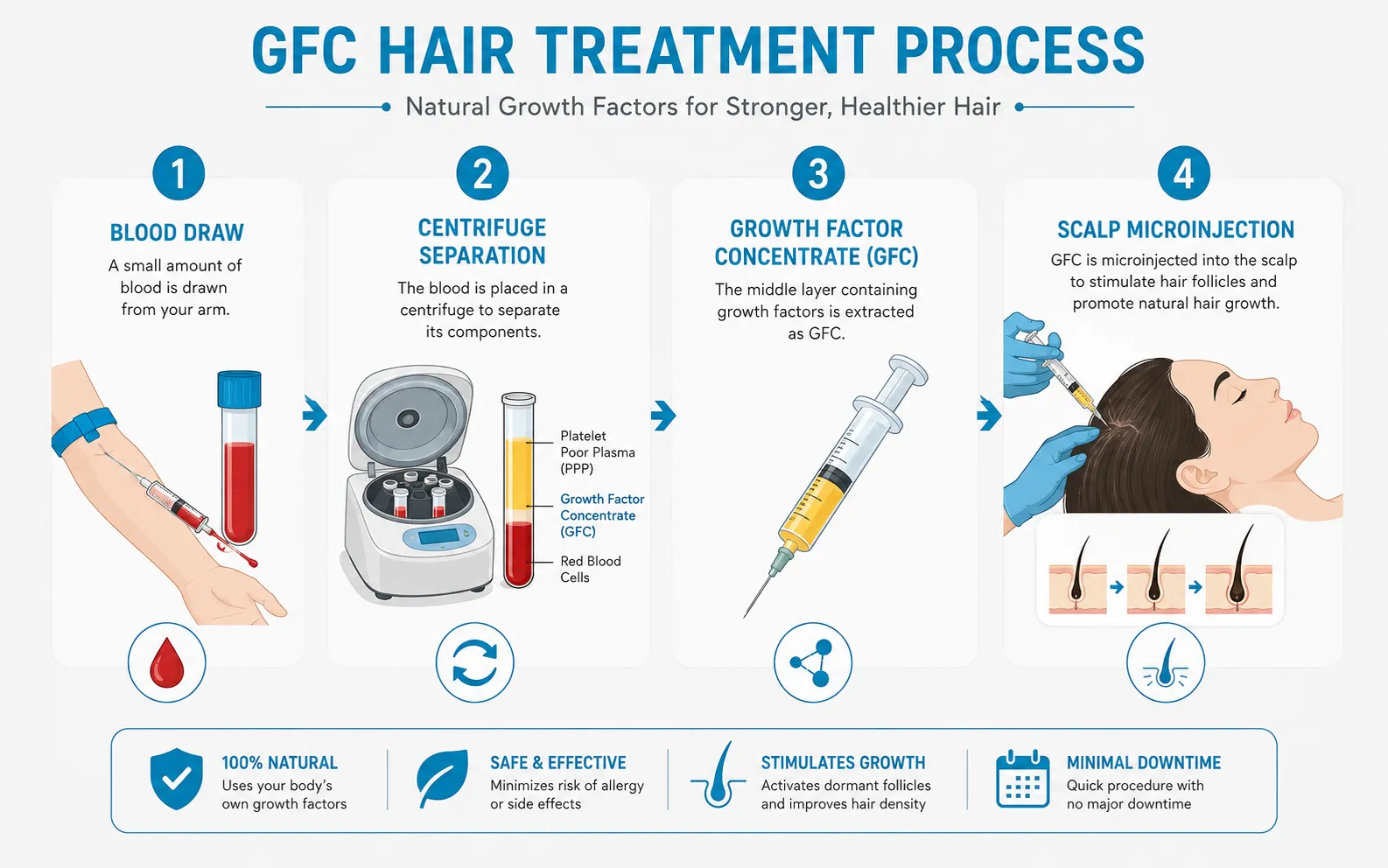
Hair thinning and hair loss affect millions of people across India, yet many remain unaware of newer, evidence-backed options beyond the familiar shampoos and supplements. GFC hair treatment — short for Growth Factor Concentrate therapy — is rapidly gaining recognition as a next-generation, minimally invasive approach to hair regrowth. Unlike older platelet-based therapies, GFC uses a highly purified concentrate of growth factors drawn from your own blood, delivering a more targeted biological signal to dormant hair follicles.
This guide explains the science behind GFC therapy, walks you through the procedure step by step, sets realistic expectations for results, and answers the questions patients most commonly ask before their first session.
GFC stands for Growth Factor Concentrate. It is an autologous (self-derived) biological therapy in which a small sample of the patient's own blood is processed using a specialised kit to extract a highly concentrated serum rich in growth factors — proteins that regulate cell proliferation, differentiation, and tissue repair.
The key growth factors involved include Platelet-Derived Growth Factor (PDGF), Vascular Endothelial Growth Factor (VEGF), Epidermal Growth Factor (EGF), and Insulin-like Growth Factor (IGF). When injected into the scalp, these proteins stimulate hair follicles that have entered a resting or miniaturising phase, encouraging them to re-enter the active growth (anagen) phase.
GFC is often compared to PRP (Platelet-Rich Plasma), and the two share a conceptual foundation. However, GFC processing eliminates red blood cells and most white blood cells, yielding a purer, more concentrated growth factor payload with less inflammatory potential. Several dermatology studies have noted higher growth factor concentrations in GFC preparations compared to standard PRP, which may translate to more consistent clinical outcomes — though large-scale randomised trials are still ongoing.
Hair grows in a cyclical pattern: anagen (active growth), catagen (transition), and telogen (resting/shedding). In androgenetic alopecia — the most common form of hair loss in both men and women — follicles progressively miniaturise under the influence of dihydrotestosterone (DHT), shortening the anagen phase until hairs become fine, short, and eventually absent.
Growth factors in GFC counteract this process through several mechanisms:
Follicle stimulation: PDGF and EGF bind to receptors on dermal papilla cells — the control centre of each follicle — promoting cell division and prolonging the anagen phase.
Angiogenesis: VEGF encourages the formation of new blood vessels around follicles, improving nutrient and oxygen delivery.
Anti-apoptotic signalling: Growth factors suppress programmed cell death in follicular cells, helping preserve existing follicles.
Stem cell activation: Emerging research suggests growth factors may activate quiescent follicular stem cells in the bulge region, a key reservoir for hair regeneration.
Because GFC is derived from the patient's own blood, the risk of allergic reaction or immune rejection is negligible — a significant safety advantage over synthetic or donor-derived treatments.
A typical GFC session at a qualified clinic follows a structured, same-day protocol:
Consultation and scalp assessment: The treating physician evaluates the pattern and grade of hair loss (often using the Norwood-Hamilton or Ludwig scale), reviews medical history, and confirms the patient is a suitable candidate.
Blood draw: Approximately 16–32 ml of blood is drawn from the patient's arm — similar to a routine blood test.
GFC preparation: The blood is placed into proprietary GFC tubes containing a gel separator and activators. The tubes are centrifuged at a specific speed and duration to separate the growth factor–rich plasma from red blood cells and other components. The resulting clear-to-straw-coloured concentrate is aspirated into syringes.
Scalp preparation: The scalp is cleansed and, in most cases, a topical anaesthetic cream is applied for 30–45 minutes to minimise discomfort during injections.
Microinjection: The GFC serum is injected into the scalp at the level of the hair follicles using fine needles, typically in a grid pattern across the affected area. The injection depth and spacing are calibrated to the individual's scalp anatomy.
Post-procedure care: Patients receive aftercare instructions — usually avoiding hair washing for 24 hours, refraining from vigorous exercise for 48 hours, and avoiding direct sun exposure on the scalp for a few days.
The entire session, from blood draw to completion, typically takes 45–75 minutes and requires no hospital admission. Patients can return to desk-based work the same day.
GFC therapy is most effective for patients who still have a reasonable number of living follicles — the treatment stimulates existing follicles rather than creating new ones. Ideal candidates include:
Men and women with early to moderate androgenetic alopecia (Norwood grades I–IV in men; Ludwig grades I–II in women)
Individuals experiencing diffuse thinning rather than complete bald patches
Patients with telogen effluvium (stress- or nutrition-related shedding) who want to accelerate recovery
Those seeking a non-surgical complement to minoxidil, finasteride, or post-hair-transplant recovery
GFC is generally not recommended for patients with active scalp infections, blood disorders, those on anticoagulant therapy, or individuals with very advanced alopecia where follicles are no longer present. A physician assessment is essential before proceeding. Profrea's dermatology and aesthetic medicine specialists in Gurugram conduct a thorough scalp evaluation to determine candidacy before any treatment is recommended.
Most protocols recommend an induction phase of 3–4 sessions, spaced approximately 3–4 weeks apart. This is followed by maintenance sessions every 4–6 months, depending on the individual's response.
The exact number varies based on:
The severity and duration of hair loss
Underlying cause (androgenetic vs. effluvium vs. post-transplant)
The patient's biological response to growth factor therapy
Whether GFC is used alone or in combination with other treatments
Patients who combine GFC with topical minoxidil or low-level laser therapy (LLLT) often report faster and more sustained improvements, as these modalities work through complementary pathways.
Managing expectations is central to patient satisfaction. GFC is not a cure for hair loss — it is a biological stimulus that, in appropriate candidates, can meaningfully slow progression and improve hair density and calibre.
Here is a realistic timeline:
Weeks 1–4: Reduced shedding is often the first sign that the treatment is working. Some patients notice increased shedding in the first 2 weeks — this is a normal part of the follicular cycling process and typically resolves.
Months 2–3: Fine, new hairs (vellus hairs) may begin to appear in thinning areas. Hair texture often improves — existing strands may feel thicker and stronger.
Months 4–6: Visible improvement in hair density becomes apparent to both the patient and clinician. Photographic comparison at this stage typically shows measurable regrowth.
Months 6–12: Peak results are usually observed after completing the induction course and one maintenance session. Continued improvement is possible with ongoing maintenance.
Clinical studies published in peer-reviewed dermatology journals, including data reviewed by the National Institutes of Health (NIH) on PubMed, have reported statistically significant improvements in hair density and shaft diameter following growth factor concentrate therapy in patients with androgenetic alopecia, with a favourable safety profile across multiple studies.
It is important to note that results vary between individuals. Patients with early-stage hair loss and good overall health tend to respond best. A realistic goal is stabilisation of hair loss and a 20–40% improvement in density over a full treatment course — not a return to the hair density of one's twenties.
Pain tolerance varies between individuals, but most patients describe the procedure as mildly uncomfortable rather than painful when a topical anaesthetic is used. The injections produce a brief stinging or pressure sensation. Some clinics also offer nerve blocks or vibration anaesthesia devices to further reduce discomfort.
After the session, mild scalp tenderness, redness, or a feeling of tightness is common and typically resolves within 24–48 hours. Swelling on the forehead (due to fluid tracking downward) occasionally occurs and settles within 2–3 days.
Because GFC uses the patient's own blood, the risk of systemic adverse effects is very low. Reported side effects are generally mild and localised:
Temporary redness and swelling at injection sites
Mild scalp soreness for 24–72 hours
Occasional small bruises at the blood draw site
Transient increased shedding in the first 1–2 weeks (a known phenomenon with follicular stimulation therapies)
Serious complications such as infection, scarring, or nerve injury are rare when the procedure is performed by a trained clinician using sterile technique. Choosing a qualified medical professional — rather than a beauty salon or unregulated provider — is the single most important safety consideration.
Profrea's network includes experienced physicians such as Dr. Shikha Bansal, a plastic surgeon with an MCh from SMS Medical College, Jaipur, and over 9 years of experience in aesthetic and reconstructive procedures across Gurugram. Patients considering aesthetic treatments at Profrea benefit from physician-led care plans rather than technician-administered protocols.
The table below summarises the key differences between GFC and conventional PRP hair therapy:
| Feature | GFC | PRP |
|---|---|---|
| Source | Patient's own blood | Patient's own blood |
| Processing | Specialised GFC kit; removes RBCs and WBCs | Standard centrifuge; retains some WBCs |
| Growth factor concentration | Higher (more purified) | Moderate |
| Inflammatory potential | Lower | Moderate |
| Post-procedure discomfort | Generally milder | Mild to moderate |
| Evidence base | Emerging; promising early data | More established; larger body of studies |
Neither treatment is universally superior — the right choice depends on the individual patient's profile, the clinician's assessment, and the specific hair loss condition being treated.
GFC is rarely used in isolation by experienced clinicians. A multimodal approach typically yields the best outcomes:
Topical minoxidil (2% or 5%): Extends the anagen phase through a different mechanism; synergises well with GFC.
Oral finasteride or dutasteride (for men): Addresses the hormonal root cause of androgenetic alopecia; GFC then works on top of a stabilised hormonal environment.
Nutritional optimisation: Deficiencies in iron, ferritin, vitamin D, zinc, and biotin are common contributors to hair loss. Profrea's nutrition and dietetics specialists can assess and correct underlying nutritional gaps that undermine hair health.
Low-Level Laser Therapy (LLLT): Photobiomodulation devices can complement GFC by improving scalp microcirculation.
Post-hair transplant recovery: GFC is increasingly used after FUE or FUT procedures to accelerate graft survival and reduce the shock loss period.
A holistic assessment — including hormonal panels, nutritional blood work, and a detailed scalp examination — is the foundation of effective hair loss management. Profrea's multi-specialty structure, spanning general medicine and metabolic health through to aesthetic procedures, enables this kind of integrated evaluation under one roof across 7 clinic locations in Gurugram.
GFC (Growth Factor Concentrate) hair treatment is a minimally invasive procedure in which a concentrated serum of growth factors — derived from your own blood — is injected into the scalp. These growth factors stimulate dormant hair follicles, prolong the active growth phase, improve blood supply to follicles, and reduce follicular cell death, collectively promoting hair regrowth and reducing shedding.
Most patients undergo an induction course of 3–4 sessions spaced 3–4 weeks apart, followed by maintenance sessions every 4–6 months. The exact number depends on the severity of hair loss, the underlying cause, and how well the individual responds to treatment. Your physician will personalise the protocol after a thorough scalp assessment.
With topical anaesthetic cream applied before the procedure, most patients experience mild discomfort rather than significant pain — often described as a brief stinging or pressure sensation during injections. Post-procedure soreness and redness typically resolve within 24–48 hours.
Side effects are generally mild and temporary: localised redness, swelling, and tenderness at injection sites; occasional bruising at the blood draw site; and a transient increase in shedding during the first 1–2 weeks. Because GFC uses your own blood, allergic reactions are extremely rare. Serious complications are uncommon when the procedure is performed by a qualified clinician.
Reduced shedding is often noticed within the first month. Visible new hair growth typically becomes apparent between months 2 and 4, with peak density improvements seen at 6–12 months after completing the induction course. Hair regrowth is a gradual biological process — patience and adherence to the full treatment plan are essential for optimal outcomes.
GFC offers a more purified growth factor concentrate with lower inflammatory potential compared to standard PRP. Early clinical data is promising, but both treatments can be effective depending on the patient's profile. A dermatologist or aesthetic physician is best placed to recommend the right option — or combination — for your specific type and stage of hair loss.
Physician-led assessment — not a technician-only consultation
Standardised, certified GFC kit (not improvised centrifuge protocols)
Transparent discussion of realistic outcomes and the number of sessions required
Integration with other hair loss treatments where appropriate
Follow-up and photographic tracking to objectively measure progress
Profrea's multi-specialty clinic network across Gurugram brings together aesthetic physicians, plastic surgeons, and general medicine specialists — including Dr. Shikha Bansal (MCh Plastic Surgery) and Dr. Soma Kumari — to support comprehensive, personalised care plans. You can also explore Profrea's health screening packages to identify nutritional or hormonal contributors to hair loss before beginning any treatment.
Speak with a Profrea physician at one of our 7 Gurugram clinic locations — or book a video consultation from wherever you are — to find out whether GFC therapy is right for your hair loss pattern.