
A clinical guide to how gait rehabilitation works, who it helps, and what to expect from a structured physiotherapy programme for walking problems.
By the Profrea Clinical Team · Published July 2026
Gait training is a structured, physiotherapy-led rehabilitation approach designed to improve the way a person walks. It addresses the mechanics of walking — including stride length, step symmetry, posture, balance, and lower-limb coordination — that can be disrupted by illness, injury, surgery, or a neurological event such as a stroke.
Walking is one of the most complex movements the human body performs. It requires the coordinated effort of muscles, joints, the vestibular system, and the nervous system. When any part of this chain is compromised, the resulting gait abnormality can affect not just mobility but also safety, confidence, and quality of life.
Gait training is not a single exercise — it is a personalised programme that a qualified physiotherapist designs after a thorough assessment of the patient's movement patterns, strength, balance, and underlying condition. At Profrea's physiotherapy clinics in Gurugram, this assessment-first approach ensures that every rehabilitation plan is matched to the individual's goals and clinical needs.
Gait abnormalities arise from a wide range of conditions. Understanding the root cause is essential before any rehabilitation programme begins. The most frequent reasons patients seek gait rehabilitation include:
Stroke and hemiplegia: Damage to motor pathways in the brain can cause weakness, spasticity, or foot drop on one side, significantly altering walking mechanics.
Neurological conditions: Parkinson's disease, multiple sclerosis, cerebral palsy, and peripheral neuropathy each produce characteristic gait disturbances — from the shuffling gait of Parkinson's to the wide-based, unsteady walk of cerebellar ataxia.
Post-surgical recovery: Hip replacement, knee replacement, spinal surgery, and fracture repair all require a period of gait retraining as the body adapts to new biomechanics or healed structures.
Orthopaedic injuries: Ligament tears, muscle injuries, and chronic joint pain can cause compensatory walking patterns that, if left uncorrected, lead to secondary problems in the knees, hips, or lower back.
Age-related changes: Reduced muscle strength, joint stiffness, and declining proprioception in older adults increase fall risk and reduce walking efficiency.
Vestibular disorders: Inner-ear problems that affect balance can make walking feel unsafe and unsteady.
According to the World Health Organization, falls are the second leading cause of accidental injury deaths globally, and impaired gait is one of the most significant modifiable risk factors — underscoring why timely gait rehabilitation matters.
A well-structured gait training programme typically unfolds in several phases, each building on the last. Here is what patients can generally expect:
The physiotherapist observes the patient walking, assesses muscle strength, joint range of motion, balance, and neurological function. Standardised tools such as the Timed Up and Go (TUG) test or the Berg Balance Scale may be used to establish a baseline. From this, a personalised programme is designed with clear, measurable goals.
Before focusing on walking itself, the programme often addresses underlying muscle weakness or tightness — particularly in the hip flexors, quadriceps, hamstrings, calves, and core. These muscles form the foundation of efficient, safe walking.
Exercises on stable and unstable surfaces train the body's ability to sense its own position in space. This is particularly important for patients with neurological conditions or those recovering from lower-limb injuries. Single-leg standing, balance board work, and targeted coordination drills are commonly used.
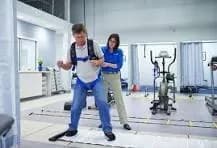
The physiotherapist guides the patient through walking exercises that specifically target the identified abnormalities — whether that is foot drop, shortened stride, trunk sway, or asymmetrical weight-bearing. Feedback is given in real time, and exercises are progressively made more challenging as the patient improves.
Where appropriate, patients are trained to use walking aids — crutches, walking frames, or ankle-foot orthoses — correctly and safely. The goal is always to reduce dependence on aids over time as strength and confidence improve.
The final phase focuses on real-world walking challenges: navigating stairs, uneven surfaces, slopes, and crowded environments. This prepares patients for independent, safe mobility in daily life.
Stroke is one of the most common reasons patients require intensive gait rehabilitation. Post-stroke gait disturbances — including hemiparetic gait, foot drop, and reduced walking speed — significantly affect independence and quality of life.
Research published by the National Institutes of Health (NIH) confirms that task-specific gait training — where patients practise walking itself, rather than only performing isolated exercises — produces meaningful improvements in walking speed, endurance, and balance in stroke survivors.
Key techniques used in post-stroke gait rehabilitation include:
Repetitive, task-oriented walking practice on flat and varied surfaces
Body-weight-supported treadmill training (where available)
Neuromuscular re-education to address spasticity and foot drop
Mirror therapy and proprioceptive neuromuscular facilitation (PNF) techniques
Electrical stimulation for foot drop correction
Early initiation of rehabilitation — ideally within days of a stroke — is associated with better outcomes. If you or a family member is seeking physiotherapy support in Gurugram following a neurological event, a prompt assessment is strongly recommended.
Beyond stroke, several neurological conditions benefit substantially from structured gait therapy:
The characteristic shuffling gait, freezing episodes, and reduced arm swing of Parkinson's disease respond well to cueing strategies — rhythmic auditory cues (such as a metronome), visual floor markers, and attentional focus techniques that help patients override the disrupted automatic walking signals from the basal ganglia.
Fatigue, spasticity, and balance impairment are the primary gait challenges in MS. Physiotherapy focuses on energy conservation strategies, lower-limb strengthening, and balance training, adapted to the patient's fluctuating symptom levels.
Children and adults with cerebral palsy often present with scissor gait, toe-walking, or crouched gait patterns. Gait training — combined with orthotic management and sometimes botulinum toxin injections — can meaningfully improve walking efficiency and reduce the long-term impact on joints.
Post-operative gait retraining is a critical but sometimes overlooked component of surgical recovery. After procedures such as total knee replacement, total hip replacement, or spinal decompression, patients frequently develop compensatory walking patterns — either because of pain, fear of movement, or muscle weakness from the period of reduced activity.
If these compensatory patterns are not corrected early, they can become habitual and place excessive load on adjacent joints, increasing the risk of secondary problems. A structured gait training programme, beginning as soon as the surgical team clears the patient for weight-bearing, is the most effective way to restore normal walking mechanics and protect the surgical outcome.
Profrea's physiotherapy and rehabilitation team in Gurugram works closely with orthopaedic and surgical specialists to coordinate post-operative care plans, ensuring continuity from hospital discharge through to full functional recovery.
Falls are a leading cause of injury-related hospitalisation among adults over 65. Declining muscle strength, reduced proprioception, slower reaction times, and medication side-effects all contribute to gait instability in older age. The good news is that gait and balance training is highly effective in this group — even modest improvements in strength and balance can substantially reduce fall risk.
A physiotherapy-led programme for older adults typically includes:
Progressive lower-limb strengthening (squats, step-ups, calf raises)
Static and dynamic balance exercises
Dual-task training — practising walking while performing a cognitive task, which mimics real-world demands
Gait speed and stride-length improvement exercises
Home environment safety advice to reduce fall hazards
If you are concerned about an older family member's walking stability, a physiotherapy assessment at one of Profrea's seven clinic locations across Gurugram is a practical first step.
Many patients are unsure what a gait physiotherapy appointment involves. Here is a straightforward overview:
History taking: The physiotherapist will ask about your medical history, the onset of your walking difficulty, any relevant diagnoses, medications, and your daily activity level.
Observational gait analysis: You will be asked to walk along a corridor or designated space while the therapist observes your walking pattern from the front, side, and behind.
Physical examination: Muscle strength, joint range of motion, sensation, reflexes, and balance will be assessed.
Goal discussion: The therapist will discuss your personal goals — whether that is returning to work, walking independently at home, or resuming recreational activities.
Programme outline: You will receive a clear explanation of the proposed treatment plan, including the frequency of sessions and any home exercises.
Sessions are typically 45–60 minutes. The number of sessions required varies widely depending on the underlying condition, severity of the gait problem, and the patient's response to treatment. Most patients notice measurable improvements within 4–8 weeks of consistent therapy.
Gurugram's rapid urbanisation has brought with it a growing population of working professionals, older adults, and post-surgical patients who need accessible, high-quality physiotherapy without the inconvenience of travelling to a large hospital. Profrea's network of seven clinics across the city is designed to meet this need.
What distinguishes Profrea's physiotherapy service is its consultation-led, assessment-first model. Rather than offering generic exercise classes, every patient undergoes a structured clinical assessment before treatment begins. This ensures that the gait training programme addresses the actual cause of the walking problem — not just its surface symptoms.
The clinics are equipped with dedicated rehabilitation spaces, and the team includes experienced physiotherapists with expertise in neurological, orthopaedic, and age-related gait conditions. For patients who find travel difficult, video consultation options are also available for initial assessments and follow-up reviews.
Profrea's multi-specialty structure also means that when gait problems have a complex underlying cause — for example, a neurological condition requiring both physiotherapy and specialist medical management — patients can access coordinated care across specialties within the same network.
Most patients notice meaningful improvements in walking confidence and stability within 4–8 weeks of regular physiotherapy sessions. The total duration of a programme depends on the underlying condition, its severity, and how consistently the patient practises home exercises between sessions.
Gait training should not be painful. Some muscle fatigue or mild soreness after sessions is normal, particularly in the early stages when muscles are being worked in new ways. A good physiotherapist will always work within your comfort level and adjust the programme if any exercise causes pain.
Yes — post-operative gait retraining is an important part of recovery after joint replacement surgery. It helps correct compensatory walking patterns, rebuild muscle strength around the new joint, and restore normal walking mechanics. Starting rehabilitation promptly after surgery, as directed by your surgical team, produces the best outcomes.
General physiotherapy covers a broad range of musculoskeletal and neurological conditions. Gait training is a specific component of physiotherapy that focuses on analysing and improving walking patterns. It may be part of a broader physiotherapy programme or, for patients whose primary problem is walking difficulty, the central focus of treatment.
In most cases, you can book a physiotherapy assessment directly without a referral. However, if your walking difficulty is related to a neurological condition, recent surgery, or an undiagnosed medical problem, it is advisable to have a medical consultation first so that the physiotherapist has a clear clinical picture to work from.
This varies considerably. A patient recovering from a minor orthopaedic injury may need 6–10 sessions, while someone with a chronic neurological condition may benefit from ongoing, long-term physiotherapy. Your physiotherapist will give you a realistic estimate after the initial assessment and review progress regularly.
Profrea's physiotherapy team in Gurugram offers personalised gait assessments and rehabilitation programmes — in clinic or via video consultation.