

A fever lasting more than two days — or one that keeps climbing — is your body's urgent signal. Know the warning signs, understand what your doctor will look for, and find out how Profrea's general physicians in Gurugram can help.
By the Profrea Medical Editorial Team · Published July 2026
Most of us have grown up treating fever as a minor inconvenience — a couple of paracetamol tablets, a day in bed, and we expect to be fine by morning. And often, that's exactly what happens. A low-grade fever (below 38.5°C / 101.3°F) triggered by a common viral infection typically resolves on its own within 24 to 48 hours.
But Gurugram's climate, dense population, and monsoon-season mosquito activity create a very real risk of infections that look like ordinary fever at first — and then escalate quickly. Dengue fever, typhoid, leptospirosis, and malaria all begin with what feels like a routine temperature spike. Missing the window for early diagnosis and treatment can turn a manageable illness into a medical emergency.
According to the World Health Organization's dengue fact sheet, the global incidence of dengue has grown dramatically in recent decades, with an estimated 100–400 million infections occurring every year — and India remains one of the highest-burden countries. Early clinical recognition and physician-guided management are the single most effective interventions available.
There is no single magic number, but experienced general physicians use a combination of temperature, duration, and accompanying symptoms to decide how urgently a patient needs evaluation. Here is a practical guide:
Fever is above 38.5°C (101.3°F) and has lasted more than 48 hours despite paracetamol or ibuprofen
You have a fever alongside a severe headache, pain behind the eyes, or a skin rash
You feel unusually fatigued — not just tired, but unable to get out of bed
You have joint or muscle pain that feels disproportionate to a simple cold
You have returned from travel within or outside Gurugram in the past two weeks
You have young children, are pregnant, are over 60, or have diabetes or an immune condition
Fever exceeds 40°C (104°F) at any point
You notice bleeding from the gums, nose, or in your urine or stool
You experience sudden drop in blood pressure, cold clammy skin, or confusion
A child under 3 months has any fever at all — this is always an emergency
Breathing becomes rapid or laboured alongside fever
If you are unsure whether your symptoms warrant an in-person visit, Profrea offers video consultations so you can speak with a qualified physician from home and get a clear recommendation within minutes — without the risk of spreading infection in a waiting room.
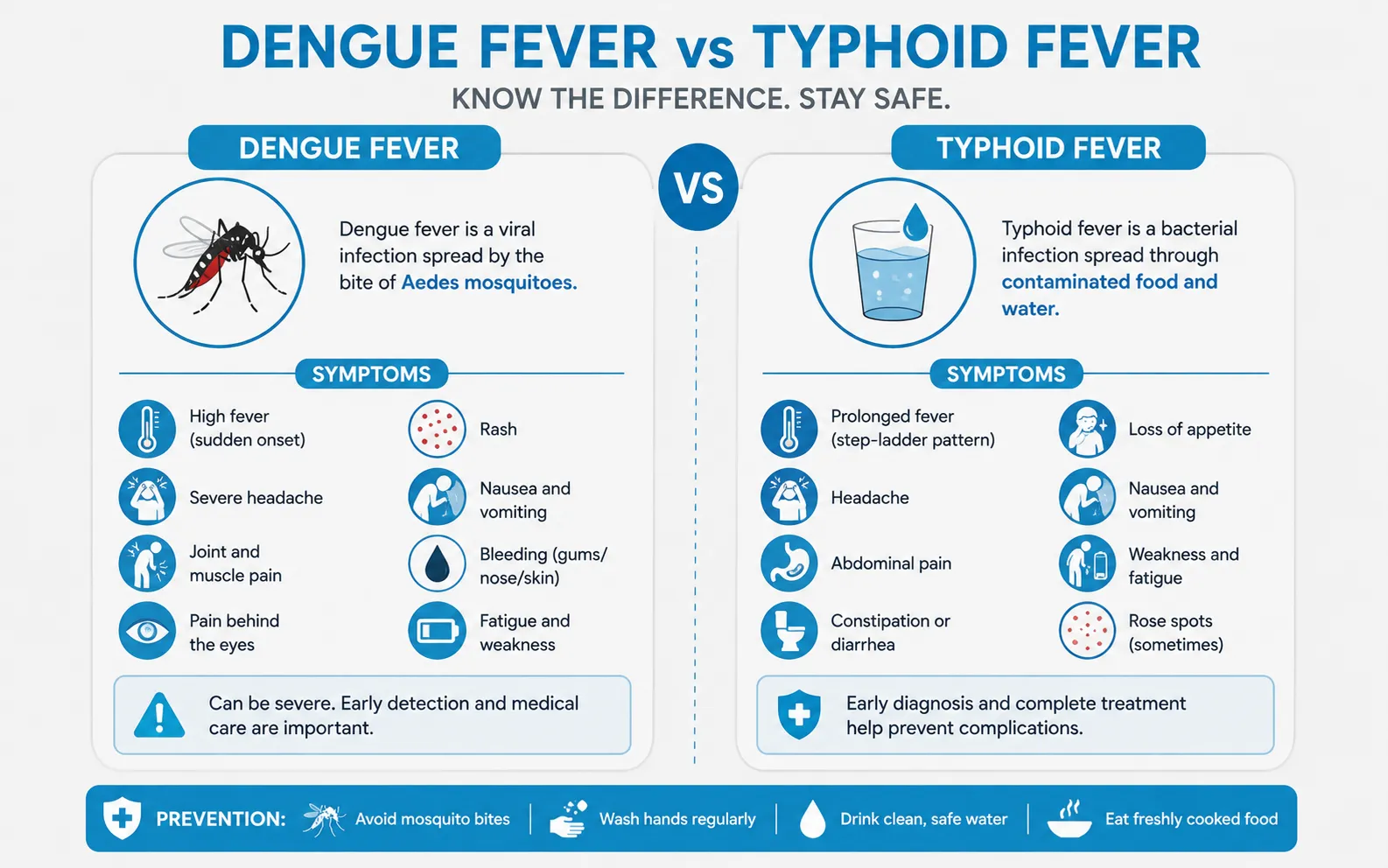
Both dengue and typhoid are common causes of prolonged fever in Gurugram, particularly from July through November. Understanding the difference matters because the treatment pathways are completely distinct.
Caused by the dengue virus transmitted through the bite of the Aedes aegypti mosquito, dengue typically presents with a sudden high fever (often 39–40°C), severe headache, pain behind the eyes, muscle and joint pain (earning it the nickname "breakbone fever"), and a characteristic rash that appears 2–5 days after fever onset. The critical danger in dengue is a drop in platelet count, which can lead to internal bleeding. There is no specific antiviral treatment — management focuses on hydration, monitoring platelet levels, and preventing complications. A physician's role is to catch the warning signs of severe dengue (dengue haemorrhagic fever) before they escalate.
Typhoid is caused by Salmonella typhi, a bacterium spread through contaminated food and water. Unlike dengue, typhoid fever tends to rise gradually over several days, often accompanied by abdominal pain, constipation or diarrhoea, a coated tongue, and a characteristic "step-ladder" fever pattern. Crucially, typhoid responds to antibiotics — but only the right ones, and only when started promptly. Delayed treatment increases the risk of intestinal perforation, a life-threatening complication. A physician like Dr. Ladli Chatterjee, who holds a Fellowship in Diabetes and General Medicine from the Royal Liverpool Academy, UK, is trained to differentiate these presentations clinically and order the appropriate confirmatory tests.
The key takeaway: self-diagnosis between dengue and typhoid is unreliable. Both require blood tests for confirmation, and the treatment for one is inappropriate — and potentially harmful — for the other.
When you visit a general physician for a fever that has lasted more than two days, expect a structured clinical evaluation — not just a prescription. Here is what a thorough workup typically includes:
Complete Blood Count (CBC): The first and most informative test. Low platelet count points toward dengue; elevated white cell count with a left shift suggests bacterial infection like typhoid.
NS1 Antigen Test: A rapid blood test that can detect dengue virus in the first 5 days of illness, before antibodies develop.
Dengue IgM/IgG Antibodies: Useful from day 5 onwards to confirm dengue infection.
Widal Test / Blood Culture: The Widal test screens for typhoid antibodies; blood culture is the gold standard for confirming Salmonella typhi infection.
Malaria Rapid Diagnostic Test (RDT) or Peripheral Smear: Ordered when malaria is a possibility based on travel history or symptom pattern.
Liver Function Tests (LFTs): Both dengue and typhoid can affect the liver; elevated enzymes help gauge severity.
Urine Routine Examination: Rules out urinary tract infection as a cause of fever, particularly in women.
Based on these results, your physician will either initiate treatment directly or refer you to a specialist if the findings suggest a more complex underlying condition. The entire diagnostic pathway — from consultation to test results to treatment plan — can often be completed within 24 hours at Profrea's clinics across Gurugram.
Profrea's General Medicine team in Gurugram includes clinicians with specific training in infectious disease presentations common to the region.
Dr. Ladli Chatterjee (MBBS, MD in General Medicine, FIDD, FAM, Fellowship in Diabetes — Royal Liverpool Academy, UK) brings a dual expertise in general medicine and metabolic conditions. She is available at Profrea's Sector 45, South City-I, and Sector 52 clinics in Gurgaon. Her training in systemic medicine means she is well-positioned to evaluate fever in patients with comorbidities such as diabetes, where infections like dengue and typhoid can behave atypically and carry higher risk.
Dr. Sanjay Misra (MBBS) is a general physician available across Profrea's Gurugram network. He provides accessible, first-contact care for patients presenting with acute fever, helping triage those who need urgent investigation from those who can be managed conservatively.
You can view Dr. Ladli Chatterjee's profile and book a consultation directly through Profrea's website or mobile app.
Yes — and in most cases, a general physician is exactly the right first point of contact. General physicians are trained to take a detailed history, perform a clinical examination, and interpret the diagnostic tests needed to confirm or rule out dengue, typhoid, malaria, and other causes of prolonged fever. They can initiate treatment, monitor your recovery, and refer you to a specialist (such as an infectious disease specialist or gastroenterologist) if complications arise.
Seeing a specialist directly without a physician's initial assessment can actually slow down your care — a general physician's structured evaluation ensures you get the right tests in the right order, without unnecessary expense or delay.
Gurugram's rapid urbanisation has created pockets of stagnant water in construction sites, low-lying areas, and even residential colonies — ideal breeding grounds for the Aedes mosquito. The city consistently reports a spike in dengue cases between August and October each year. Simultaneously, contaminated water supply during heavy rains raises the risk of typhoid and hepatitis A.
Practical prevention steps include:
Eliminating standing water in and around your home (flower pots, coolers, tyres)
Using mosquito repellents and nets, especially during early morning and evening hours
Drinking only boiled or sealed bottled water during and after heavy rain
Ensuring your typhoid vaccination is up to date (the Vi polysaccharide vaccine offers protection for 2–3 years)
Seeking physician review promptly if fever develops — do not wait to see if it "settles on its own" beyond 48 hours
Profrea's 7 clinic locations spread across Gurugram mean that for most residents, a same-day or next-day in-person consultation is genuinely accessible. And for those who cannot travel, video consultations with Dr. Ladli Chatterjee are available through the Profrea app — allowing a physician to assess your symptoms, advise on which tests to get done locally, and review results remotely.
Sometimes a persistent fever is the first sign of an underlying condition that has gone undetected — anaemia, an autoimmune disorder, or even early-stage diabetes, which impairs immune function and makes infections harder to clear. Profrea offers structured health screening packages that can provide a baseline picture of your overall health, making it easier for your physician to interpret future illness episodes in context.
If you have been experiencing recurrent fevers or feel your immunity has been low, consider booking a Profrea Health Screen alongside your physician consultation. The Profrea Health Screen Premium includes a comprehensive panel of blood tests that can surface conditions your fever may be masking.
See a general physician if your fever is above 38.5°C and has not improved after 48 hours, if it is accompanied by a rash, severe headache, joint pain, or bleeding, or if you have any underlying health condition. Do not wait longer than two days for a fever you cannot explain.
Dengue is a viral infection spread by mosquitoes, causing sudden high fever, eye pain, rash, and low platelet count. Typhoid is a bacterial infection spread through contaminated food and water, causing a gradual step-ladder fever, abdominal symptoms, and a coated tongue. Both require blood tests to confirm — they cannot be reliably distinguished by symptoms alone.
Yes. A general physician is the appropriate first point of contact. They will take your history, examine you, order the relevant blood tests (NS1 antigen, CBC, Widal, blood culture), interpret the results, and initiate treatment. Specialist referral is only needed if complications arise.
Typically: Complete Blood Count (CBC), NS1 antigen test, dengue antibodies (IgM/IgG), Widal test or blood culture for typhoid, malaria RDT if indicated, liver function tests, and urine routine examination. The exact panel depends on your symptoms, travel history, and how long the fever has lasted.
Yes. Profrea offers video consultations through its mobile app and website. A physician can assess your symptoms remotely, advise on which tests to get done at a nearby lab, and review your results — all without you needing to travel to a clinic. This is particularly useful in the early stages of illness when you may not feel well enough to leave home.
Profrea's general physicians in Gurugram are available for same-day in-clinic and video consultations — so you get answers and a treatment plan fast.