

Everything you need to know about supervised fasting therapy — from intermittent fasting to guided detox programs — and how it fits into a naturopathic wellness plan in Gurugram.
By Profrea· Published June 2026
Fasting is one of humanity's oldest healing traditions — referenced in Ayurvedic texts, ancient Greek medicine, and modern clinical research alike. Yet for most people in today's fast-paced urban environment, the idea of deliberately abstaining from food feels counterintuitive. What if controlled, professionally supervised fasting is precisely what your body needs to reset, repair, and thrive?
This guide unpacks the science and practice of fasting therapy — covering intermittent fasting, therapeutic fasting, and guided detox programs — and explains why professional supervision matters, especially when you have specific health goals or an underlying condition. Profrea's naturopathy specialists in Gurugram integrate fasting therapy into personalised wellness plans designed around your medical history, lifestyle, and nutritional needs.
Fasting therapy is a structured, clinically guided practice of abstaining from food — and sometimes specific beverages — for defined periods to support the body's innate healing mechanisms. Unlike crash dieting or unsupervised skipping of meals, therapeutic fasting is intentional, time-bound, and tailored to the individual.
There are several recognised approaches:
Intermittent Fasting (IF): Cycling between eating windows and fasting periods — common protocols include 16:8 (16 hours fasting, 8 hours eating) and 5:2 (normal eating five days, restricted calories two days).
Short-Term Therapeutic Fasting: A 24–72-hour medically supervised fast, often used to initiate detoxification or metabolic reset.
Modified Fasting / Fasting-Mimicking Diets: Very low-calorie, nutrient-specific protocols that replicate the physiological benefits of fasting while allowing some food intake.
Juice or Broth Fasting: Liquid-only programs that provide micronutrients while giving the digestive system a rest.
Each approach has distinct indications, contraindications, and optimal durations. A qualified naturopathy practitioner will assess which protocol — or combination — is appropriate for you before any program begins.
Modern research has shed considerable light on why fasting produces measurable health benefits. Several key biological processes are activated during a fasting state:
When the body is deprived of external nutrients, it activates autophagy — a process by which cells break down and recycle damaged proteins and organelles. This cellular housekeeping is linked to reduced inflammation and improved cellular longevity. Research published by the National Institutes of Health (NIH) highlights autophagy as a central mechanism through which fasting exerts its protective effects on metabolic and cellular health.
After glycogen stores are depleted — typically 12–16 hours into a fast — the liver begins converting fatty acids into ketone bodies. This metabolic switch from glucose to ketones as a primary fuel source is associated with improved insulin sensitivity, reduced blood glucose variability, and enhanced mental clarity. For individuals managing pre-diabetes or metabolic syndrome, this shift can be clinically significant.
Continuous eating — especially of processed foods — keeps the digestive system in a near-constant state of activity. Fasting periods allow the gut lining to repair, reduce intestinal permeability, and support a more balanced gut microbiome. Improved gut health has downstream effects on immunity, mood, and systemic inflammation.
Fasting modulates several key hormones: insulin levels drop (improving sensitivity), human growth hormone (HGH) levels rise (supporting fat metabolism and muscle preservation), and norepinephrine increases (enhancing fat breakdown). These hormonal shifts collectively support weight management and metabolic health.
When conducted under professional supervision, fasting therapy can offer a wide range of evidence-informed benefits:
Natural Detoxification: Reduced digestive load allows the liver and kidneys to more efficiently process and eliminate metabolic waste products.
Weight and Fat Loss: Caloric restriction combined with metabolic switching promotes fat utilisation without significant muscle loss when protein intake is optimised around eating windows.
Improved Insulin Sensitivity: Particularly relevant for individuals with pre-diabetes, PCOS, or metabolic syndrome.
Reduced Systemic Inflammation: Lower circulating inflammatory markers have been observed in multiple clinical studies on intermittent fasting.
Enhanced Mental Clarity and Energy: Many individuals report improved focus and sustained energy levels once they adapt to a fasting protocol — typically within 1–2 weeks.
Digestive Reset: Relief from bloating, sluggish digestion, and food sensitivities through gut rest and microbiome rebalancing.
Cardiovascular Support: Improvements in blood pressure, LDL cholesterol, and triglyceride levels have been documented in supervised fasting programs.
It is important to note that individual responses vary. A qualified dietitian or naturopathy specialist at Profrea will assess your baseline health markers before recommending any fasting protocol.
Fasting therapy is not a one-size-fits-all intervention. It is generally well-suited for adults who:
Want to support natural detoxification and digestive health
Are managing weight or metabolic conditions such as insulin resistance or high triglycerides
Experience chronic fatigue, brain fog, or low energy linked to poor metabolic health
Seek a structured reset after a period of unhealthy eating or lifestyle stress
Are exploring complementary approaches alongside conventional medical care
Fasting is not appropriate without medical clearance for individuals who are pregnant or breastfeeding, have a history of eating disorders, are underweight, have Type 1 diabetes or are on insulin, or have certain cardiovascular or kidney conditions. This is precisely why professional supervision — not self-directed internet protocols — is the gold standard for therapeutic fasting.
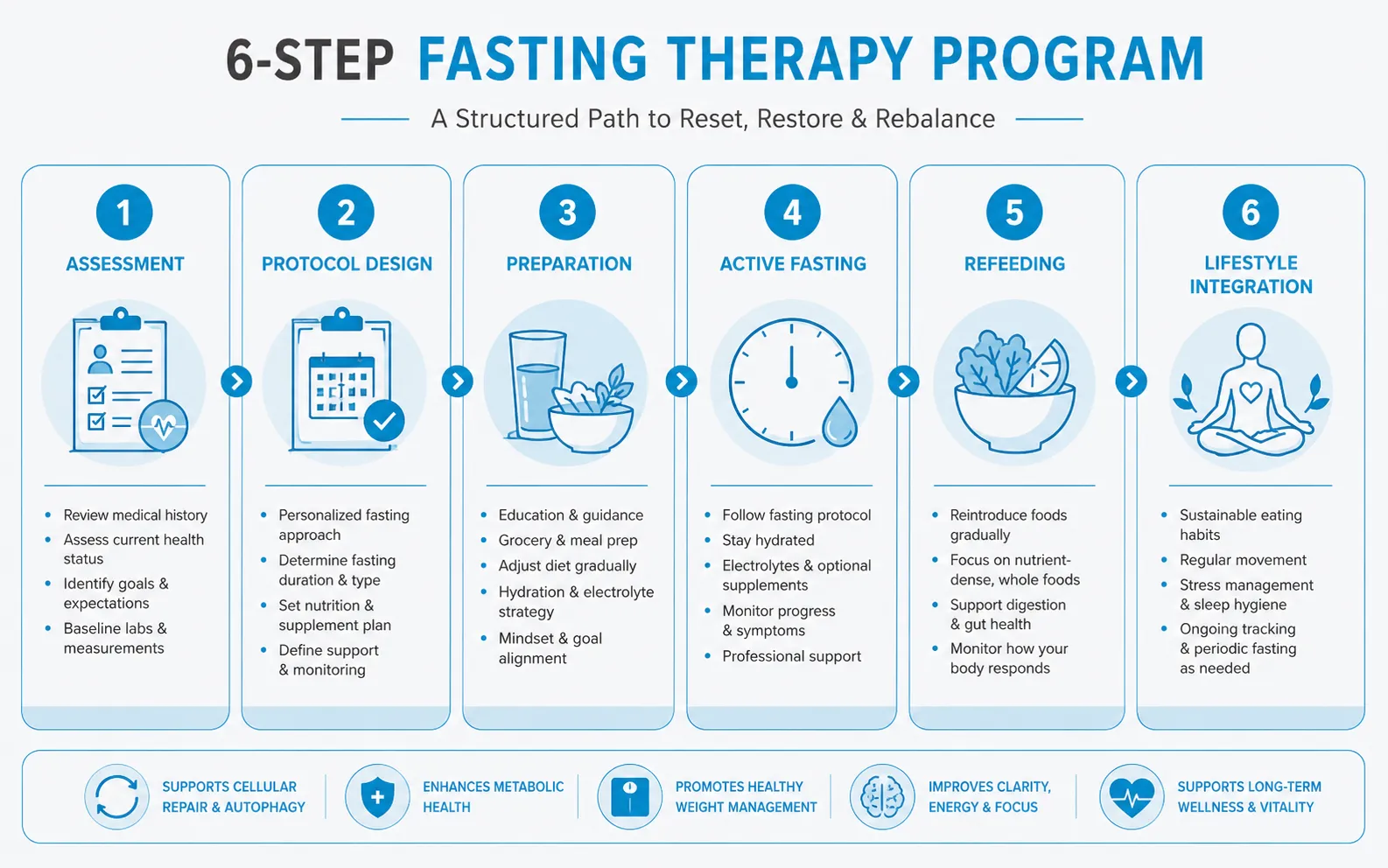
At Profrea's naturopathy clinics across Gurugram, fasting therapy is embedded within a broader holistic wellness framework. Here is what a typical guided fasting program involves:
A comprehensive consultation reviews your medical history, current medications, dietary habits, lifestyle factors, and health goals. Relevant baseline investigations (blood glucose, lipid profile, liver and kidney function) may be recommended before the program begins. You can book this as an initial health screening at Profrea to establish your starting point.
Based on your assessment, the naturopathy specialist designs a fasting protocol suited to your physiology. This includes the fasting window, permitted liquids, electrolyte support, and any herbal or nutritional supplements to ease the transition. The protocol is documented in your care plan, accessible via the Profrea mobile app.
A gradual dietary transition — reducing processed foods, caffeine, and refined sugars — prepares the body for the fasting period and minimises common side effects such as headaches or irritability during the initial days.
During the fasting period, regular check-ins — either in-clinic at one of Profrea's 7 Gurugram locations or via video consultation — ensure you are progressing safely. Vital signs, energy levels, and any symptoms are tracked. Adjustments are made in real time if needed.
Breaking a fast incorrectly can negate its benefits and cause discomfort. The refeeding phase is carefully structured — starting with easily digestible foods and gradually reintroducing a balanced diet. Nutritional guidance from a registered dietitian at Profrea ensures your nutritional status is restored optimally.
The most durable benefits of fasting therapy come from integrating its principles into everyday life. Your care team will help you establish sustainable eating rhythms, stress management practices, and follow-up schedules to maintain the gains achieved during the program.
One of the most common reasons people explore fasting therapy is weight management. Fasting can be an effective tool for fat loss — but it works best when combined with a nutrient-dense diet, adequate hydration, and appropriate physical activity during eating windows.
Clinically, intermittent fasting has been shown to produce comparable weight loss outcomes to continuous caloric restriction, with the added advantage of improvements in metabolic markers such as fasting insulin and blood pressure. However, fasting is not a shortcut. Sustainable weight management requires addressing the root causes of weight gain — hormonal imbalances, stress eating, sleep disruption, and sedentary behaviour — alongside the fasting protocol itself.
Profrea's integrated approach combines naturopathy, nutrition and dietetics expertise, and general medicine support to address weight management holistically — not just calorically.
The word "detox" is heavily marketed — often attached to products that have little scientific basis. Therapeutic fasting, by contrast, supports the body's existing detoxification systems rather than claiming to introduce external detoxifying agents.
The liver, kidneys, lymphatic system, and gut collectively manage the elimination of metabolic waste, environmental toxins, and cellular debris. When the digestive system is given a rest through fasting, these organs can redirect energy toward more efficient clearance. This is the physiological basis for the "lighter" and "clearer" feeling many people report after a well-managed fasting program.
What fasting does not do is eliminate heavy metals, environmental pollutants, or pharmaceutical residues in any dramatic or rapid fashion — claims to the contrary are not supported by evidence. A naturopathy specialist will give you an honest, evidence-informed picture of what to expect.
Even well-designed fasting programs can produce temporary side effects, particularly in the first few days. These include:
Headaches — often related to caffeine withdrawal or mild dehydration; managed with adequate water and electrolyte intake.
Fatigue and irritability — common during the metabolic transition phase; typically resolves within 3–5 days.
Dizziness or light-headedness — usually a sign of low blood pressure or electrolyte imbalance; requires prompt clinical review.
Hunger and food preoccupation — normal initially; diminishes as the body adapts to the fasting rhythm.
Muscle cramps — often linked to magnesium or potassium depletion; addressed through targeted supplementation.
Professional supervision — whether through in-clinic visits or video consultations — allows these side effects to be identified early and managed before they become significant. This is a key reason why self-directed fasting based solely on online content carries real risk, particularly for individuals with any underlying health condition.
Naturopathy views the body as an integrated system capable of self-healing when given the right conditions. Fasting therapy is one of several tools within this framework — often used alongside dietary counselling, herbal medicine, stress management techniques, and physiotherapy to address the whole person rather than isolated symptoms.
At Profrea, naturopathy is part of a genuinely multi-specialty environment. If your fasting assessment reveals an underlying hormonal issue, our gynaecology specialists or general medicine doctors can be brought into your care plan seamlessly. If musculoskeletal stiffness is limiting your activity during the program, physiotherapy support is available across our Gurugram clinics. This integrated model ensures that fasting therapy is never delivered in isolation from your broader health picture.
Program duration varies based on your health goals and the protocol selected. Intermittent fasting programs are typically structured over 4–12 weeks, with ongoing monitoring. Short-term therapeutic fasts usually last 1–3 days and are embedded within a longer preparation and refeeding phase of 2–3 weeks total.
Light to moderate exercise — walking, yoga, gentle stretching — is generally encouraged during intermittent fasting programs and can enhance fat utilisation. High-intensity training is typically modified or rescheduled to eating windows to preserve muscle mass and energy levels. Your care team will provide specific guidance based on your protocol.
Significant muscle loss is uncommon in well-designed, supervised fasting programs, particularly when adequate protein is consumed during eating windows and the fasting period is not excessively prolonged. The rise in growth hormone during fasting actually has a muscle-preserving effect. Your dietitian will ensure your protein targets are met.
Fasting can be beneficial for people with Type 2 diabetes or pre-diabetes under close medical supervision, as it can improve insulin sensitivity and reduce blood glucose levels. However, it requires careful monitoring and medication adjustments — particularly for those on insulin or sulphonylureas — and must only be undertaken with explicit medical clearance and ongoing clinical oversight.
Self-directed fasting based on general online guidance does not account for your individual health status, medication interactions, nutritional deficiencies, or psychological relationship with food. Profrea's supervised programs include a baseline health assessment, personalised protocol design, regular monitoring, dietitian-guided refeeding, and integration with other specialties if needed — making the process both safer and more effective.
Profrea's naturopathy and nutrition specialists can assess your health profile and design a safe, personalised fasting therapy plan — available across 7 clinic locations and via video consultation.