
An in-depth, clinician-reviewed guide to how exosome therapy works, what the science says, and whether it could be right for you.
By the Profrea Editorial Team · Reviewed by Dr. Ladli Chatterjee, MD (General Medicine) · Published July 2026
Hair loss affects an estimated 50% of men and 25% of women at some point in their lives, and the search for effective, minimally invasive treatments has never been more intense. Platelet-Rich Plasma (PRP) therapy dominated aesthetic hair clinics for the past decade — but a newer, more targeted approach is rapidly gaining ground: exosome hair treatment.
Exosome therapy sits at the intersection of regenerative medicine and aesthetic dermatology. Unlike older treatments that rely on delivering growth factors in bulk, exosomes work at the cellular communication level — instructing hair follicle cells to repair, regenerate, and re-enter the active growth phase. This guide explains the science in plain language, compares exosomes to PRP, outlines realistic expectations, and addresses the most common questions patients ask before booking a session.
At Profrea, our multi-specialty clinic network across Gurugram brings together dermatology, aesthetic medicine, and general medicine expertise — including specialists like Dr. Shikha Bansal, our MCh-qualified Plastic Surgeon with 9+ years of experience — to help patients navigate emerging treatments with evidence-based guidance.
Exosomes are nano-sized extracellular vesicles — tiny membrane-bound packets — naturally secreted by cells throughout the body. Think of them as the body's internal messaging system: they carry proteins, lipids, messenger RNA (mRNA), and microRNA between cells, delivering precise biological instructions that regulate repair, inflammation, and regeneration.
In hair restoration, exosomes used clinically are typically derived from mesenchymal stem cells (MSCs) — often sourced from umbilical cord tissue or adipose (fat) tissue under strict laboratory conditions. These MSC-derived exosomes are rich in growth factors including:
VEGF (Vascular Endothelial Growth Factor) — stimulates blood vessel formation around follicles
Wnt signalling proteins — reactivate dormant follicle stem cells
KGF (Keratinocyte Growth Factor) — promotes keratinocyte proliferation in the hair shaft
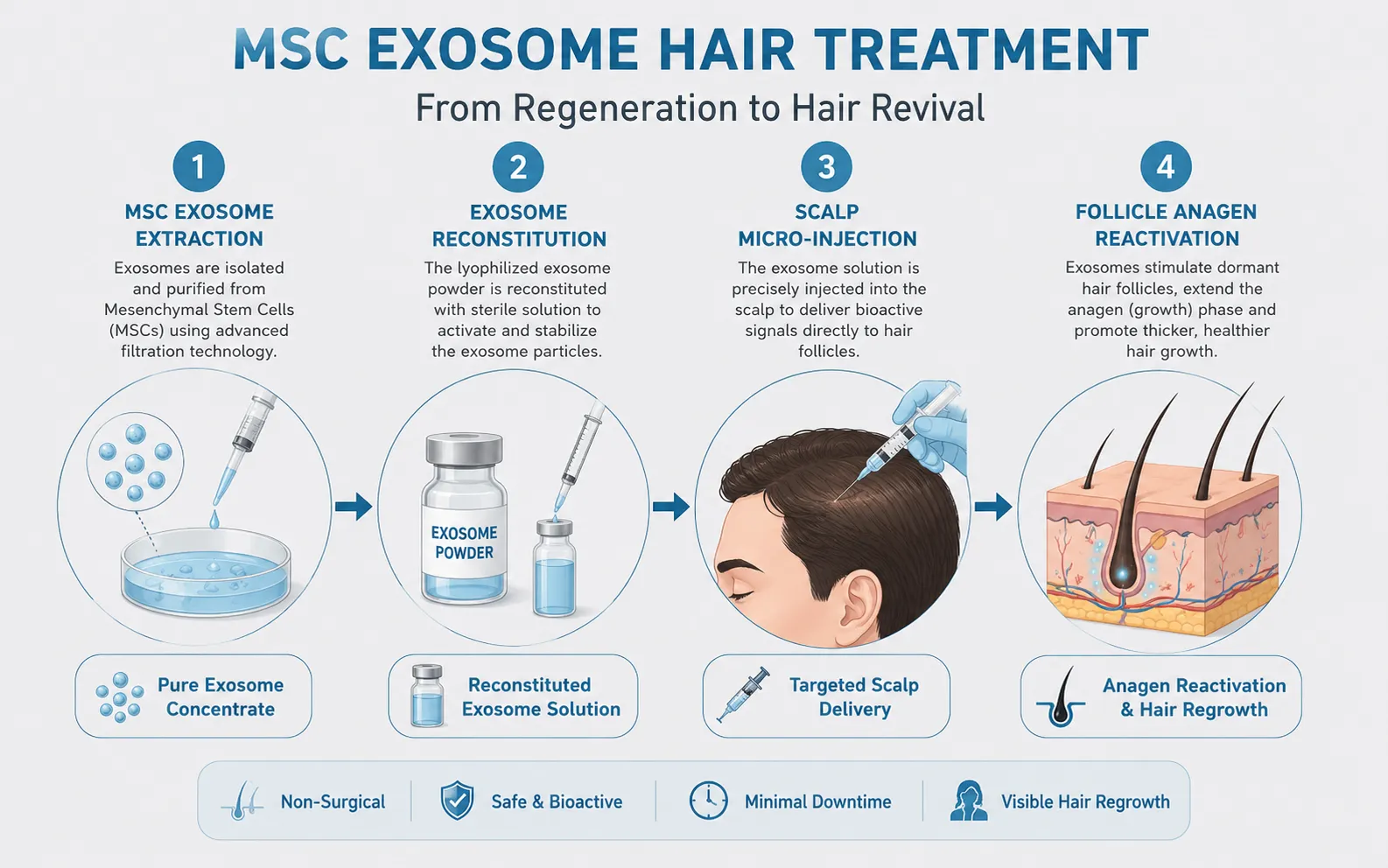
TGF-β regulators — help shift follicles from the resting (telogen) phase back to the active growth (anagen) phase
When injected into the scalp — typically via micro-needling or direct intradermal injection — these exosomes are taken up by follicle cells and dermal papilla cells, triggering a cascade of regenerative signals. A 2022 review published on PubMed (NIH) highlighted that MSC-derived exosomes significantly promoted hair follicle cycling and increased hair density in preclinical models, with early human trials showing promising results.
Crucially, because exosomes are cell-free, they carry no risk of immune rejection and no risk of transmitting live cells — a significant safety advantage over cell-based therapies.
PRP (Platelet-Rich Plasma) therapy has been a mainstay of hair restoration for over a decade, and it remains a clinically validated option. However, exosome therapy offers several meaningful advances:
| Feature | PRP | Exosome Therapy |
|---|---|---|
| Source | Patient's own blood | Lab-derived MSC exosomes |
| Growth factor concentration | Variable (depends on patient health) | Standardised, highly concentrated |
| Mechanism | Growth factor release | Cell-to-cell signalling + gene expression |
| Immune rejection risk | Minimal (autologous) | Very low (cell-free) |
| Sessions typically needed | 3–6 sessions | 2–4 sessions |
| Downtime | Minimal | Minimal |
| Evidence base | Established (10+ years) | Emerging (strong preclinical, growing clinical) |
The key advantage of exosomes is consistency. PRP quality depends heavily on the patient's own platelet count and health status — someone with anaemia or nutritional deficiencies may produce a less potent PRP preparation. Exosome products, by contrast, are manufactured under controlled conditions with a defined concentration of bioactive molecules, making the treatment more predictable across patients.
That said, PRP remains a cost-effective, well-studied option — and for many patients, a combination approach (exosomes plus PRP, or exosomes plus micro-needling) may yield the best outcomes. A qualified clinician, such as those available through Profrea's specialist team in Gurugram, can assess your specific hair loss pattern and recommend the most appropriate protocol.
Exosome therapy is most effective when hair follicles are still present but miniaturised or dormant — not completely destroyed. Ideal candidates typically include:
Men and women with androgenetic alopecia (pattern baldness) at early to moderate stages (Norwood I–IV in men; Ludwig I–II in women)
Individuals experiencing telogen effluvium — diffuse shedding triggered by stress, illness, nutritional deficiency, or hormonal changes
Patients with alopecia areata (patchy hair loss) — early evidence suggests exosomes may help modulate the autoimmune component
Those who have had hair transplant surgery and want to accelerate graft survival and scalp healing
Individuals who have not responded adequately to minoxidil or finasteride alone
Exosome therapy is generally not recommended for patients with active scalp infections, certain autoimmune conditions in a flare state, or those who are pregnant or breastfeeding. A thorough consultation — including a trichoscopy assessment if available — is essential before proceeding.
A typical exosome hair treatment session at a specialist clinic follows a structured process:
Consultation and scalp assessment — The clinician evaluates hair loss pattern, density, and scalp health. Baseline photographs are taken for comparison.
Scalp preparation — The treatment area is cleansed and a topical anaesthetic cream is applied (30–45 minutes before injection) to minimise discomfort.
Exosome preparation — The lyophilised (freeze-dried) exosome product is reconstituted according to the manufacturer's protocol. Quality products are typically standardised to a defined particle concentration (often 2–5 billion exosomes per mL).
Delivery — Exosomes are delivered into the scalp dermis via micro-needling (using a derma-roller or automated pen) or direct intradermal micro-injections, or a combination of both. The session typically takes 30–60 minutes.
Post-treatment care — Patients are advised to avoid washing the scalp for 12–24 hours, avoid direct sun exposure, and refrain from vigorous exercise for 24 hours.
Most patients describe the procedure as mildly uncomfortable rather than painful, particularly after topical anaesthesia. There is no significant downtime — most people return to work the same day or the following morning.
The number of sessions depends on the severity of hair loss, the underlying cause, and individual response. General guidance:
Initial course: Most protocols recommend 2–4 sessions spaced 4–6 weeks apart for the primary treatment phase.
Maintenance: After the initial course, a single maintenance session every 6–12 months is typically recommended to sustain results.
Combined protocols: When exosomes are combined with micro-needling or PRP, the total number of sessions may vary — your clinician will tailor the plan.
It is important to set realistic expectations: hair regrowth is a slow biological process. Most patients begin to notice reduced shedding within 4–6 weeks, with visible new hair growth typically appearing at 3–6 months after the first session. Full results are usually assessed at the 6–9 month mark.
Clinical observations and early published studies report the following outcomes in suitable candidates:
Reduced hair shedding — often the first sign of response, noticed within the first 4–8 weeks
Increased hair density — new, finer hairs (vellus hairs) transitioning to thicker terminal hairs over 3–6 months
Improved scalp health — reduced scalp inflammation, better sebum balance, and improved follicle environment
Enhanced hair shaft quality — existing hair may appear thicker, shinier, and stronger
It is worth noting that exosome therapy is not a cure for androgenetic alopecia — the underlying genetic and hormonal drivers continue. Ongoing maintenance, and often concurrent use of evidence-based medical therapies (minoxidil, finasteride, or their alternatives), is part of a comprehensive hair restoration plan. Patients with very advanced hair loss (Norwood VI–VII) where follicles are completely absent may not benefit significantly and may be better served by hair transplant surgery.
Before-and-after photographs shared by clinics should always be interpreted carefully — lighting, camera angle, and hair styling can all affect appearance. Ask your clinician for standardised trichoscopy images taken under consistent conditions for a true assessment of progress.
Exosome hair therapy has a favourable safety profile in published literature to date. Because the exosome products used are cell-free and typically derived from rigorously screened donor tissue, the risk of serious adverse events is low. Commonly reported, temporary side effects include:
Mild scalp redness and swelling — usually resolves within 24–48 hours
Tenderness or sensitivity at injection sites — typically subsides within 1–2 days
Temporary increased shedding — some patients notice a brief shedding phase in the first 2–4 weeks as follicles reset; this is generally a positive sign of follicle cycling
Mild itching — related to the healing response in the scalp
Serious complications such as infection, scarring, or allergic reaction are rare when the procedure is performed by a trained clinician using a reputable, quality-controlled exosome product. The regulatory landscape for exosome products in India is still evolving — patients should ensure their clinic uses products that comply with applicable guidelines and can provide documentation of the product's origin, sterility testing, and particle concentration.
As with any aesthetic procedure, the skill and experience of the administering clinician significantly influence both safety and outcomes. Profrea's network of specialist clinicians — including Dr. Shikha Bansal (MCh Plastic Surgery) — brings surgical-grade precision and aesthetic medicine expertise to hair restoration consultations across Gurugram.
The scientific rationale for exosome therapy in hair loss is grounded in well-established cell biology. Hair follicle cycling — the alternation between anagen (growth), catagen (regression), and telogen (rest) phases — is regulated by complex molecular signals between dermal papilla cells and follicle stem cells. In androgenetic alopecia, DHT (dihydrotestosterone) disrupts these signals, progressively miniaturising follicles.
MSC-derived exosomes have been shown in laboratory and animal studies to:
Activate the Wnt/β-catenin pathway — a master regulator of hair follicle stem cell activity
Suppress the TGF-β1 pathway — which, when overactive, drives follicle miniaturisation
Promote angiogenesis (new blood vessel growth) around follicles, improving nutrient delivery
Reduce scalp inflammation — a contributing factor in multiple forms of hair loss
Research indexed on the NIH's PubMed database continues to grow, with multiple research groups publishing findings on exosome-mediated hair follicle regeneration. While large-scale randomised controlled trials in humans are still limited — a common feature of emerging regenerative therapies — the mechanistic evidence and early clinical data are compelling enough that leading aesthetic medicine centres globally have begun incorporating exosome therapy into their hair restoration protocols.
It is important to approach this treatment with informed optimism: the science is promising, the safety profile is favourable, but patients should be wary of clinics making unsubstantiated claims of guaranteed results or miraculous regrowth. Evidence-based, realistic communication is the hallmark of responsible practice.
The most effective approach to hair loss is rarely a single treatment in isolation. A well-designed hair restoration plan typically combines:
Medical therapy — topical minoxidil, oral finasteride or dutasteride (where appropriate), or newer agents such as oral minoxidil at low doses
Nutritional optimisation — addressing deficiencies in iron, ferritin, vitamin D, zinc, and biotin, which are common contributors to hair shedding. Profrea's nutrition and dietetics specialists, including Dt. Swagata Pahari, can assess and address nutritional gaps that may be compounding hair loss.
Regenerative procedures — exosome therapy, PRP, or micro-needling to stimulate follicle activity
Psychological support — hair loss has a significant psychological impact, particularly in women. Profrea's psychology team, led by Dr. Sarika Thakral (M.Phil Clinical Psychology, 15+ years experience), offers support for the emotional dimensions of hair loss and body image concerns.
Surgical options — for advanced cases, hair transplant surgery (FUE or FUT) may be the definitive solution, with exosome therapy used post-operatively to enhance graft survival
Profrea's multi-specialty structure across 7 clinic locations in Gurugram means patients can access this integrated care model — from nutritional assessment to aesthetic procedures to psychological support — within a single coordinated network, with both in-clinic and video consultation options available.
Before committing to exosome therapy, we recommend asking your clinician the following:
What exosome product do you use, and can you provide documentation of its particle concentration, sterility, and source?
Am I a suitable candidate based on my specific hair loss pattern and stage?
Will you take standardised baseline photographs or trichoscopy images so we can objectively track progress?
What is the recommended protocol for me — number of sessions, interval, and delivery method?
What concurrent treatments (medical or nutritional) would you recommend alongside exosome therapy?
What results can I realistically expect, and over what timeframe?
A clinician who answers these questions clearly and honestly — without overpromising — is one you can trust with your care.
Exosomes are nano-sized vesicles secreted by stem cells that carry growth factors, proteins, and genetic material (mRNA, microRNA). When applied to the scalp, MSC-derived exosomes deliver regenerative signals to hair follicle cells, reactivating dormant follicles, improving blood supply, and reducing inflammation — all of which support hair regrowth.
Exosome therapy offers a more standardised, highly concentrated payload of bioactive molecules compared to PRP, whose quality varies with the patient's own health. Exosomes also work via cell-to-cell signalling rather than simple growth factor release, potentially offering deeper biological impact. However, PRP has a longer clinical track record. Many specialists now consider a combined approach — or exosomes as a step up for patients who have not responded adequately to PRP.
Common, temporary side effects include mild scalp redness, swelling, and tenderness at injection sites — typically resolving within 24–48 hours. Some patients experience a brief shedding phase in the first few weeks, which usually indicates follicle cycling is being activated. Serious adverse events are rare when the procedure is performed by a trained clinician using a quality-controlled product.
Most protocols recommend an initial course of 2–4 sessions spaced 4–6 weeks apart, followed by maintenance sessions every 6–12 months. The exact number depends on the severity and cause of your hair loss, and your individual response to treatment. Your clinician will tailor a protocol based on your specific assessment.
Realistic outcomes include reduced shedding within 4–8 weeks, followed by visible new hair growth at 3–6 months, and improved hair density and thickness assessed at 6–9 months. Results vary by individual, hair loss stage, and whether concurrent medical therapies are used. Standardised trichoscopy images — not just casual photographs — provide the most objective before-and-after comparison.
Yes. Aesthetic and regenerative hair treatments, including advanced options like exosome therapy, are available through specialist clinics in Gurugram. Profrea's multi-specialty network across 7 locations in Gurugram offers consultations with qualified clinicians who can assess your suitability and guide you through evidence-based hair restoration options. You can book an in-clinic or video consultation through the Profrea health screening and consultation portal.
Profrea's specialist clinicians across Gurugram offer personalised hair loss assessments — in clinic or via video — to help you make an informed, evidence-based decision.