
Understanding the difference can save you months of trial and error — and help you reach your health goals faster with the right clinical guidance.
By the Profrea Clinical Nutrition Team · Published July 2026
If you have typed "diet consultation near me in Gurugram" into a search bar recently, you have almost certainly encountered two terms used interchangeably: dietitian and nutritionist. They sound similar, they both talk about food, and yet the difference between them can significantly affect the quality of care you receive — especially when your goals involve weight loss, diabetes management, or a chronic health condition.
This article breaks down exactly what each professional does, how Indian regulations distinguish them, and which one you should book when you want a personalized diet plan that actually works for your body, lifestyle, and medical history.
In India, the term dietitian is used for professionals who hold a recognized degree in dietetics or food and nutrition — typically a B.Sc. or M.Sc. in Dietetics, or a postgraduate diploma from a medical institution. Many registered dietitians work within hospital settings, managing therapeutic diets for patients with diabetes, kidney disease, cancer, or post-surgical recovery. Their training includes biochemistry, medical nutrition therapy, and clinical rotations under physicians.
The term nutritionist, by contrast, is far less regulated in India. Anyone with a short online certificate — or sometimes no formal qualification at all — can legally call themselves a nutritionist. That said, many nutritionists hold legitimate degrees in food science, public health nutrition, or sports nutrition, and provide excellent general wellness guidance for healthy individuals.
The practical takeaway: if you have a medical condition such as Type 2 diabetes, PCOS, thyroid disorders, or hypertension, you need a qualified clinical dietitian — not a general nutritionist. For general healthy eating, weight maintenance, or sports performance, a certified nutritionist with a relevant degree may suffice.
According to the World Health Organization, obesity and overweight affect more than 1 billion people globally, and medical nutrition therapy delivered by trained dietitians is among the most evidence-backed first-line interventions for weight management and metabolic disease.
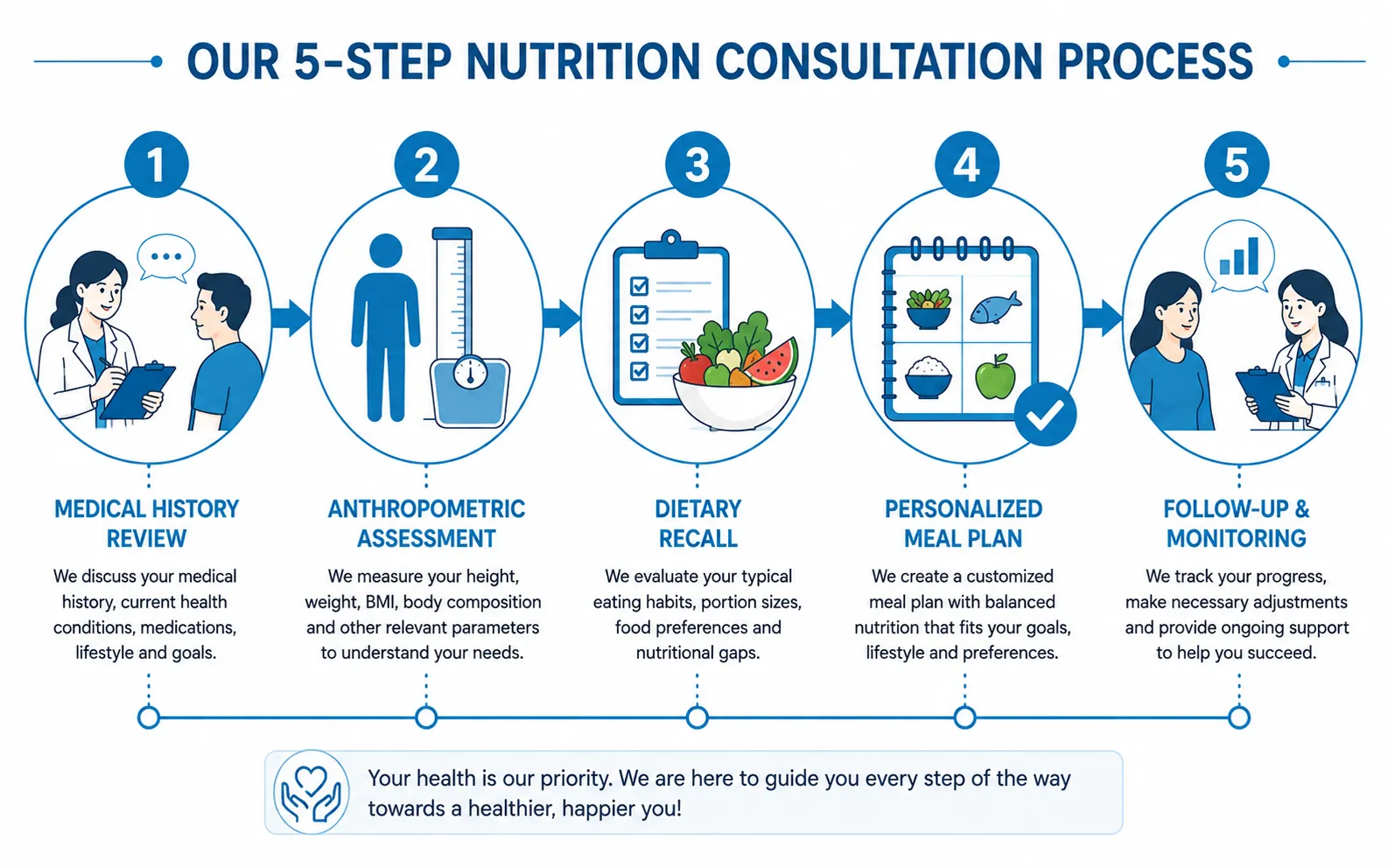
A clinical dietitian does far more than hand you a printed meal plan. A thorough first consultation typically involves:
Medical history review — existing diagnoses, medications, allergies, and lab reports (HbA1c, lipid profile, thyroid panel, etc.)
Anthropometric assessment — body weight, BMI, waist-to-hip ratio, and where clinically available, body composition analysis
Dietary recall and food preference mapping — a 24-hour or 3-day dietary recall to understand current intake patterns
Goal setting — realistic, time-bound targets for weight, blood sugar, or other markers
Personalized meal plan creation — calorie targets, macronutrient distribution, meal timing, and culturally appropriate food choices
Follow-up and plan adjustment — reviewing progress, troubleshooting plateaus, and updating the plan as your body responds
This structured, evidence-based process is what separates clinical nutrition counselling from generic diet advice found on social media or wellness apps. At Profrea's Gurugram clinics, the nutrition team works in close coordination with physicians — including Dr. Ladli Chatterjee, General Physician and Diabetologist — so that your diet plan is always aligned with your broader medical care.
Yes — and this is one of the most important reasons to choose a clinical dietitian over a general nutritionist when you have metabolic concerns. Weight loss and blood sugar control are deeply interconnected. A reduction of even 5–10% of body weight in people with Type 2 diabetes can lead to meaningful improvements in HbA1c, blood pressure, and lipid levels, as noted in guidelines from the National Institutes of Health (NIH).
A clinical dietitian trained in diabetology understands how different carbohydrates affect postprandial glucose, how to time meals around insulin or oral medication schedules, and how to prevent hypoglycaemia during a calorie deficit. This level of nuance simply cannot be provided by a general wellness nutritionist.
At Profrea, the Nutrition & Dietetics team works alongside diabetologists to create integrated care plans — so if you are managing diabetes while trying to lose weight, you receive coordinated guidance rather than conflicting advice from separate providers. You can also explore our specialist dietitian consultations or connect with our clinical nutrition experts for a comprehensive assessment.
There is no universal answer, but clinical practice and research consistently point to a few key principles:
Session 1 (Assessment): Comprehensive intake, goal setting, and initial plan creation. This is the longest session — typically 45–60 minutes.
Sessions 2–4 (Weeks 2–6): Progress review, troubleshooting, and plan refinement. Bi-weekly follow-ups are common in the early phase.
Sessions 5 onwards (Months 2–6): Monthly check-ins to sustain momentum, adjust for lifestyle changes, and prevent weight regain.
Most patients who commit to at least 4–6 structured sessions over three months see measurable, sustainable results. Sporadic one-off consultations tend to produce short-lived outcomes. Profrea's membership and care-plan model is designed specifically to support this kind of ongoing, accountable relationship between patient and dietitian.
For most nutrition counselling goals — weight loss, diabetes diet management, PCOS nutrition, or general healthy eating — video consultations are clinically equivalent to in-person visits, provided the dietitian has access to your recent lab reports and can conduct a thorough dietary assessment. The convenience factor also improves adherence: patients who can book a follow-up from their office or home are far more likely to actually attend.
Profrea offers both in-clinic consultations across its 7 clinic locations in Gurugram and video consultations via its mobile app and patient portal — so you can choose the format that fits your schedule without compromising on care quality. For your first visit, an in-clinic session is often preferred so the dietitian can perform a full anthropometric assessment.
If you are looking for a nutrition specialist in Gurugram who offers both in-clinic and video options, Profrea's multi-format model is built for exactly that flexibility.
| Factor | Registered Dietitian | General Nutritionist |
|---|---|---|
| Regulatory status in India | Degree-regulated; hospital-trained | Largely unregulated; varies widely |
| Medical nutrition therapy | Yes — trained for clinical conditions | Generally not |
| Suitable for diabetes / PCOS / kidney disease | Yes | Not recommended |
| General weight loss guidance | Yes | Yes (if qualified) |
| Works with physician team | Typically yes | Rarely |
| Personalized clinical diet plan | Yes — evidence-based | Varies by qualification |
Whether you are searching for a dietitian or a nutritionist in Gurugram, watch out for these warning signs that suggest unqualified advice:
Promises of rapid weight loss (more than 1–1.5 kg per week) without medical supervision
Generic meal plans not tailored to your medical history, food preferences, or cultural background
Recommendations to eliminate entire food groups without clinical justification
Selling proprietary supplements as a core part of the plan
No follow-up structure or progress monitoring
Inability to explain the rationale behind dietary recommendations in plain language
A qualified clinical dietitian will always explain why a particular dietary approach is recommended for your specific situation, and will adjust the plan based on your lab results and lived experience — not a one-size-fits-all template.
Profrea's multi-specialty clinic network in Gurugram brings together qualified dietitians, physicians, and specialists under one roof — or one app. This integrated model means your nutrition plan is never created in isolation. If you are managing weight alongside a condition like diabetes, the dietitian coordinates directly with the treating physician to ensure dietary recommendations are safe, effective, and consistent with your medication regimen.
Key features of Profrea's nutrition consultation pathway include:
In-clinic consultations at 7 Gurugram locations, including Sector 45, South City-I, and Sector 52
Video consultations via the Profrea app for follow-up sessions and remote patients
Membership and care-plan packages that bundle multiple sessions for sustained results
Corporate wellness programmes for organisations seeking preventive nutrition support for employees
Coordination with specialists including diabetologists, gynaecologists, and physiotherapists for holistic care
You can also explore Profrea's health screening packages that include nutritional assessment as part of a comprehensive preventive health check — an excellent starting point if you are unsure where to begin your wellness journey.
For women managing weight alongside hormonal or reproductive health concerns, Profrea's gynaecology and infertility specialist Dr. Soma Kumari works in conjunction with the nutrition team to address conditions like PCOS where diet plays a central therapeutic role.
In India, a dietitian typically holds a recognised degree in dietetics or clinical nutrition and is trained to manage therapeutic diets for medical conditions. The term nutritionist is largely unregulated — qualifications range from postgraduate degrees in food science to short online certificates. For medical nutrition therapy (diabetes, kidney disease, PCOS, post-surgical recovery), always consult a qualified clinical dietitian.
A clinical dietitian begins with a detailed assessment of your medical history, current medications, lab reports, anthropometric measurements, and dietary habits. They then set realistic calorie and macronutrient targets, design culturally appropriate meal plans, and schedule follow-up sessions to track progress and adjust the plan based on your response.
Yes. A clinical dietitian trained in diabetology can design a calorie-restricted meal plan that also manages postprandial blood glucose, prevents hypoglycaemia, and aligns with your medication schedule. At Profrea, the nutrition team works alongside diabetologists like Dr. Ladli Chatterjee to deliver coordinated care for patients with Type 2 diabetes who also want to lose weight.
Most patients benefit from a minimum of 4–6 structured sessions over three months — an initial comprehensive assessment followed by bi-weekly or monthly follow-ups. Patients who commit to ongoing sessions tend to achieve more sustainable results and are better equipped to maintain weight loss long-term.
For most nutrition counselling goals, video consultations are clinically comparable to in-person visits, provided the dietitian has access to your recent lab reports and conducts a thorough dietary assessment. Profrea offers both formats — in-clinic at 7 Gurugram locations and video via its app — so you can choose based on your schedule and preference.
Look for a professional with a B.Sc. or M.Sc. in Dietetics or a postgraduate diploma from a recognised medical institution, ideally with hospital clinical experience. Ask about their approach to personalised plans, follow-up structure, and whether they coordinate with physicians. Profrea's Gurugram clinics offer access to qualified dietitians as part of an integrated multi-specialty care network.
Profrea's qualified dietitians in Gurugram are available for in-clinic and video consultations — book a session and get a diet plan built around your health, not a template.