
A practical, dermatology-informed comparison to help Gurgaon residents choose the most effective peel for pigmentation, acne, and skin brightening — without the guesswork.
By the Profrea Clinical Editorial Team · Published June 2026
If you have been searching for a reliable solution to dull skin, uneven tone, or stubborn pigmentation in Gurgaon, chances are you have come across two popular options: the carbon laser peel (also called a carbon peel or Hollywood peel) and the chemical peel. Both treatments promise clearer, brighter skin — but they work in fundamentally different ways, suit different skin concerns, and carry different recovery timelines.
This guide breaks down exactly how each treatment works, who it is best suited for, what the science says, and what you can realistically expect in terms of results and downtime. Whether your concern is pigmentation, acne scars, open pores, or overall radiance, reading this before booking your appointment could save you time, money, and disappointment.
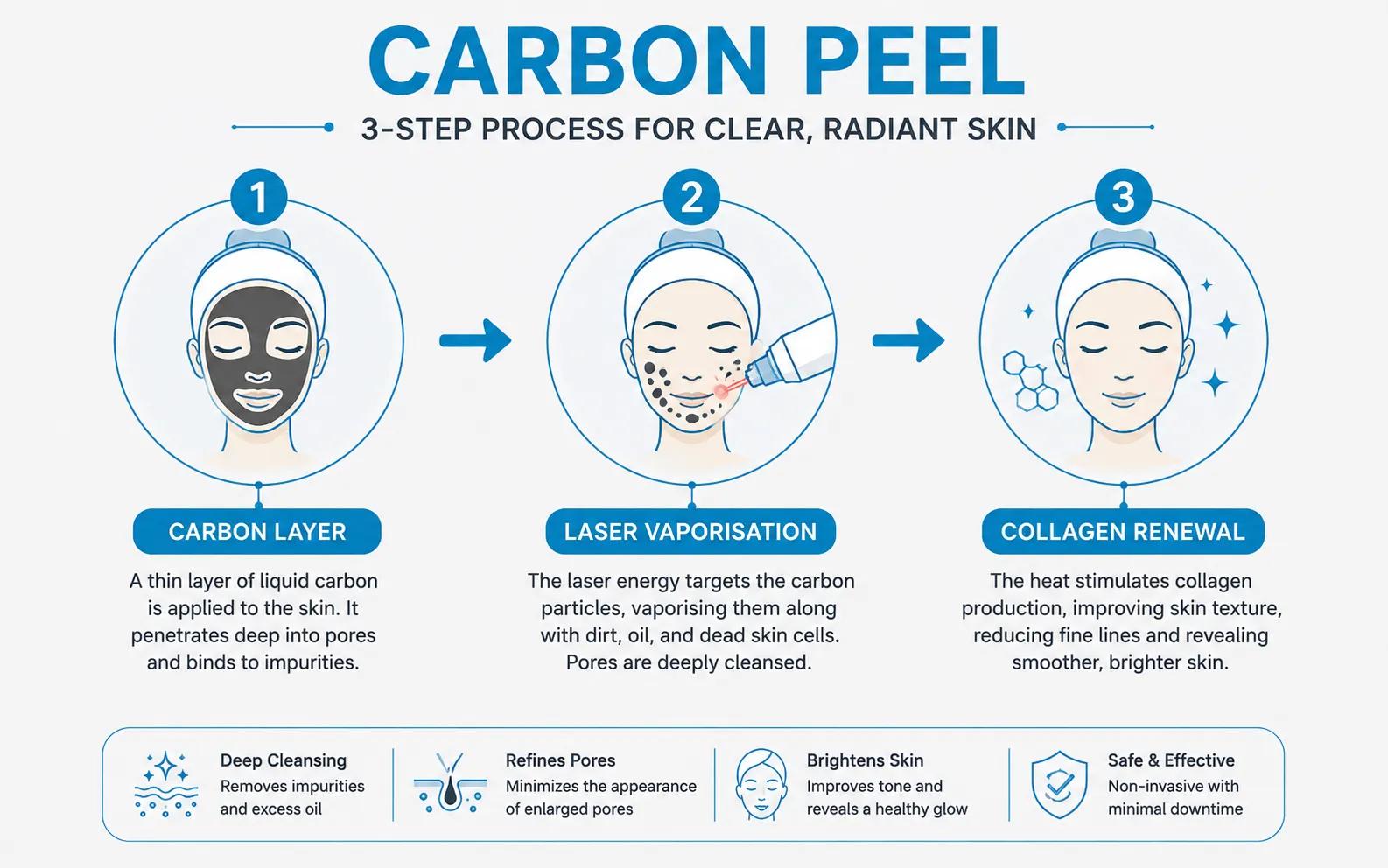
A carbon laser peel — sometimes marketed as a carbon facial, Hollywood peel, or China doll peel — is a non-invasive laser-based skin rejuvenation procedure. The treatment involves two key steps:
Application of liquid carbon: A thin layer of medical-grade liquid carbon is applied evenly across the face. Carbon particles penetrate deep into the pores, bonding with dirt, oil, dead skin cells, and sebum.
Laser pass: A Q-switched Nd:YAG laser is passed over the skin. The laser energy is strongly absorbed by the carbon particles, causing them to vaporise instantly. This micro-explosion exfoliates the skin surface, destroys the carbon along with the debris it has absorbed, and simultaneously delivers controlled thermal energy to the deeper dermis — stimulating collagen production.
The result is immediate: skin looks visibly brighter, pores appear tighter, and the complexion feels smoother — often described as a "glass skin" effect. Because the laser targets the carbon rather than the skin pigment directly, the procedure is generally considered safe for Indian and South Asian skin tones (Fitzpatrick types IV–VI), which are more prone to post-inflammatory hyperpigmentation (PIH) from aggressive treatments.
According to a review published in the Journal of Cutaneous and Aesthetic Surgery (NCBI/PubMed), Q-switched Nd:YAG laser treatments show a favourable safety profile in darker skin phototypes, making them a preferred option for pigmentation management in South Asian populations.
Most patients describe the sensation as a mild warmth or a light snapping feeling — similar to a rubber band flick — as the laser passes over the skin. There is no anaesthesia required in most cases, and the procedure typically takes 20–30 minutes. There is no downtime: you can return to work or social activities immediately after the session. Mild redness may persist for a few hours but generally resolves by the end of the day.
A chemical peel is a dermatological procedure in which a carefully selected acid solution is applied to the skin to induce controlled exfoliation of the outer layers. As the damaged skin peels away over the following days, fresh, healthier skin is revealed underneath. Chemical peels are broadly classified by depth:
Superficial peels (e.g., glycolic acid 20–50%, lactic acid, mandelic acid): Target only the outermost layer of skin (epidermis). Minimal downtime — 1 to 3 days of mild flaking. Ideal for dull skin, mild pigmentation, and uneven texture.
Medium-depth peels (e.g., TCA 20–35%, Jessner's solution): Penetrate into the upper dermis. More significant peeling over 5–7 days. Effective for moderate pigmentation, melasma, acne scars, and fine lines.
Deep peels (e.g., phenol peel): Reach the mid-dermis. Require sedation and carry a longer recovery of 2–4 weeks. Rarely used in Indian skin due to high PIH risk; reserved for severe scarring or deep wrinkles under specialist supervision.
For most patients seeking chemical peel treatment for pigmentation in Gurgaon, superficial to medium-depth peels using glycolic acid, mandelic acid, or TCA are the most commonly recommended options. Mandelic acid peels are particularly popular for Indian skin because mandelic acid's larger molecular size means slower, more controlled penetration — reducing the risk of PIH.
| Feature | Carbon Laser Peel | Chemical Peel |
|---|---|---|
| Mechanism | Laser energy + carbon particles | Acid-induced exfoliation |
| Best for | Open pores, oily skin, mild pigmentation, skin brightening | Pigmentation, melasma, acne scars, uneven texture |
| Pain level | Minimal (mild warmth/snapping) | Mild to moderate (tingling/stinging during application) |
| Downtime | None to minimal (a few hours of redness) | 1–7 days depending on peel depth |
| Sessions needed | 4–6 sessions (2–4 weeks apart) | 3–6 sessions (3–4 weeks apart) |
| Safe for dark Indian skin? | Yes — generally safe for Fitzpatrick IV–VI | Yes, with careful acid selection (mandelic, glycolic at low %) |
| Collagen stimulation | Yes — laser thermal energy triggers neocollagenesis | Moderate — deeper peels stimulate more collagen |
| Immediate glow | Yes — visible after first session | After peeling subsides (3–7 days) |
| Suitable for pre-event prep | Yes — no downtime | Plan 1–2 weeks before an event |
This is the most common question asked by patients in Gurgaon, and the honest answer is: it depends on the type and depth of your pigmentation.
For superficial pigmentation — sun spots, post-acne marks, mild uneven tone — both treatments are effective. The carbon laser peel offers the advantage of zero downtime and an immediate brightening effect, making it popular among working professionals in Gurugram's corporate belt who cannot afford days of visible peeling.
For deeper or more stubborn pigmentation — such as melasma, post-inflammatory hyperpigmentation from acne, or dermal pigmentation — a medium-depth chemical peel (TCA or a combination peel) tends to produce more significant and lasting results, because it reaches the layer of skin where the excess melanin is deposited. However, this requires careful patient selection and expert application to avoid triggering further PIH in darker skin tones.
Many dermatologists now recommend a combination approach: a series of chemical peels to address the pigmentation, followed by maintenance carbon laser sessions to sustain the glow and prevent recurrence. At Profrea's clinics across Gurugram, the clinical team — including Dr. Shweta Sharma and Dr. Deepa Agarwal — assesses each patient's Fitzpatrick skin type, pigmentation depth, and lifestyle before recommending a personalised peel protocol.
There is no universal answer, but here are realistic expectations based on clinical practice:
Carbon laser peel: Most patients notice a visible improvement in skin texture and brightness after the first session. For sustained results — particularly for acne control, pore minimisation, and mild pigmentation — a course of 4 to 6 sessions spaced 2 to 4 weeks apart is typically recommended, followed by monthly maintenance sessions.
Superficial chemical peel: A minimum of 4 to 6 sessions spaced 3 to 4 weeks apart is generally needed for meaningful improvement in pigmentation and skin texture. Results build progressively with each session.
Medium-depth chemical peel: Often 2 to 3 sessions are sufficient for moderate pigmentation or acne scarring, given the deeper level of exfoliation achieved per session.
Consistency with sun protection (SPF 50+ daily) is non-negotiable between sessions — Gurgaon's high UV index, particularly from March to October, can undo treatment gains rapidly without adequate photoprotection.
Yes — but with important caveats. Indian skin (Fitzpatrick types IV to VI) has higher melanin density, which makes it more reactive to heat, friction, and chemical stimulation. Poorly chosen or incorrectly applied peels can trigger post-inflammatory hyperpigmentation (PIH) — a darkening of the skin that can be more distressing than the original concern.
Safe practice for darker skin tones includes:
Starting with lower acid concentrations and building up gradually
Preferring mandelic acid or lactic acid over glycolic acid for initial peels
Avoiding medium or deep peels during summer months or when the skin is actively tanned
Pre-treating with a tyrosinase inhibitor (such as kojic acid or niacinamide) for 2–4 weeks before a chemical peel to reduce PIH risk
For laser treatments, using Q-switched Nd:YAG settings calibrated for darker phototypes
This is why choosing a qualified, experienced clinician — rather than a budget parlour offering "chemical peels" — matters enormously for patients with Indian skin. The American Academy of Dermatology emphasises that chemical peels should always be performed or supervised by a licensed medical professional, particularly for patients with darker skin tones.
Downtime varies significantly by peel depth:
Superficial peel: Mild redness for a few hours; light flaking or dryness over 1–3 days. Most patients can continue daily activities, though heavy exercise and direct sun exposure should be avoided.
Medium-depth peel: Significant redness and swelling for 2–3 days, followed by visible peeling and skin shedding over days 3–7. The new skin underneath is initially pink and sensitive. Full social presentability typically returns within 7–10 days.
Deep peel: 2–4 weeks of recovery. Rarely performed in routine aesthetic practice in India.
During the peeling phase, it is critical not to pick or peel the skin manually — doing so increases the risk of scarring and PIH. Gentle moisturisation and strict sun avoidance are the pillars of post-peel care.
By contrast, the carbon laser peel has no meaningful downtime — a key reason it has become the go-to pre-event skin treatment for many Gurgaon residents ahead of weddings, corporate events, and social occasions.
Use this quick reference to orient your decision before your consultation:
Dull, tired-looking skin / pre-event glow: Carbon laser peel — results visible same day, no downtime.
Oily skin and enlarged pores: Carbon laser peel — the laser's thermal effect tightens pores and reduces sebum production.
Active acne and comedones: Carbon laser peel — the carbon absorbs excess oil and the laser has an antibacterial effect on P. acnes bacteria.
Mild to moderate pigmentation / sun damage: Either treatment works; combination approach is often most effective.
Melasma: Superficial chemical peel (mandelic or glycolic) under medical supervision; carbon laser used cautiously as an adjunct.
Acne scars (superficial): Medium-depth chemical peel or a series of carbon laser sessions; deeper scars may need additional treatments such as microneedling or fractional laser.
Fine lines and early skin ageing: Both treatments stimulate collagen; medium-depth peels offer more dramatic anti-ageing results.
If you are dealing with acne scarring specifically, it is worth exploring Profrea's dedicated plastic surgery and scar management expertise with Dr. Shikha Bansal (MCh Plastic Surgery, SMS Medical College Jaipur), who brings over 9 years of experience in reconstructive and aesthetic procedures at Profrea's Gurugram clinics.
Gurgaon's aesthetic treatment market has grown rapidly, and so has the number of unregulated salons and beauty parlours offering "chemical peels" and "laser facials" at very low prices. The risks of receiving these treatments from untrained hands include chemical burns, permanent scarring, and severe PIH — outcomes that are far more difficult and expensive to treat than the original skin concern.
At Profrea — a multi-specialty clinic network with 7 locations across Gurugram — all aesthetic procedures are performed or directly supervised by qualified medical professionals. The network's clinicians include specialists across dermatology-adjacent fields, with structured care plans, pre-treatment skin assessments, and post-procedure follow-up built into every patient journey.
Profrea also offers video consultations for patients who want an initial assessment before committing to an in-clinic visit — a convenient option for busy professionals across Gurugram's corporate corridors. You can also explore the Profrea Health Screen packages for a comprehensive wellness baseline alongside your aesthetic goals.
A carbon laser peel is a non-invasive skin rejuvenation treatment that uses liquid carbon applied to the face, which is then vaporised by a Q-switched Nd:YAG laser. The laser energy exfoliates the skin surface and stimulates collagen production in the deeper dermis. The procedure is not painful — most patients describe a mild warmth or a light snapping sensation. No anaesthesia is required, and there is no downtime.
For superficial pigmentation and general skin brightening, both are effective — the carbon laser peel offers the advantage of no downtime. For deeper or more stubborn pigmentation such as melasma or post-inflammatory hyperpigmentation, a medium-depth chemical peel (TCA or combination peel) tends to deliver more significant results. Many clinicians recommend a combination of both for optimal, long-lasting outcomes.
For superficial chemical peels, most patients require 4 to 6 sessions spaced 3 to 4 weeks apart to see meaningful improvement in pigmentation and texture. Medium-depth peels may achieve comparable results in 2 to 3 sessions. Results are progressive and build with each treatment. Consistent sun protection between sessions is essential to maintain gains.
Yes, both treatments can be safely performed on Indian skin (Fitzpatrick types IV–VI) when carried out by an experienced medical professional using appropriate protocols. For chemical peels, mandelic or lactic acid is preferred over glycolic acid for darker skin. For laser treatments, Q-switched Nd:YAG settings calibrated for darker phototypes are used. Pre-treatment with skin-brightening agents reduces the risk of post-inflammatory hyperpigmentation.
Downtime depends on the peel depth. Superficial peels cause mild redness and light flaking for 1 to 3 days, with most patients able to continue normal activities. Medium-depth peels involve visible peeling and skin shedding over 5 to 7 days, with full recovery in 7 to 10 days. During the peeling phase, it is important not to pick the skin and to apply SPF 50+ sunscreen diligently. Carbon laser peels have no meaningful downtime.
Book a skin assessment at any of Profrea's 7 Gurugram clinics — or start with a video consultation from the comfort of your home — and let our clinical team build a personalised treatment plan for your skin type and goals.