Stubborn fat pockets, loose skin after weight loss, or a body shape that no longer reflects your effort — body contouring treatments are designed to address exactly these concerns with personalised, clinically guided care.
By Profrea · Published July 2026
Body contouring — sometimes called body sculpting or body shaping — is a broad category of aesthetic treatments designed to reshape specific areas of the body. These procedures target concerns that diet and exercise alone often cannot fully resolve: localised fat deposits, skin laxity after significant weight loss, and contour irregularities that affect how clothes fit and how you feel in your own skin.
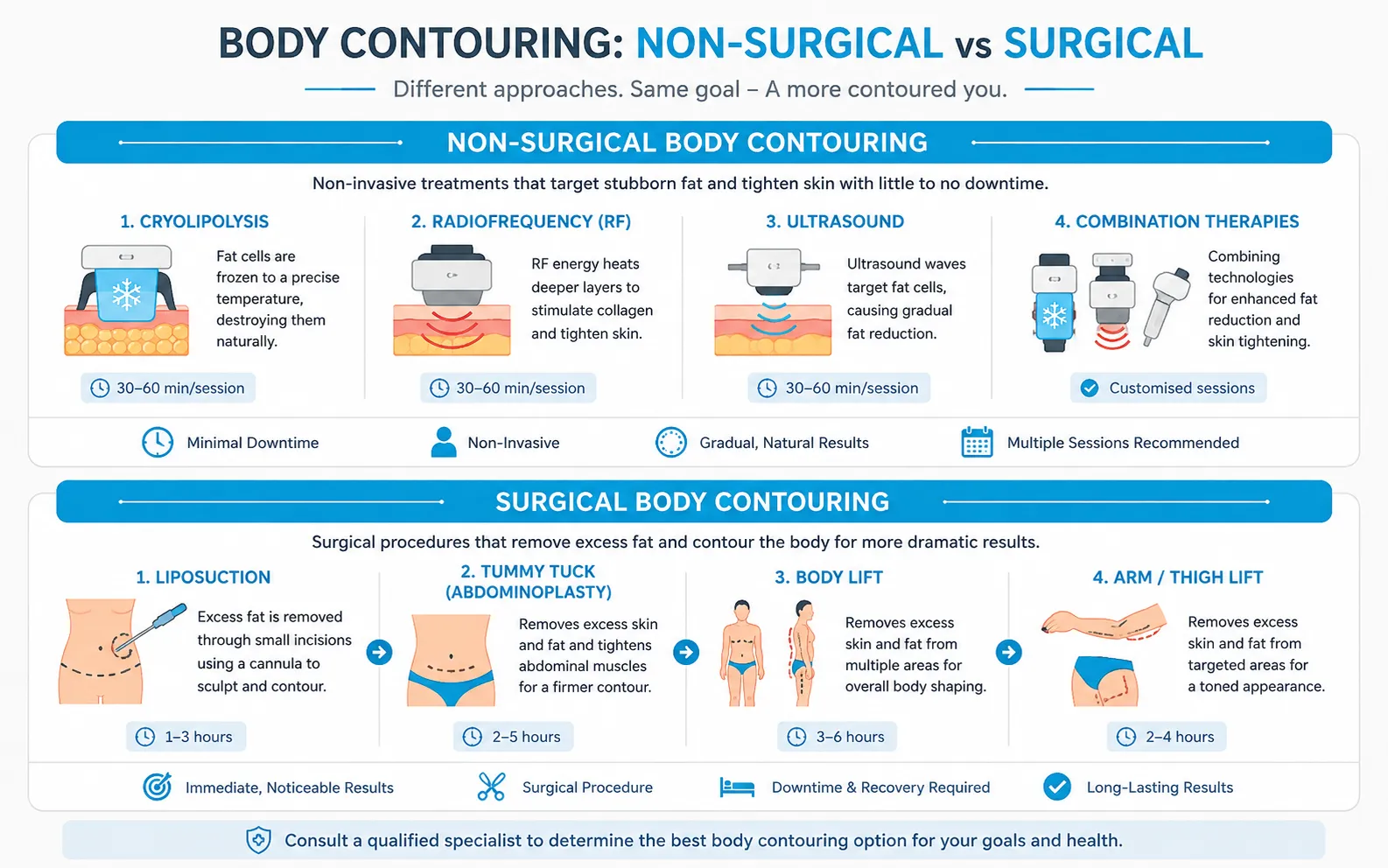
Body contouring encompasses both non-surgical and surgical options. Non-surgical body contouring treatments use advanced technologies — such as radiofrequency, ultrasound, cryolipolysis, or laser energy — to reduce fat cells and tighten skin without incisions. Surgical body contouring procedures, such as liposuction or abdominoplasty, offer more dramatic reshaping for patients with larger volumes of excess fat or skin.
At Profrea's aesthetic clinics in Gurugram, experienced aesthetic physicians assess each patient individually to recommend the most appropriate body contouring approach — whether non-invasive, minimally invasive, or surgical — based on the patient's body goals, health status, and realistic expectations.
Body contouring is not a weight-loss solution — it is a body-reshaping tool. Understanding whether your concerns align with what these treatments can realistically achieve is the first step. Here are the most common situations where body contouring may be appropriate:
Many people maintain a healthy lifestyle yet struggle with localised fat in areas such as the abdomen, flanks (love handles), inner thighs, upper arms, or under the chin. These fat deposits are often genetic and resistant to caloric deficit. Body contouring treatments — particularly non-surgical options like cryolipolysis or radiofrequency-based fat reduction — are specifically designed to target these pockets without affecting surrounding tissue.
Significant weight loss — whether through lifestyle changes or bariatric surgery — is a major health achievement. However, rapid or substantial fat loss often leaves behind excess, inelastic skin, particularly around the abdomen, arms, thighs, and breasts. According to research published on PubMed/NCBI, body contouring surgery after massive weight loss significantly improves quality of life, physical function, and psychological wellbeing. Skin-tightening body contouring procedures — both non-surgical (radiofrequency, ultrasound) and surgical (body lift, arm lift) — can address this concern.
Pregnancy and childbirth cause significant changes to the abdomen, including stretched skin, separated abdominal muscles (diastasis recti), and persistent fat deposits. Many women find that even after returning to their pre-pregnancy weight, the abdominal area looks and feels different. Body contouring treatments — ranging from non-surgical skin tightening to surgical abdominoplasty — can help restore abdominal contour after pregnancy.
Some individuals are at a healthy weight overall but feel that certain body areas are disproportionate — for example, wider hips relative to the waist, or fullness in the upper arms that affects clothing choices. Body sculpting treatments can selectively reduce volume in specific areas to improve overall body proportion and symmetry.
While body contouring is a physical treatment, its impact is often psychological. Patients who feel self-conscious about specific body areas — avoiding certain clothing, social situations, or physical activities — may find that addressing these concerns through appropriate body shaping treatments improves their confidence and quality of life. A thorough consultation with an aesthetic physician helps determine whether body contouring is the right approach or whether other interventions (such as nutritional support or physiotherapy) may be more appropriate first.
The right body contouring approach depends on the area of concern, the degree of change desired, the patient's health, and their tolerance for downtime. Here is an overview of the main categories:
Non-surgical body contouring procedures are performed without incisions and typically require no anaesthesia or recovery time. They are best suited for patients with mild to moderate fat deposits or mild skin laxity who are close to their ideal body weight.
Cryolipolysis (fat freezing): Uses controlled cooling to destroy fat cells, which are then naturally eliminated by the body over several weeks.
Radiofrequency (RF) body contouring: Delivers heat energy to stimulate collagen production and tighten skin while also reducing fat. Effective for mild skin laxity and body shaping.
High-Intensity Focused Ultrasound (HIFU): Targets fat cells and stimulates deep tissue tightening using focused ultrasound energy.
Laser-based fat reduction: Uses laser energy to disrupt fat cell membranes, allowing the body to process and eliminate them naturally.
Electromagnetic muscle stimulation: Induces powerful muscle contractions to build muscle tone and reduce fat simultaneously — commonly used for abdominal and gluteal contouring.
Most non-surgical body contouring treatments require a series of sessions for optimal results. Results develop gradually over 8–12 weeks as the body processes treated fat cells or produces new collagen.
Minimally invasive options such as injection lipolysis (fat-dissolving injections) and laser lipolysis involve small needles or micro-cannulas. They offer more targeted fat reduction than non-surgical treatments with minimal downtime — typically a few days of mild swelling or bruising.
Surgical body contouring is recommended for patients with larger volumes of excess fat or skin, or those who have not achieved adequate results with non-surgical methods. Common surgical body contouring procedures include:
Liposuction: Removes fat deposits from specific areas using a suction cannula. Can be combined with skin-tightening procedures.
Abdominoplasty (tummy tuck): Removes excess abdominal skin and fat, and tightens the abdominal muscles. Often sought after pregnancy or major weight loss.
Arm lift (brachioplasty) and thigh lift: Removes excess skin and fat from the upper arms or inner thighs.
Body lift: A comprehensive procedure addressing the abdomen, buttocks, hips, and thighs — typically for patients after massive weight loss.
Surgical procedures require anaesthesia, a recovery period, and careful post-operative care. They offer more significant and permanent reshaping compared to non-surgical alternatives.
Body contouring — whether surgical or non-surgical — is most effective and safest when performed on appropriate candidates. General criteria that aesthetic physicians consider include:
Being at or near a stable, healthy body weight (body contouring is not a substitute for weight loss)
Having specific, localised areas of concern that have not responded to diet and exercise
Being in good general health with no uncontrolled medical conditions
Having realistic expectations about the degree of improvement achievable
Not being pregnant or planning pregnancy in the near future (for abdominal procedures)
Being a non-smoker, or willing to stop smoking before and after surgical procedures
A detailed consultation with an experienced aesthetic physician is essential to assess candidacy, discuss options, and set realistic goals. At Profrea, our aesthetic physicians conduct thorough assessments before recommending any body contouring treatment plan.
Managing expectations is one of the most important aspects of body contouring care. Here is what patients can generally expect:
Non-surgical treatments typically produce gradual, subtle improvements over 8–16 weeks. Multiple sessions are usually required. Results are best appreciated in terms of improved contour and clothing fit rather than dramatic before-and-after changes. Fat reduction per treatment cycle is typically in the range of 20–25% in the treated area, though this varies by technology and individual response.
Maintaining a stable weight after treatment is important — non-surgical body contouring reduces the number of fat cells in treated areas, but remaining fat cells can still enlarge with weight gain.
Surgical procedures offer more significant and longer-lasting reshaping. Results are visible once post-operative swelling resolves — typically within 4–8 weeks for most procedures, with final results apparent at 3–6 months. Scars from surgical body contouring fade over time but are permanent; their placement is carefully planned to be as discreet as possible.
Both surgical and non-surgical body contouring results are best maintained through a healthy lifestyle — balanced nutrition, regular physical activity, and stable body weight. Profrea's care pathway includes post-treatment guidance to help patients sustain their results long-term, with access to nutrition and dietetics support as part of a holistic approach.
Gurugram has seen a significant rise in demand for body contouring treatments over the past several years, driven by growing awareness of non-surgical aesthetic options and increased access to qualified aesthetic physicians. The city's cosmopolitan population — including many working professionals and post-pregnancy patients — has made body sculpting and body shaping treatments among the most sought-after aesthetic procedures in the region.
When choosing a body contouring provider in Gurugram, it is important to look for clinics with qualified aesthetic physicians (not just technicians), advanced and well-maintained technology, a transparent consultation process, and clear communication about realistic outcomes and potential side effects.
Profrea operates across 7 clinic locations in Gurugram, offering both in-clinic and video consultations for body contouring assessments. The clinics are equipped with advanced aesthetic technologies designed to target stubborn fat, improve body contours, and support skin tightening — all within a modern, hygienic, patient-friendly environment. Patients also have access to specialist consultations across complementary specialties including physiotherapy and nutrition, supporting a comprehensive approach to body goals.
At Profrea, body contouring is approached as a personalised, physician-led process — not a one-size-fits-all treatment. The care pathway typically involves:
Detailed initial consultation: An experienced aesthetic physician reviews your health history, body goals, and areas of concern. Photographs and measurements may be taken to establish a baseline.
Customised treatment planning: Based on the consultation, a tailored body contouring plan is developed — specifying the recommended treatment type, number of sessions, expected timeline, and realistic outcomes.
Professional procedure delivery: Treatments are performed by trained aesthetic physicians and clinical staff using advanced, well-maintained technology in a safe, clinical environment.
Post-treatment guidance: Patients receive clear aftercare instructions and lifestyle recommendations to support and prolong results. Follow-up appointments are scheduled to monitor progress.
Holistic support: Where appropriate, patients are connected with dietetics and nutrition specialists or physiotherapists to complement their body contouring journey.
This structured approach ensures that body contouring at Profrea is not just a procedure but a guided experience focused on natural-looking, sustainable results.
No. Body contouring reshapes specific areas of the body by reducing localised fat deposits or tightening loose skin — it does not produce significant overall weight loss. Ideal candidates are at or near a healthy, stable weight and are seeking to improve body shape and proportion rather than reduce their total body weight.
This depends on the technology used, the area being treated, and the individual's response. Most non-surgical body contouring treatments require between 3 and 6 sessions, spaced 2–4 weeks apart. Your aesthetic physician will outline the recommended treatment plan during your consultation.
Non-surgical body contouring treatments are generally well-tolerated. Patients may experience sensations of cold, warmth, tingling, or mild pressure during treatment, depending on the technology used. Surgical procedures are performed under anaesthesia, so discomfort is managed during the procedure; some soreness and swelling are expected during recovery.
Fat cells destroyed by non-surgical treatments do not regenerate, so results can be long-lasting if body weight remains stable. Surgical results are similarly durable. However, significant weight gain after any body contouring treatment can affect results. Maintaining a healthy lifestyle is the most important factor in sustaining outcomes.
Some non-surgical body contouring technologies — particularly radiofrequency and HIFU — have a skin-tightening effect in addition to fat reduction. However, for significant skin laxity (such as after major weight loss or pregnancy), surgical body contouring procedures are generally more effective. Your physician will advise on the most appropriate option based on your specific concern.
When performed by qualified aesthetic physicians using appropriate technology and protocols, body contouring treatments have a well-established safety profile. As with any medical or aesthetic procedure, there are potential side effects — these vary by treatment type and are discussed in detail during your consultation. Choosing a reputable clinic with qualified physicians is the most important safety consideration.
If you recognise any of the signs discussed in this article, a consultation with an experienced aesthetic physician is the best first step. At Profrea, our physicians provide personalised body contouring assessments across 7 clinic locations in Gurugram, with both in-clinic and video consultation options available.
You can also explore our aesthetic physicians' profiles or Profrea's health screening packages to understand how a comprehensive health assessment can complement your body contouring journey. Transparent guidance, personalised care plans, and a focus on natural-looking results are at the core of everything we do.
Book a consultation with a Profrea aesthetic physician in Gurugram and receive a personalised body contouring assessment tailored to your goals.