A practical guide to understanding the difference between acne scars and pigmentation — and choosing the right treatment, from chemical peels to photofacials, at Profrea's clinics across Gurugram.
By Profrea · Published July 2026
If you have ever stood in front of a mirror wondering whether those dark marks left behind by a breakout are acne scars or pigmentation, you are not alone. The two conditions look similar, are often discussed interchangeably, and yet they are biologically distinct — which means the treatments that work for one can be ineffective, or even counterproductive, for the other.
Getting the diagnosis right before choosing a procedure — whether that is a chemical peel, photofacial, carbon facial, or a more advanced resurfacing technique — is the single most important step toward clearer skin. This guide breaks down what each condition actually is, how to tell them apart, and which evidence-based treatments are best suited for each.
This is one of the most common questions dermatologists and plastic surgeons hear — and the answer matters enormously for treatment planning.
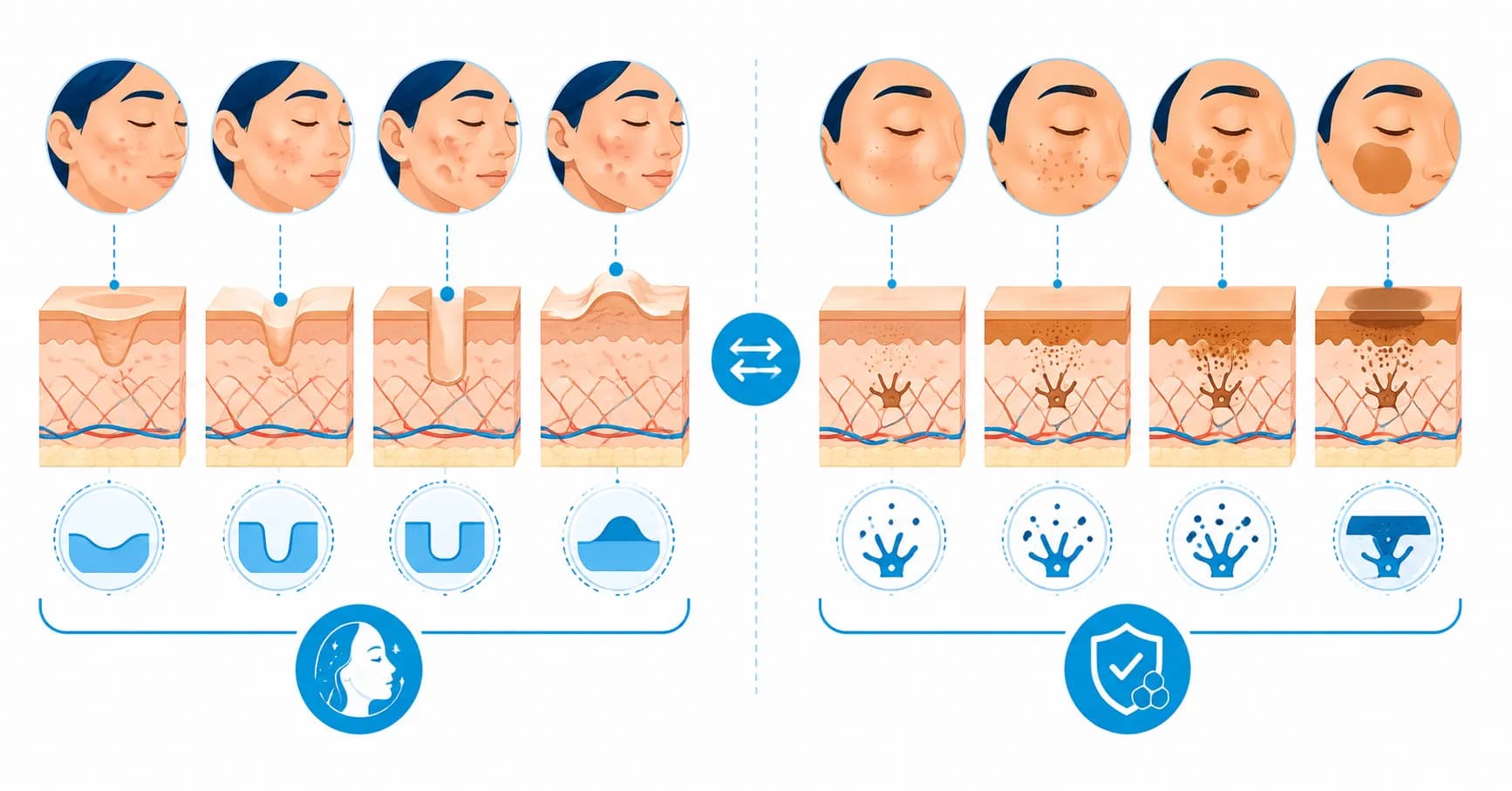
Acne marks, also called post-inflammatory hyperpigmentation (PIH), are flat, discoloured patches — typically pink, red, or brown — that remain after a pimple heals. They are not true scars because the skin's underlying structure (collagen and elastin) is intact. PIH is caused by excess melanin production triggered by inflammation. The good news: most acne marks fade on their own within 3–12 months, and targeted treatments can accelerate this significantly.
True acne scars involve a structural change in the skin. They are classified into two broad categories:
Atrophic scars — depressions in the skin caused by collagen loss. Subtypes include icepick scars (deep, narrow), boxcar scars (wide, defined edges), and rolling scars (undulating, wave-like surface).
Hypertrophic or keloid scars — raised scars caused by excess collagen production, more common in darker skin tones.
Unlike PIH, true scars do not fade on their own and require procedural intervention to remodel the skin's architecture. Dr. Shikha Bansal, Profrea's Plastic Surgeon with an MCh from SMS Medical College, Jaipur, and over 9 years of experience, assesses scar type and depth before recommending any treatment protocol.
Pigmentation disorders are a broader category. While PIH from acne is one type, other common pigmentation concerns include:
Melasma — symmetrical brown or grey-brown patches, often triggered by hormonal changes, sun exposure, or pregnancy.
Sunspots (solar lentigines) — flat, darkened patches caused by cumulative UV damage.
Freckles — small, concentrated melanin deposits, often genetic and worsened by sun exposure.
According to the American Academy of Dermatology, melasma affects an estimated 5 million people in the United States alone, with a significantly higher prevalence in South Asian populations — making it a particularly relevant concern for patients in Gurugram and across India. Pigmentation treatments must address melanin overproduction without triggering further inflammation, which is why the choice of procedure and peel strength is highly individualised.
This is perhaps the most searched question on the topic — and the honest answer is: it depends on the scar type and depth. Superficial atrophic scars and PIH respond very well to non-invasive and minimally invasive treatments, often achieving 70–90% improvement. Deep icepick scars may require punch excision or subcision in addition to resurfacing. No single treatment guarantees 100% removal, but a well-planned, multi-session protocol can produce dramatic, lasting improvement.
The National Institutes of Health (NIH) has published evidence supporting combination approaches — pairing resurfacing procedures with topical agents — as the most effective strategy for atrophic acne scars in skin of colour.
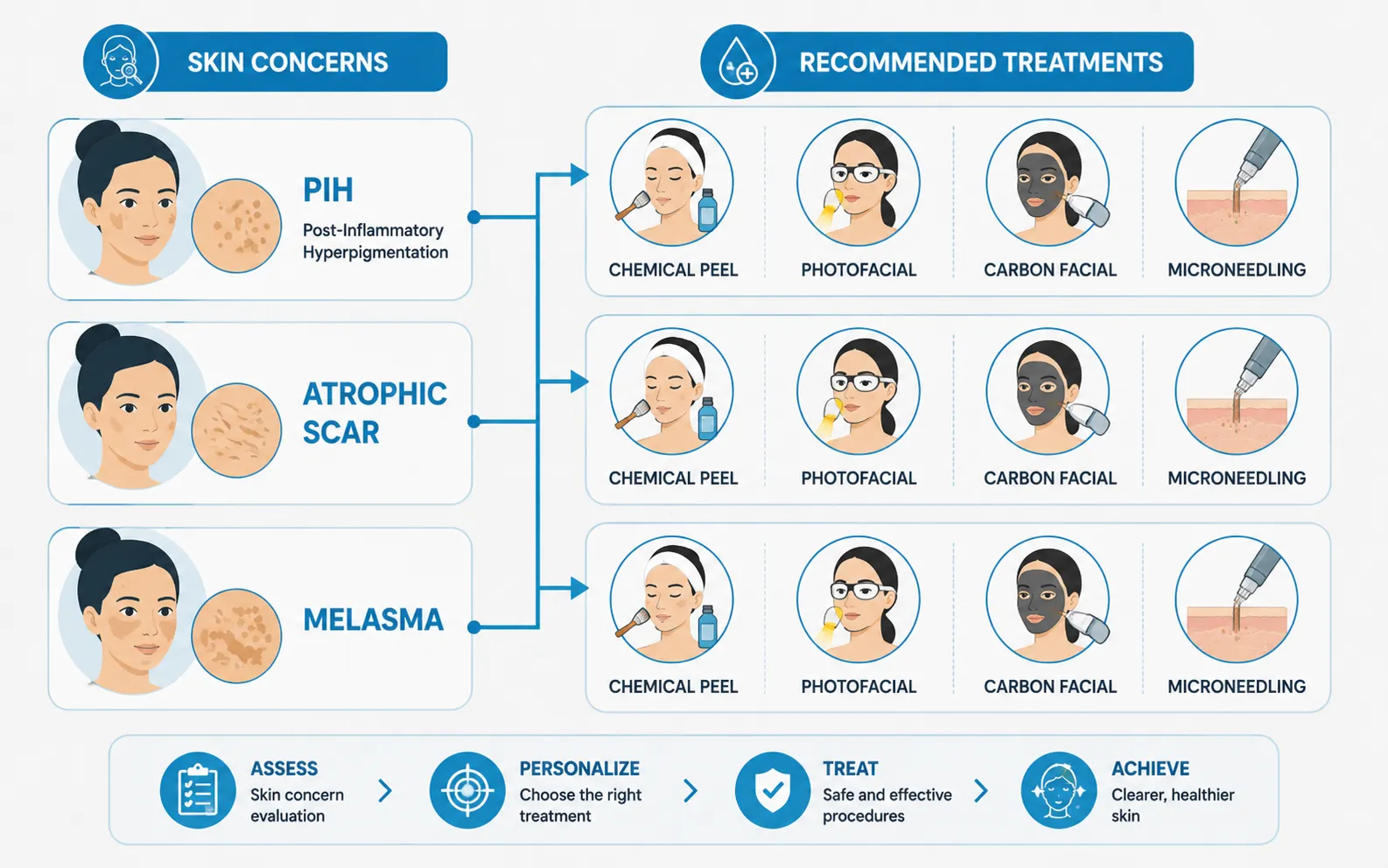
Below is a practical overview of the most commonly recommended procedures, mapped to the condition they treat best.
A chemical peel uses an acid solution (glycolic, salicylic, lactic, TCA, or mandelic acid) to exfoliate the outer layers of skin, stimulating fresh cell turnover and reducing melanin deposits. Superficial peels (e.g., glycolic 20–70%) are excellent for PIH, sunspots, and mild textural irregularities. Medium-depth peels (e.g., TCA 20–35%) can address moderate atrophic scars by triggering collagen remodelling. For Indian skin tones (Fitzpatrick III–V), a trained clinician must select peel strength carefully to avoid post-peel PIH — a risk that is often underestimated at non-specialist clinics.
Typical sessions needed: 4–6 sessions, spaced 3–4 weeks apart, for pigmentation. 6–8 sessions for scar reduction.
A photofacial (Intense Pulsed Light, or IPL) delivers broad-spectrum light energy into the skin, targeting melanin and haemoglobin. It is particularly effective for sunspots, redness, and post-inflammatory redness (PIE — post-inflammatory erythema, the pink/red marks that follow acne). IPL is less effective for textural scars because it does not remodel collagen architecture. It is also not suitable for very dark skin tones without careful parameter adjustment. Patients with active acne should complete their acne treatment before undergoing IPL.
Typical sessions needed: 3–5 sessions, spaced 3–4 weeks apart.
The carbon facial, also known as the Hollywood Peel or carbon laser peel, involves applying a thin layer of medical-grade liquid carbon to the face, which is then vaporised by a Q-switched Nd:YAG laser. The laser energy destroys the carbon particles along with dead skin cells, excess sebum, and bacteria in the pores. The result is a deep cleanse, pore tightening, and mild collagen stimulation. Carbon facials are excellent for oily, acne-prone skin and can improve mild post-acne texture. They are not a primary treatment for deep atrophic scars or significant pigmentation, but they work well as a maintenance treatment between more intensive sessions.
How many sessions of carbon facial are needed for acne? Most patients see visible improvement in skin clarity and texture after 4–6 sessions, spaced 2–4 weeks apart. Maintenance sessions every 6–8 weeks are recommended for ongoing acne control.
Microneedling uses fine needles to create controlled micro-injuries in the dermis, triggering the body's natural wound-healing response and stimulating new collagen and elastin production. It is one of the most evidence-backed treatments for rolling and boxcar scars. When combined with platelet-rich plasma (PRP) or topical growth factors, results are enhanced further. Microneedling is safe for all skin tones and carries a low risk of PIH — making it particularly suitable for South Asian patients.
Fractional lasers (ablative or non-ablative) deliver laser energy in a pixelated pattern, treating a fraction of the skin at a time while leaving surrounding tissue intact. This accelerates healing and reduces downtime compared to fully ablative lasers. Fractional CO2 laser is considered a gold standard for moderate-to-severe atrophic acne scars. It requires careful patient selection and post-procedure sun protection, especially in Gurugram's high-UV environment.
Both are effective, but they work differently and suit different pigmentation types:
Chemical peels are generally preferred for epidermal pigmentation (PIH, mild melasma, uneven skin tone) across a range of skin tones. They are more affordable and can be customised by acid type and concentration.
Photofacial (IPL) is better for discrete sunspots, vascular redness, and PIE. It is less suitable for diffuse melasma and darker skin tones without specialist expertise.
For melasma specifically, neither alone is a complete solution — a combination of topical depigmenting agents (e.g., tranexamic acid, kojic acid, niacinamide) alongside a carefully chosen peel or laser protocol typically yields the best results.
A consultation with a qualified clinician — not a one-size-fits-all package — is the only reliable way to determine the right approach for your specific pigmentation pattern and skin type. Profrea's aesthetic team in Gurugram conducts a detailed skin analysis before recommending any procedure.
There is no single "best" treatment — the right protocol depends on scar type, depth, skin tone, and budget. However, for the Indian population (predominantly Fitzpatrick III–V), the following hierarchy is generally supported by clinical evidence:
Microneedling with PRP — first-line for rolling and boxcar scars; safe for all Indian skin tones.
Fractional non-ablative laser — effective with lower PIH risk than ablative options.
TCA cross (chemical reconstruction of skin scars) — highly effective for icepick scars specifically.
Fractional CO2 laser — gold standard for moderate-to-severe scars; requires experienced hands in darker skin.
Subcision + filler — for tethered rolling scars that do not respond to surface treatments.
Combination protocols — for example, subcision followed by microneedling and a maintenance chemical peel series — consistently outperform single-modality approaches in published literature.
Gurugram's urban lifestyle — high pollution levels, long commutes, stress, and erratic sleep patterns — creates a perfect storm for acne-prone skin. Add to this the intense UV index during summer months (April–September), and post-acne pigmentation becomes a near-universal concern for residents.
At Profrea's 7 clinic locations across Gurugram, aesthetic consultations are available both in-clinic and via video, making it easy to get an expert opinion without disrupting a busy schedule. Specialist consultations are structured around a thorough skin assessment — including scar classification, Fitzpatrick skin typing, and a review of previous treatments — before any procedure is recommended.
Profrea also offers comprehensive health screening packages that can identify underlying hormonal or metabolic contributors to persistent acne — such as PCOS or insulin resistance — which, if left unaddressed, will cause new breakouts and new scars regardless of how many aesthetic sessions are completed.
No aesthetic procedure works in isolation. Skin healing is heavily influenced by nutrition, hydration, sleep quality, and stress levels. A diet rich in antioxidants (vitamins C and E), zinc, and omega-3 fatty acids supports collagen synthesis and reduces inflammation — both of which accelerate scar remodelling. Conversely, high-glycaemic diets and dairy consumption have been associated with increased acne severity in some studies.
Profrea's integrated care model means patients can access dietitian and nutrition guidance alongside their aesthetic treatment plan — a holistic approach that is often missing from standalone skin clinics. Addressing root causes, not just surface symptoms, is what separates a good outcome from a great one.
Every dermatologist and plastic surgeon will tell you the same thing: sunscreen is the most important part of any pigmentation or scar treatment plan. UV exposure stimulates melanocytes and can reverse months of treatment progress in a matter of weeks. A broad-spectrum SPF 50+ sunscreen, reapplied every 2–3 hours when outdoors, is non-negotiable — especially in Gurugram's climate.
Post-procedure sun protection is even more critical. After a chemical peel, photofacial, or laser session, the skin is temporarily more photosensitive. Your treating clinician will provide specific post-care instructions tailored to the procedure performed.
Acne marks (PIH) are flat, discoloured patches caused by excess melanin — the skin's structure is intact and they often fade over time. True acne scars involve structural damage to the dermis (collagen loss or excess), creating depressions or raised tissue that does not resolve without treatment.
Chemical peels are generally more versatile for Indian skin tones and work well for PIH, mild melasma, and uneven tone. Photofacials (IPL) are better for discrete sunspots and vascular redness. The right choice depends on your specific pigmentation type and skin tone — a consultation is essential before booking either.
Most patients require 4–6 sessions spaced 2–4 weeks apart to see meaningful improvement in acne, oiliness, and mild texture. Maintenance sessions every 6–8 weeks help sustain results. Carbon facials are best used as part of a broader acne management plan rather than as a standalone cure.
Significant and lasting improvement is achievable for most scar types with the right treatment protocol. Superficial scars and PIH respond very well, often achieving 70–90% improvement. Deep icepick scars may require multiple modalities. No treatment guarantees 100% removal, but a well-planned protocol can produce dramatic, durable results.
For Indian skin tones, microneedling with PRP is a popular first-line option for atrophic scars due to its safety profile. Fractional lasers, TCA cross, and subcision are used for more resistant or deeper scars. Combination protocols tailored to your scar type consistently outperform single-treatment approaches.
Run your finger over the area in question. If the skin surface feels smooth and the concern is only colour, it is likely pigmentation (PIH). If you feel a depression, raised texture, or uneven surface, it is likely a true scar. Many patients have both simultaneously, which is why a clinical assessment is the most reliable starting point.
If you are unsure whether you are dealing with acne scars, pigmentation, or both, the most effective next step is a consultation with a qualified clinician who can assess your skin in person. Profrea's multi-specialty team in Gurugram includes physicians, plastic surgeons, and aesthetic specialists who work together to address both the root causes and the visible effects of acne on your skin. Consultations are available across 7 clinic locations in Gurugram and via video — so expert guidance is always within reach.
Get a personalised assessment from Profrea's aesthetic and plastic surgery team — and start your journey to clearer, healthier skin with a treatment plan built specifically for you.