
A clinician-led guide to what actually works for scar reduction and what your skin can realistically achieve with the right treatment plan.
By the Profrea Clinical Team · Published July 2026
Acne scars are one of the most emotionally charged skin concerns that patients bring to a clinic. Unlike active breakouts, scars are a daily visible reminder of past inflammation and they resist every over-the-counter cream marketed at them. The good news is that modern dermatological and plastic-surgery-grade procedures can produce measurable lasting improvements. The important caveat is that results depend heavily on scar type, skin tone, and the clinical expertise guiding the treatment plan.
This guide walks through the science of acne scarring, the treatments that consistently deliver the best before-and-after outcomes, and what patients at Profrea's clinics across Gurugram are experiencing under the care of specialists including plastic surgeon Dr. Shikha Bansal (MCh in Plastic Surgery, SMS Medical College Jaipur; 9+ years of experience) and Dr. Soma Kumari, Obstetrician and Gynecologist at Profrea Gurugram.
When a pimple or cyst ruptures, the body rushes collagen to repair the wound. If too little collagen is deposited the result is an atrophic or depressed scar — the classic icepick, boxcar, or rolling type. If too much collagen accumulates you get a hypertrophic or keloid scar that sits above the skin surface. Both types involve structural changes in the dermis that topical products simply cannot reverse.
According to data published by the National Institutes of Health, acne affects up to 85% of people aged 12 to 24, and a significant proportion develop post-inflammatory scarring that persists into adulthood. In India, darker Fitzpatrick skin types IV through VI add an extra layer of complexity because aggressive treatments can trigger post-inflammatory hyperpigmentation, making expert calibration essential.
This is precisely why a one-size-fits-all approach fails and why the clinical assessment at Profrea begins with a detailed scar-mapping consultation before any procedure is recommended.
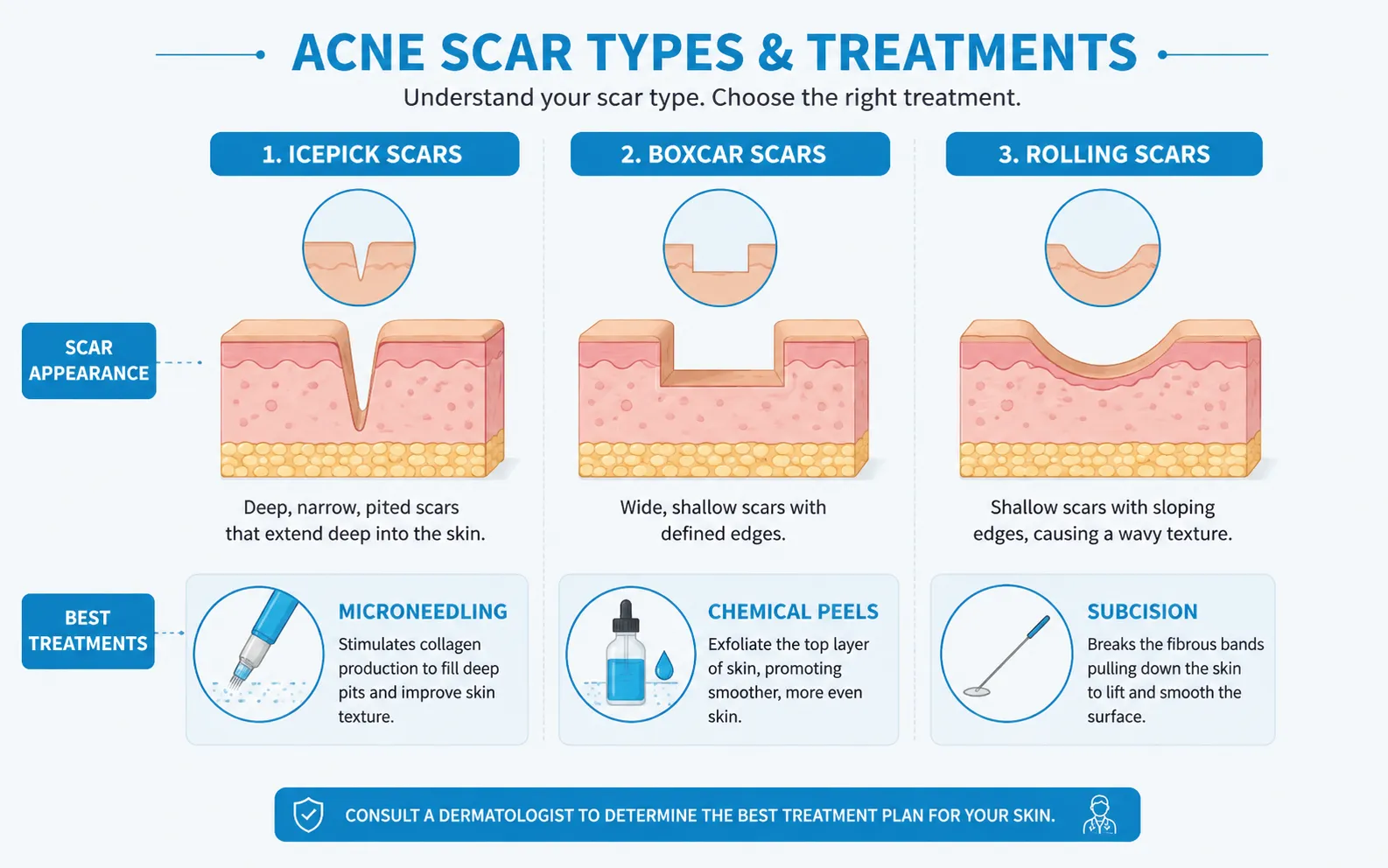
Understanding your scar type is the first step toward realistic before-and-after expectations.
Icepick scars: Deep narrow channels that extend into the dermis. Hardest to treat with surface-level procedures alone and often require subcision or TCA CROSS.
Boxcar scars: Broad well-defined depressions with sharp edges. Respond well to laser resurfacing and microneedling with RF.
Rolling scars: Undulating wave-like texture caused by fibrous bands tethering the skin. Subcision combined with fillers or microneedling yields the most dramatic before-and-after change.
Hypertrophic and keloid scars: Raised firm scars treated with intralesional steroids, silicone sheets, or laser.
Post-inflammatory hyperpigmentation (PIH): Technically not a true scar but a pigment change that responds to chemical peels and topical brightening agents.
Most patients present with a mix of scar types which is why combination protocols rather than a single modality tend to produce the most compelling before-and-after results.
Microneedling or collagen induction therapy uses fine needles to create controlled micro-injuries in the dermis, triggering the skin's natural wound-healing cascade and stimulating new collagen and elastin production. It is one of the most evidence-backed procedures for atrophic acne scars, particularly rolling and boxcar types.
Typical before-and-after timeline:
After session 1: Skin appears smoother with mild redness for 24 to 48 hours. Collagen remodelling begins beneath the surface.
After sessions 2 to 3: Visible reduction in scar depth and texture becomes more even. Most patients notice this improvement around weeks 6 to 10.
After sessions 4 to 6: Significant improvement in rolling and boxcar scars with skin tone more uniform. Optimal results typically require 4 to 6 sessions spaced 4 weeks apart.
When combined with platelet-rich plasma or growth-factor serums applied immediately after needling, results are often accelerated. Radiofrequency microneedling delivers energy deeper into the dermis making it particularly effective for deeper scars and for patients who want faster visible change.
At Profrea's clinics in Gurugram, microneedling protocols are personalised to needle depth, skin type, and scar severity. This calibration makes a measurable difference in both safety and outcome especially for patients with Fitzpatrick IV to V skin tones common in North India. You can explore Profrea's skin and aesthetic specialists in Gurugram to find the right clinician for your concern.
Chemical peels work by applying an acid solution to the skin surface, causing controlled exfoliation and stimulating cellular turnover. They are particularly effective for PIH, superficial boxcar scars, and overall skin texture improvement.
Glycolic acid peels: Superficial and ideal for PIH and mild texture irregularities with minimal downtime. A series of 6 to 8 sessions is recommended.
Salicylic acid peels: Superficial to medium and excellent for oily acne-prone skin with active breakouts and early scarring.
TCA peels: Medium to deep and effective for moderate boxcar and rolling scars. Requires 5 to 7 days of downtime. TCA CROSS is a specialist technique for icepick scars that can produce dramatic before-and-after improvement.
Combination peels: Used for more complex scar presentations and performed under close clinical supervision.
A key consideration in Gurugram's climate — hot humid summers — is timing. Peels are best scheduled between October and March to minimise sun exposure during the healing phase. Profrea's team factors in seasonal and lifestyle variables when designing treatment calendars.
This is one of the most common questions patients ask and the honest answer is that neither modality is universally superior. The right choice depends on scar type, depth, skin tone, and lifestyle particularly downtime tolerance.
| Factor | Microneedling | Chemical Peel |
|---|---|---|
| Best scar type | Rolling, boxcar, deep atrophic | PIH, superficial texture, icepick via TCA CROSS |
| Downtime | 24 to 48 hours redness | 1 to 7 days depending on depth |
| Sessions needed | 4 to 6 sessions | 4 to 8 sessions |
| Safe for dark skin tones | Yes with proper calibration | Superficial peels yes; deep peels require caution |
| Collagen stimulation | High via dermal remodelling | Moderate via surface renewal |
In clinical practice the most impressive before-and-after results come from combination protocols — for example a series of glycolic peels to address PIH followed by RF microneedling for deeper scar remodelling and subcision for tethered rolling scars. Dr. Shikha Bansal's plastic surgery background at Profrea means patients have access to this full spectrum of interventions under one roof rather than being limited to a single modality.
Beyond microneedling and peels, Profrea's scar reduction programme includes a range of targeted interventions:
Subcision: A minor surgical technique where a needle is inserted beneath the scar to break fibrous bands. Particularly effective for rolling scars and often combined with filler or PRP for volume restoration.
Dermal fillers: Hyaluronic acid or collagen-stimulating fillers can temporarily elevate depressed scars producing immediate visible improvement while longer-term treatments take effect.
Fractional laser resurfacing: Fractional CO2 or Erbium lasers ablate the outer skin layers and stimulate deep collagen production delivering some of the most dramatic before-and-after changes for moderate to severe atrophic scarring.
Intralesional corticosteroid injections: First-line treatment for hypertrophic and keloid scars that flattens raised tissue over a series of monthly injections.
Topical prescription regimens: Retinoids, azelaic acid, and vitamin C serums are used as adjuncts to in-clinic procedures to maintain and extend results.
The availability of day-care and minor surgery facilities across Profrea's 7 Gurugram clinic locations means that procedures like subcision can be performed conveniently without hospital admission. Patients can also access Profrea's health screening packages to combine skin health with a broader wellness assessment.
This is perhaps the most important question to answer honestly. The short answer is that significant improvement is consistently achievable while complete elimination depends on scar type and severity.
Superficial scars and PIH can often be resolved to the point where they are invisible to the naked eye. Moderate rolling and boxcar scars typically improve by 50 to 70 percent with a well-designed combination protocol — a result that is clinically meaningful and visually transformative. Deep icepick scars are the most resistant and TCA CROSS with subcision can improve their appearance substantially but complete elimination is rarely achievable in a single course of treatment.
Setting realistic expectations is a core part of the consultation process at Profrea. Patients receive a clear picture of what their specific scar profile can achieve before any treatment begins. This transparency is what separates a credible clinical outcome from a disappointing one.
Session count varies by modality and severity:
Mild scarring and PIH: 4 to 6 sessions of superficial peels or microneedling spaced 3 to 4 weeks apart.
Moderate atrophic scars: 6 to 8 sessions of microneedling or medium peels with subcision added after session 2 or 3.
Severe or mixed scarring: 8 to 12 sessions across multiple modalities over 6 to 12 months with laser resurfacing incorporated after initial collagen priming.
Maintenance sessions once or twice a year are typically recommended after the primary course to preserve collagen levels and prevent new scarring from future breakouts. Profrea's membership portal makes it easy to schedule and track ongoing care without losing continuity between sessions.
Patient feedback from Profrea's scar reduction programme consistently highlights two themes: the thoroughness of the initial assessment and the visible improvement in texture after the third or fourth session.
One patient, Priya aged 28 from Sector 45, described her experience: "I had rolling scars on both cheeks for six years. After four sessions of microneedling with PRP at Profrea, my skin texture has improved more than I thought possible. The doctor explained exactly what to expect at each stage and that made a huge difference to my confidence in the process."
Another patient, Rahul aged 32 from South City, noted: "I tried creams for two years with no result. The combination of a chemical peel series and subcision at Profrea gave me results I could actually see in photographs. The before-and-after difference is significant."
These outcomes reflect the clinical approach championed by Dr. Shikha Bansal — combining plastic surgery precision with aesthetic medicine protocols to address scars at their structural root rather than just their surface appearance. Patients can also consult Dr. Nupur Gurugoswami at Profrea Gurugram for specialist aesthetic guidance.
Pricing for acne scar treatment in Gurugram varies by procedure type, number of sessions, and clinic expertise. The following are indicative market ranges:
| Treatment | Approximate Cost per Session |
|---|---|
| Superficial chemical peel | Rs 1,500 to Rs 3,500 |
| Medium or TCA peel | Rs 3,000 to Rs 7,000 |
| Microneedling standard | Rs 3,000 to Rs 6,000 |
| RF Microneedling | Rs 6,000 to Rs 15,000 |
| Subcision | Rs 5,000 to Rs 12,000 |
| Fractional laser resurfacing | Rs 8,000 to Rs 20,000 |
These are indicative market ranges for Gurugram. Profrea provides a transparent breakdown of recommended sessions and costs before any treatment begins so patients can plan their care without financial surprises.
Understanding the clinical process helps patients arrive prepared and confident. Here is what a typical scar reduction journey at Profrea looks like:
Scar mapping consultation: The clinician photographs and classifies each scar by type, depth, and distribution. Skin tone is assessed on the Fitzpatrick scale to guide treatment selection and minimise PIH risk.
Personalised treatment plan: A written protocol is provided detailing recommended modalities, session frequency, expected milestones, and approximate costs.
Priming phase if needed: Patients with active acne or significant PIH may begin with a 4 to 6 week topical priming regimen before in-clinic procedures start.
In-clinic treatment sessions: Performed at one of Profrea's 7 Gurugram locations with Smart In-clinic Consultation slots available for time-pressed patients.
Progress review: Standardised photography at each session allows objective before-and-after comparison and protocol adjustment.
Maintenance plan: After the primary course a maintenance schedule is agreed to sustain results long-term.
Video consultations are also available for patients who want an initial assessment before visiting a clinic. You can also review Dr. Shashi Vermani's profile at Profrea for specialist consultation options across Gurugram.
Given India's predominantly darker skin tones the best treatment is the one that delivers maximum scar improvement with minimum risk of PIH. This typically means starting with superficial peels to address PIH and prime the skin, progressing to microneedling for atrophic scar remodelling, adding subcision for rolling scars and TCA CROSS for icepick scars as targeted interventions, and reserving fractional laser for patients with lighter skin tones or those who have not achieved sufficient improvement with the above.
A clinical review published by the National Institutes of Health consistently supports combination therapy as the most effective approach for moderate to severe scarring — a finding that aligns with Profrea's clinical philosophy.
If you are based in Gurugram and considering treatment, a consultation with Profrea's specialist team in Gurugram is the most reliable way to determine which combination is right for your specific scar profile.
Combination protocols — typically microneedling with chemical peels and subcision for rolling scars — deliver the best results for Indian skin tones. The right combination depends on your scar type and Fitzpatrick skin classification assessed at your first consultation.
Mild scarring typically requires 4 to 6 sessions; moderate scarring 6 to 8 sessions; severe or mixed scarring may need 8 to 12 sessions across multiple modalities over 6 to 12 months. Sessions are spaced 3 to 4 weeks apart to allow collagen remodelling between treatments.
Superficial scars and PIH can often be resolved completely. Moderate atrophic scars typically improve by 50 to 70 percent with a well-designed protocol. Deep icepick scars can be significantly improved but complete elimination is rarely achievable in a single course of treatment.
Neither is universally superior. Microneedling is better for deeper atrophic scars such as rolling and boxcar types. Chemical peels are better for PIH and superficial texture. Most patients benefit from both in a combined protocol and your clinician will recommend the right sequence based on your scar assessment.
Costs range from approximately Rs 1,500 per session for superficial peels to Rs 20,000 per session for fractional laser resurfacing. A full treatment course of 6 to 8 sessions of microneedling typically costs Rs 18,000 to Rs 48,000. Profrea provides a transparent cost breakdown at consultation before any commitment is made.
Yes when performed by an experienced clinician who calibrates treatment parameters for darker Fitzpatrick types. Microneedling and superficial peels have excellent safety profiles for Indian skin. Deeper peels and aggressive laser settings require more caution and should only be performed by specialists with relevant experience.
Book a scar assessment consultation at one of Profrea's 7 Gurugram clinics — in-person or via video — and get a personalised treatment plan from a specialist who will be honest about what your skin can achieve.